Power plants and industrial campuses are adding on-site daycare to support shift workers, but a playground inside these environments cannot be treated as a typical park installation. The equipment still has to meet child-development and injury-prevention requirements, while also working within restricted access, buried utilities, vehicle movement, and high-visibility security expectations. This guide covers the equipment choices, layout rules, surfacing decisions, and inspection habits that keep an industrial-site daycare play area compliant, durable, and easier to supervise.
Why Industrial Site Daycares Need a Different Playground Standard
A public playground standard starts with impact attenuation, entrapment protection, protruding-hardware limits, and age-appropriate fall heights. The U.S. Consumer Product Safety Commission and ASTM F1487-21 establish those core requirements for public play areas, including employer-managed child care spaces [1][2]. In the European market, EN 1176-1 provides a comparable safety framework for playground equipment and surfacing [3].
On an industrial site, those rules still apply, but the site layer adds another set of pressures: the play area must be visually controllable, physically separated from work zones, and located away from underground and overhead hazards. A slide or spinner that is safe in a municipal park may be a poor fit if it creates blind corners, encourages children to run toward a gate, or sits too close to a gas line. The right specification is therefore a combination of standard playground compliance and site-specific risk control.
Site Safety Protocols That Should Shape Equipment Selection
Before choosing individual products, the daycare operator or project team should document the site rules that affect placement and equipment type.
| Site Protocol | How It Should Influence Equipment Selection |
|---|---|
| Controlled access and fencing | Keep the playground inside a secure daycare boundary; do not place entrances where children can exit toward vehicle traffic. |
| Sight-line requirements | Avoid tall enclosed structures or solid panels that block a supervisor’s view from the primary observation point. |
| Underground utility clearance | Confirm utility locations before excavation; set foundations away from gas, water, and power lines. |
| Grade and drainage control | Specify equipment with foundation requirements that work on the site’s soil, and plan grading so water does not pool in fall zones. |
| Age separation | Separate toddler and school-age play areas with clear, defensible boundaries instead of mixing equipment randomly. |
These protocols do not replace the product safety standard; they operate alongside it. For example, a climbing structure may pass EN 1176 in a product test, but if it is installed so that children can climb a fence at the edge of the fall zone, the site arrangement creates a new hazard that the equipment standard alone cannot address. This is why industrial daycare playgrounds require both product compliance and a site-level review.
Equipment Choices for Constrained Industrial Daycare Zones
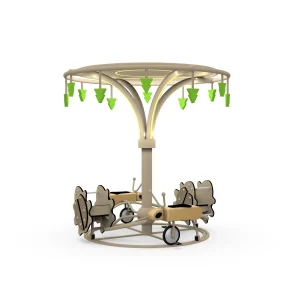
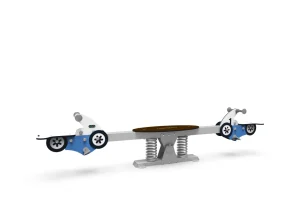
Industrial daycare yards are often smaller than public parks, so compact, low-height equipment tends to be easier to place and supervise. Spring riders, single-player spinners, and multi-person seesaws can deliver active play without the large required fall zones of tall slides or complex climbing towers.
| Equipment Type | Suitable Age | Maximum Fall Height and Footprint | Why It Suits an Industrial Daycare |
|---|---|---|---|
| Single-player spinner | 2+ years | 34 cm fall height; about 60 × 60 × 90 cm to 95 × 80 × 160 cm | Low fall height, compact footprint, easy sight lines |
| Spring rider | 2+/3+ years | 50 cm fall height; about 60–99 × 35–39 × 79–110 cm | Small single-user footprint and fast installation |
| Multi-person seesaw | 3+ years | 60 cm fall height; about 300–320 cm long | Supports 2–10 children in a contained group |
| Multi-player spinning wheel | 2+ to 6+ years | 55–77 cm fall height depending on model | Serves 6–10 children but needs adequate surfacing depth |
These figures come from LvDong product-library specifications and should be verified for the exact model before finalizing the surfacing plan. The key point is not that one type is always better; it is that fall height and footprint need to be matched to the available yard and the depth of impact-attenuating surfacing.
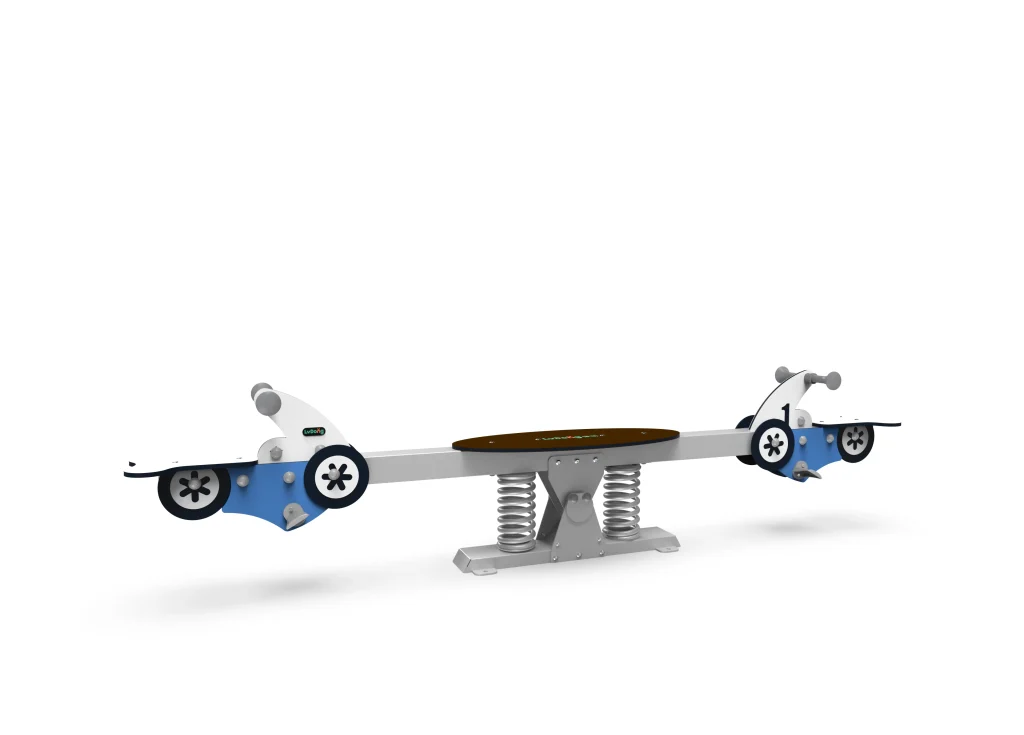
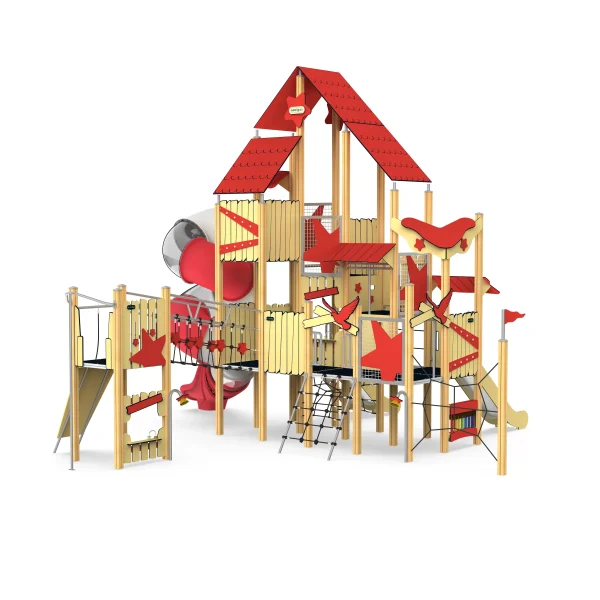
For most industrial daycare sites, a small combination of spring riders and low-profile spinning equipment provides the best balance of play value, supervision, and space efficiency. A taller slide should only be introduced when the fall zone, access route, and visual control can all be confirmed without compromise.
Need to Match a Specific Site Protocol?
Send the site plan, fencing layout, fall-zone target, and age group to [email protected]. Include whether the daycare must meet EN 1176, ASTM F1487, or both. The design team can then check which equipment and foundations fit the restricted site dimensions before you finalize the order.
Surfacing, Drainage, and Fall Zones
Impact-attenuating surfacing must extend across the entire fall zone for each piece of equipment, with the depth determined by the maximum fall height of the highest accessible point [1][2]. On an industrial site, drainage is equally important because standing water can reduce the effectiveness of loose-fill surfacing and create a separate slip risk after rain.
Industrial daycare yards frequently combine compact footprints with heavy site drainage requirements, making slope and grading decisions just as important as equipment selection. <Playset Ground Leveling and Drainage Solutions for Outdoor Slides> covers preparation practices that keep outdoor play areas stable and usable after rainfall.
Loose-fill materials such as engineered wood fiber or rubber mulch may require containment edges and regular replenishment. Unitary surfaces such as poured-in-place rubber or rubber tiles can reduce some maintenance concerns, but they still need a properly prepared base and drainage path. The choice should follow the project’s maintenance capacity, climate, and the maximum fall height of the selected equipment.
Installation, Foundations, and Utility Clearance
Industrial-site installation requires more coordination than a standard park project. The project team should confirm the location of underground utilities before any excavation, and the equipment foundation must be compatible with the site’s soil bearing capacity. In areas with heavy vehicle movement or vibration, anchoring details should be reviewed against the manufacturer’s instructions and the relevant structural requirements.
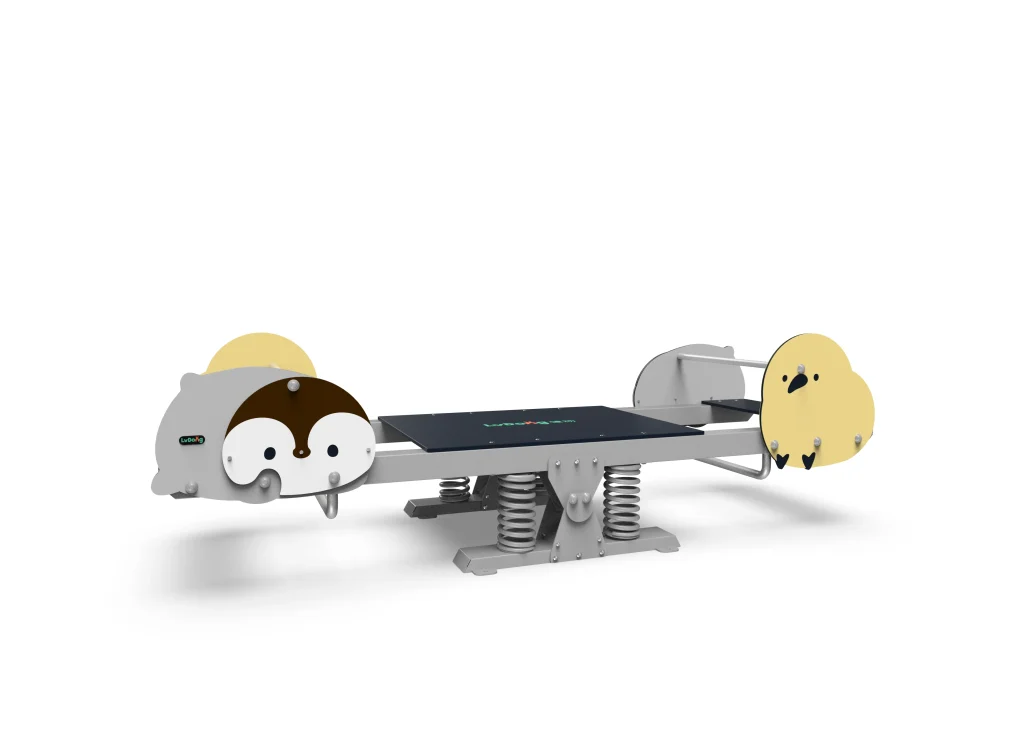
For low-height spring riders and spinners, installation can be relatively fast, but that does not reduce the need for accurate base preparation. A spring ride that feels stable at installation can loosen over time if the base is placed on uncompacted fill or if drainage is ignored. Industrial sites also tend to accumulate dust and debris, so access around the base should allow cleaning and inspection without disassembling the equipment.
Access, Inclusion, and Communication
An on-site daycare may still need to provide an accessible route to and within the play area under applicable accessibility standards [4]. That requirement often influences surfacing selection, slope design, and the location of entry points. Ground-level interactive panels or low sensory components can be useful inclusions because they provide activity without requiring transfer platforms or additional fall-height surfacing.
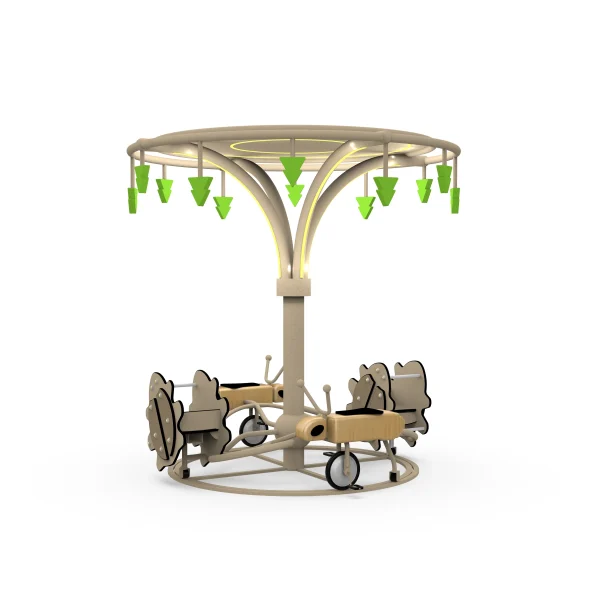
For constrained industrial yards, the layout should also make it easy for a supervisor to see the entire area from a single approved position. If the best observation point is near the daycare door or a security checkpoint, the equipment should be arranged so that no structure creates a blind zone. This is a communication and operational safety issue, not only a design preference.
Industrial daycare layouts often share the same space constraints as restaurant play areas: tight footprint, controlled access, and a need for constant adult visibility. <Small Space Solutions for Restaurant Childrens Play Areas> covers layout strategies for compact supervised play zones.
Maintenance, Inspection, and Industrial Wear
Playground equipment on an industrial campus is exposed to more dust, vibration, and sometimes more intense sun or wind than a typical neighborhood park. That makes maintenance documentation more important. The operator should follow a daily visual check, a monthly fastener and moving-part check, and a documented annual inspection by a qualified person [2].
Industrial dust and vibration can accelerate wear on rotating components and bearings if they are not checked at the right interval. <Stand and Spin Equipment Essential Maintenance Safety Guide> covers inspection habits and component checks for spinning play equipment.
Moving parts on spinners and seesaws should be checked for lubrication, unusual noise, loose fasteners, and deformation. Spring riders should be checked for spring fatigue and base stability. If the equipment is used across multiple shifts, the daycare should adjust the inspection frequency upward rather than relying on a once-a-year schedule alone.
Get a Site-Specific Playground Recommendation
Send your daycare site plan and the required safety protocol list to LvDong. Include the age group, available footprint, surfacing plan, and any security or environmental constraints. The design team can recommend the equipment mix that fits the restricted industrial setting without creating unnecessary supervision or maintenance burdens.
Contact [email protected] or WhatsApp +86 139 1568 4545 for a project-specific review.
FAQ
Can a playground be installed on an active industrial site?
Yes, if the play area is inside a controlled daycare boundary and separated from vehicle movement, equipment operations, and buried utility lines. The equipment must still meet the applicable playground safety standard, and the site layout must not introduce hazards such as blind corners or gates that open toward work traffic.
What surfacing works best in an industrial daycare?
There is no single best surface. The depth must match the maximum fall height of the equipment, and drainage must prevent water from pooling in the fall zone. Loose-fill materials need regular replenishment, while unitary rubber surfaces require a stable prepared base.
Does the equipment need to meet different standards than a normal park?
The core standards are the same: ASTM F1487 or EN 1176, depending on the market. What changes is the site-level review. The playground must also be compatible with utility clearance, access control, sight lines, and the industrial environment.
How much space do compact spring riders and spinners require?
A single-player spinner may fit in a footprint of about 60 × 60 cm to 95 × 80 cm, while spring riders are similar in compactness. The fall zone and surfacing area around them still need to be added, so the total useful space is larger than the equipment footprint.
What is the most important inspection item in these settings?
Moving-part security is the highest recurring concern. Loose fasteners, worn bearings, spring fatigue, and unstable bases should be checked regularly. On industrial sites with dust and vibration, inspections should be more frequent than the typical park schedule.
References
[1] U.S. Consumer Product Safety Commission, Public Playground Safety Handbook, Publication No. 325.
[2] ASTM International, ASTM F1487-21 Standard Consumer Safety Performance Specification for Playground Equipment for Public Use.
[3] European Committee for Standardization, EN 1176-1:2017 Playground Equipment and Surfacing — Part 1: General Safety Requirements and Test Methods.
[4] U.S. Access Board, Americans with Disabilities Act Accessibility Standards.
If you’re interested, check out these related articles:
Mastering Metal Slide Heat Prevention Strategies for Playgrounds
Weatherproof Play Panels Material Durability Comparison
Playground Spring Rider Materials Steel vs Anti Rust
Sensory Play Panels Inclusive Design for Special Needs
Buying Playground Spinners Pricing Discounts and Supplier Insights