For embassy and consulate family areas, playground equipment sits at the intersection of two demanding frameworks: host-country child-safety standards and diplomatic-compound security protocols. A school playground can tolerate visible fencing, bright interactive panels, and open sightlines. A consular compound usually cannot. Equipment must support normal childhood development without creating concealment points, climbable perimeter assists, or visual clutter that complicates surveillance. This guide is for facility managers, security officers, and procurement teams planning family areas inside restricted-access properties.
Why Embassy and Consulate Family Areas Need a Different Installation Standard
Standard public playground planning assumes the biggest risks are falls, entrapment, and collisions. Embassy and consulate family areas add a second risk register: perimeter control, visitor monitoring, blast-mitigation standoff, and access discipline.
The core difference is the phrase “discreet, high-security installation.” Discreet does not mean unsafe or invisible. It means the equipment should avoid creating unauthorised observation points, should not provide a step-up path toward walls or roof lines, and should sit comfortably inside a controlled landscape rather than announcing itself as a public attraction.
Security reviewers typically evaluate playground equipment as potential improvised climbing structures. A slide tower placed too close to a perimeter wall can reduce effective wall height. A spring rider anchored only at grade can be unbolted, moved, and repurposed. These are not product-quality failures; they are placement and anchoring decisions. They must be treated as security requirements from the first site survey, not as afterthoughts.
Site Selection and Security Overlays Before Equipment Is Chosen
Equipment selection starts only after the security overlay is fixed. The facility security officer should mark approved play zones, forbidden zones, standoff lines, camera coverage gaps, and access-control paths before any catalogue is opened.
Within embassy and consulate family areas, the preferred play zone is usually an internal courtyard, a screened residential compound yard, or a secure annex garden. Each has different constraints:
- Internal courtyards favour compact footprints and low profiles.
- Screened residential yards allow more generous age zoning but still require tamper-resistant fasteners.
- Secure annex gardens can accommodate larger multi-activity structures if the perimeter remains protected.
Governing standards remain applicable regardless of security status. EN 1176-1 sets out general safety requirements including entrapment, structural integrity, and fall protection [1]. ASTM F1487-21 provides the equivalent public-use performance specification widely referenced in U.S. and international procurement [2]. Impact-attenuating surfacing must be tested according to the relevant standard, normally EN 1177 or ASTM F1292 depending on the contract jurisdiction [5].
Security protocols do not replace these standards. They add a layer of placement, anchoring, materials, and documentation control.
Discreet Design Language: Low-Visibility Equipment That Still Feels Inviting
Children in consular family areas should feel they are entering a protected family space, not a security installation. That requires careful equipment selection.
Colour is the first consideration. Highly saturated reds, yellows, and electric blues draw attention from outside the compound and can clash with heritage or government-adjacent architecture. Earth tones, muted greens, greys, and warm timber-look finishes tend to blend into landscaped courtyards while still reading as play equipment to children.
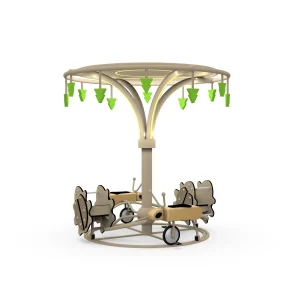
Profile is the second consideration. Low-profile spinners, ground-level play panels, and gentle-slope slides keep the visual envelope below compound wall lines. Tower structures, when required, should be placed away from the perimeter and visually screened with planting. Avoid climbable external frames that create unmonitored elevation gain.
The third consideration is noise. Seesaw impact buffers, rubberised rider bases, and low-clatter bearings matter more in diplomatic residential settings than in municipal parks. Continuous mechanical noise can disturb adjacent office or residence functions and can be mistaken for maintenance issues. Rubber bumpers, enclosed bearing seats, and spring-assisted damping reduce both noise and complaint risk.
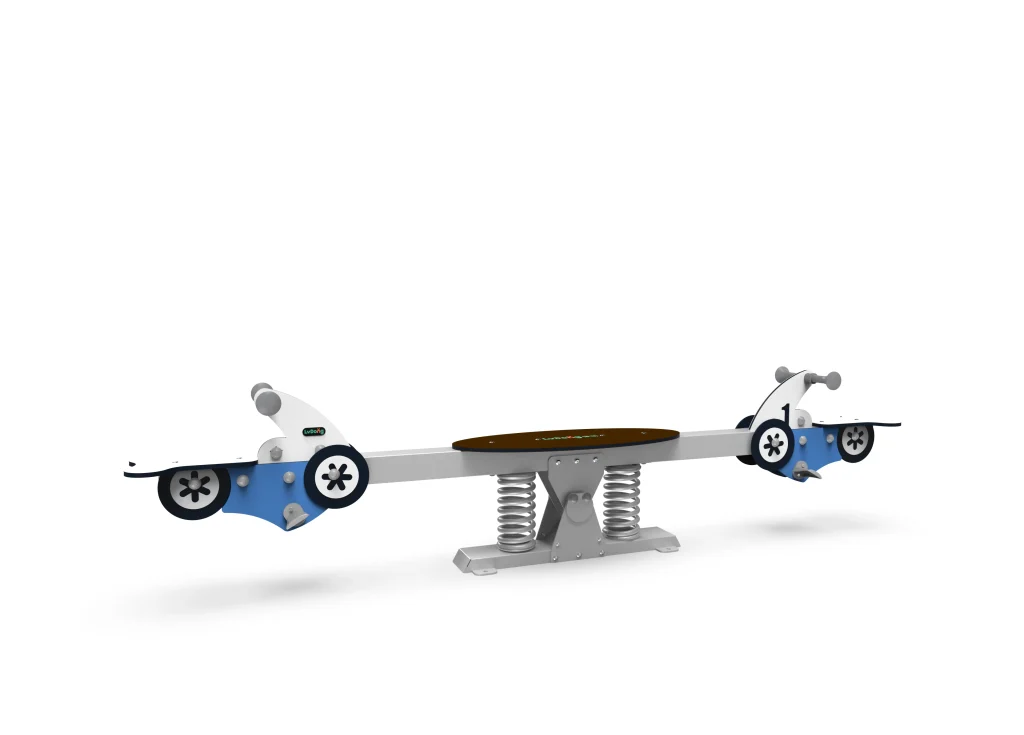
A discreet playground is not stripped of play value. A well-chosen spring rider, a two-person seesaw, or a low platform with a short slide can provide full motor-skill engagement while keeping the installation visually calm and auditorily unobtrusive.
Perimeter, Sightlines, and Controlled Access
Sightline management is essential in restricted compound family areas. Every piece of equipment should be visible from at least one staffed surveillance point or camera location. Tunnels, enclosed playhouses, and high-walled panels create blind zones that complicate supervision and compromise security review [2].
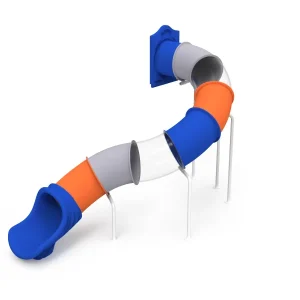
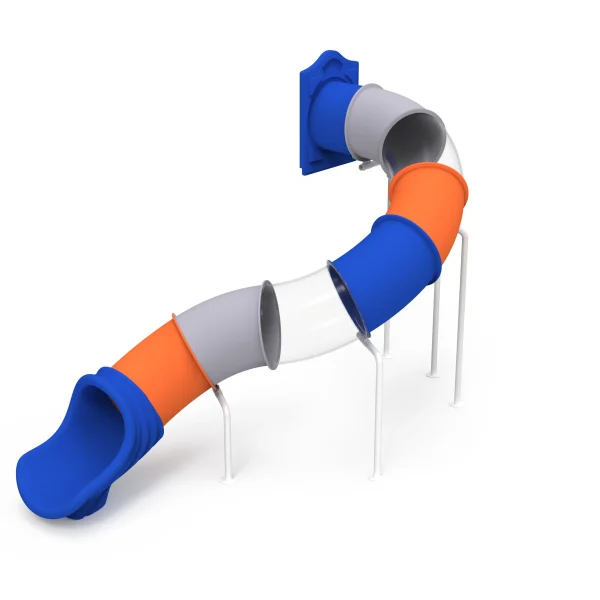
If tunnel slides are desired, select models with transparent portholes or interruption gaps that allow partial visual inspection. Fully opaque tube runs are difficult for both parental and security observation and should be avoided unless the facility accepts a documented supervision procedure.
Access control is another installation-level concern. The family area should have a defined single entry point, preferably visible to the guard post or reception desk. Equipment should be arranged so children do not need to cross vehicle routes or loading zones to reach play features. Gates should swing inward where permitted by local code, with self-closing hardware that does not create finger-pinch points [1].
Anchoring requires special attention in security-sensitive sites. Equipment must be fixed to engineered concrete footings or embedded anchors that are not easily disassembled with standard hand tools. Tamper-resistant fasteners and locking caps are common requirements. The goal is not to make maintenance impossible, but to ensure unauthorised removal or relocation is obvious and time-consuming.
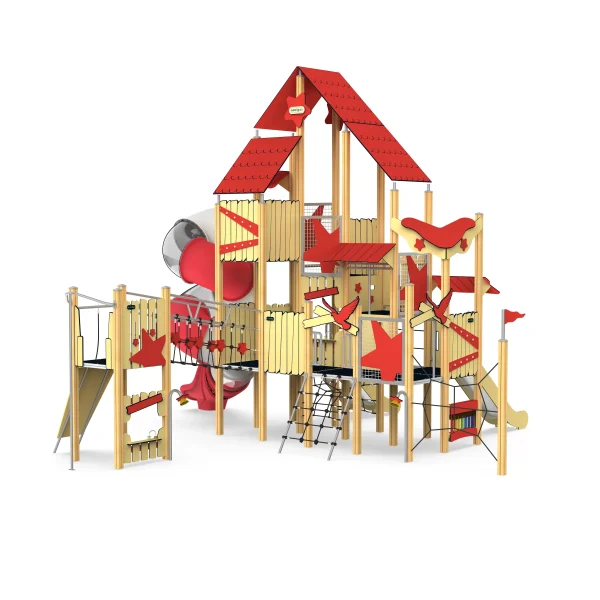
No equipment should be placed where it provides a step toward a perimeter fence, wall, gate, or utility cabinet. A 1.5-meter buffer from compound perimeter features is often part of internal security guidance, but the exact setback must come from the facility security officer and local codes, not from a product guide.
Material and Structural Requirements for Restricted Installations
Embassy and consulate family areas often operate under stricter lifecycle controls than standard municipal parks. Materials should be selected for long service intervals, low replacement frequency, and minimal visual degradation.
Hot-dip galvanised steel frames with powder-coated finish layers provide corrosion resistance and a neutral, low-glare surface. Stainless steel fasteners reduce dissimilar-metal corrosion and simplify long-term maintenance. Rotational-moulded LLDPE components can be specified in muted tones and are resistant to moisture and UV stress without the brittle failure risk of cheaper plastics.
For coastal consulates, stainless steel becomes the preferred structural material rather than an aesthetic upgrade. Salt spray accelerates rust at connection points, and failed fasteners become both safety issues and security vulnerabilities. Stainless steel components reduce that risk but must be isolated from carbon steel to avoid galvanic corrosion [6].
Surfacing selection should favour impact attenuation without creating loose material that can be thrown or tracked into sensitive areas. Bonded rubber mulch, wet-pour rubber, or engineered turf over a tested base are generally easier to keep clean and maintain than sand or wood chips. Sand may be prohibited in some compounds because it can conceal small objects or degrade into drainage systems. The final surfacing must still meet EN 1177 or ASTM F1292 impact requirements [5].
Supplier Vetting and Procurement Documentation
Embassy and consulate procurement is rarely a one-line purchase order. The buying entity often requires manufacturer registration, product certification, material traceability, and a defined after-sales support path before equipment enters a controlled site.
Before signing a contract, buyer-side verification should review the supplier’s production controls, testing records, and ability to produce documentation in the contract language. Restricted-compound projects frequently require named project contacts, confidentiality clauses, and scheduled delivery windows that avoid peak diplomatic hours.
Before you sign a contract, supplier verification becomes a security step as well as a quality step. <Factory Visit Checklist Playground Equipment Supplier Evaluation> covers the inspection points that matter in restricted-project procurement.
Certification evidence should be collected as part of the quotation, not after arrival. Manufacturers serving international projects should be able to provide current EN 1176 or ASTM F1487 test documentation, material certificates, and product-origin details without delay.
For embassy compound procurement, certification evidence is rarely optional. <8 Essential Certifications for Playground Equipment Manufacturers> covers the manufacturer credentials that simplify compliance review.
Sample review is also useful. A physical or photographed sample shows weld quality, coating thickness, edge radius, and fastener detailing before the full shipment enters the compound. This is especially important when the equipment will be installed behind a security perimeter where re-delivery is logistically awkward.
A pre-purchase sample review is where finish quality and fabrication discipline become visible before shipment. <Evaluate Playground Equipment Samples Before Buying A Guide> covers what to test when a sample arrives.
Installation Acceptance: A Discipline-Specific Checklist
Installation inside a diplomatic compound must follow a controlled plan. The supplier should provide foundation drawings, assembly procedures, torque values, surfacing instructions, and an acceptance checklist before workers arrive. On-site personnel may be subject to background screening, escort requirements, or limited working hours.
The table below summarises the acceptance elements most often required in restricted installations.
| Verification Item | Requirement | Acceptance Evidence |
|---|---|---|
| Site security overlay | Play zone approved by facility security officer | Signed site plan with security note |
| Equipment certification | EN 1176 or ASTM F1487 compliance | Test reports and declaration of conformity |
| Impact surfacing | EN 1177 or ASTM F1292 compliance | Fall-height test certificate |
| Anchoring and fasteners | Engineered footing, tamper-resistant hardware | Torque log and photo record |
| Accessible route | Clear path to and through play area | Route inspection or accessibility review |
| Sightline coverage | No visual dead zones from staffed point | Camera or supervision verification |
| Maintenance access | Serviceable parts reachable without removing security features | Tooling and parts schedule |
Only after these items are signed off should the family area be opened for use. A controlled handover also reduces the chance that minor defects are discovered later under conditions that require a new security approval cycle.
Age Zoning and Play Flow Without Compromising Oversight
Embassy family areas often serve a narrow age band: toddlers and young children of posted staff. Mixed-age zoning still matters, but the space may be smaller than a community park.
For toddler-focused areas, ground-level spring riders and low play panels provide motor skill engagement without elevated fall risk. For school-age children, a low platform slide or a multi-person seesaw supports social play while keeping the activity compact. Avoid separating age groups with solid walls that break sightlines. A low planting edge or a change in surfacing colour is often enough.
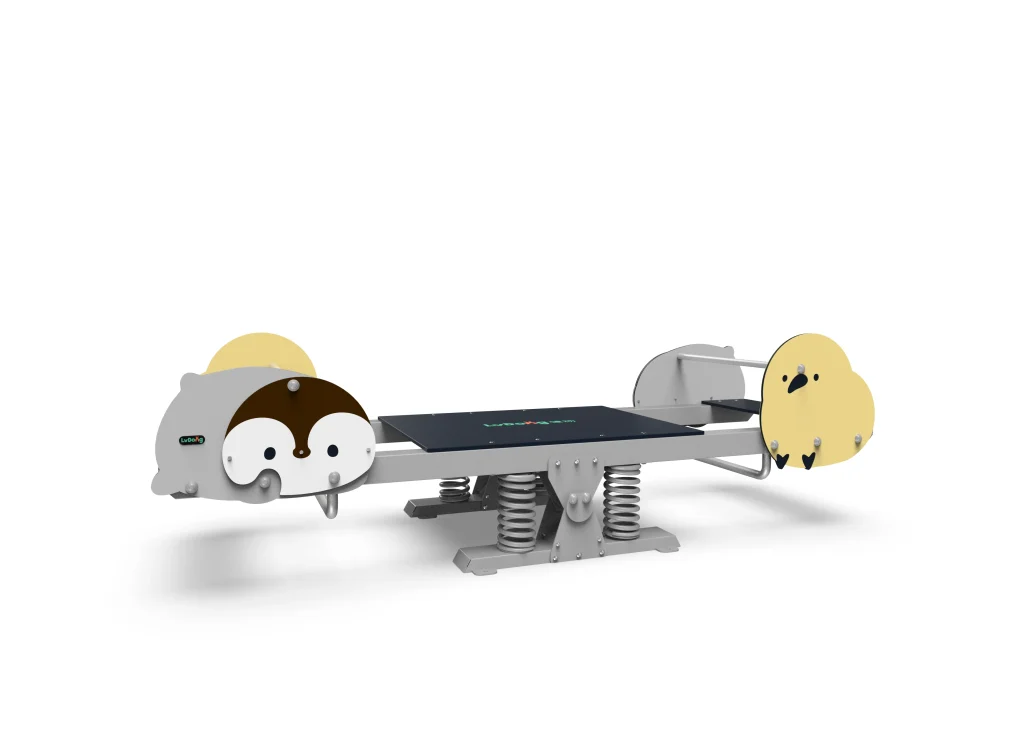
Play flow should guide children from a low-energy entry activity, such as a tactile panel, toward more active equipment, and then back toward a quiet zone near seating. This pattern reduces running through unsupervised corners and helps parents and security staff maintain natural observation.
Maintenance, Spare Parts, and Long-Term Operational Security
A neglected playground inside an embassy compound creates more than a maintenance issue. Loose fasteners, broken spring covers, or cracked panels can become small security anomalies that trigger compound inspections. A defined maintenance calendar prevents this.
Fastener torque checks should be part of routine inspection, especially for vibrating equipment such as spinners and seesaws. Bearings should be lubricated, springs checked for rust or deformation, and impact surfacing tested for compaction and loose particles. All maintenance should be logged because diplomatic facilities are often subject to property condition audits [3].
Spare parts planning is especially important when the compound is overseas. Long lead times for spring assemblies, bearing kits, or slide hoods can leave equipment closed for extended periods. Procurement should specify minimum spare-part quantities for the first two years of operation and confirm that the supplier can ship to the final consular address or a secure forwarder, not just a commercial port.
Documentation retention is also a security discipline. Keep certificates, installation logs, torque records, and maintenance reports in both digital and hard-copy form where allowed. If the facility is transferred, renovated, or audited, complete records support continued occupancy and reduce delays.
Plan a Secure Family Area Without Compromising Discretion
Embassy and consulate family areas require a different procurement mindset: equipment is not simply selected and shipped; it is screened, placed, anchored, documented, and maintained as part of the secure campus. The right supplier can help you keep the play area calm, low-profile, and fully compliant without turning it into a visual barrier.
For confidential project support, send your approved site plan, security overlay notes, and preferred equipment list to [email protected] or reach us on WhatsApp at +86 139 1568 4545. Our team can prepare a quotation with discreet colour palettes, tamper-resistant anchoring options, and current EN 1176 or ASTM F1487 documentation.
FAQ
What makes embassy playground installation different from a standard public park installation?
The main difference is the security overlay. Equipment must be placed so it does not create climbing paths toward perimeter walls, blind surveillance zones, or unauthorised removal risk. It also requires tighter documentation, tamper-resistant anchoring, and often a controlled installation schedule.
Which safety standards apply to playground equipment in consular family areas?
The two most common references are EN 1176 for structural and safety requirements and ASTM F1487-21 for public playground performance in U.S.-linked procurements [1][2]. Surfacing must follow EN 1177 or ASTM F1292 impact-attenuation methods [5]. The applicable standard is usually defined in the contract or host-country regulation.
Can playground equipment be customised to match a discreet, low-profile design?
Yes. Muted colours, low platform heights, non-climbable side panels, rubberised noise buffers, and tamper-resistant fasteners can all be specified. The goal is to retain age-appropriate play value while keeping the installation visually restrained and easy to monitor.
What documentation should be requested before installation inside a diplomatic compound?
Request current product test reports, material certificates, foundation drawings, torque values, surfacing test certificates, and a signed declaration of conformity. The facility security officer should also receive a site plan showing exact equipment placement relative to perimeter lines and camera coverage.
How long does installation typically take without disrupting compound security?
It depends on the equipment scope and the approved working-hour windows. A compact four-to-six-piece family area can often be installed within one to three working days at the foundation stage if safety and security inspections are scheduled in advance. Delivery should be coordinated with the facility access calendar.
References
[1] EN 1176-1:2017, Playground equipment and surfacing — Part 1: General safety requirements and test methods. European Committee for Standardization.
[2] ASTM F1487-21, Standard Consumer Safety Performance Specification for Playground Equipment for Public Use. ASTM International.
[3] U.S. Consumer Product Safety Commission. Public Playground Safety Handbook, Publication No. 325.
[4] U.S. Access Board. Americans with Disabilities Act Accessibility Standards.
[5] EN 1177:2018, Impact attenuating playground surfacing — Methods of test for determination of impact attenuation. European Committee for Standardization.
[6] ISO 9001:2015, Quality management systems — Requirements. International Organization for Standardization.
If you’re interested, check out these related articles:
Double Slide Playground Design for Optimal Traffic Flow Strategies
Swing Set Components Advanced Material Selection for Durability
Optimal Seasonal Care for Outdoor Metal Swing Sets
Eco Friendly Playground Equipment SGS REACH RoHS Standards Explained
Playground Equipment Safety Your Essential Self Inspection Checklist