Film production creates a specific childcare problem: children need a safe, supervised place to play during long shoot days, but the space available is rarely permanent. A trailer unit, soundstage corner, empty rehearsal room, or fenced area beside a location base may need to become a play area in the morning and disappear by wrap. Mobile, unpowered play equipment answers that problem without requiring site works, mains power, or permanent surfacing. This guide covers the equipment choices, safety checks, and logistics that matter most for film studio on-set childcare and temporary production locations.
<img src="https://lvdongtoys.com/wp-content/uploads/2026/02/Interactive-Playground-Equipment_20260202_175330.webp" alt="Interactive Playground Equipment" style="max-width: 600px; height: auto; display: block; margin: 20px auto;" />
Why Temporary Production Childcare Needs a Different Equipment Standard
A permanent playground can spread across a large footprint, use in-ground foundations, and accept long installation timelines. A temporary childcare area cannot. The equipment must arrive in panels or manageable components, assemble quickly, sit safely on hard floors or temporary mats, and pack down without leaving marks that would damage a rented venue or studio floor.
The structural safety baseline for public and workplace childcare play equipment is EN 1176 [1]. Equipment selected for a temporary site should meet the same standard, but it should also be judged on three additional practical tests: how quickly it can be made safe, how easily it can be supervised from one or two sight lines, and how quietly it operates near a set. Unpowered equipment generally performs better than electronic play features on all three, because it avoids cables, data concerns, electrical inspection requirements, and sound bleed into sensitive recording areas.
Site Assessment Before Equipment Selection
Before any equipment list is made, the production childcare coordinator should record the usable clear floor area, ceiling or overhead clearance, surface type, access route from truck or trailer, child age range, and expected peak number of children. A corner that looks large in a floor plan may shrink once cables, stroller parking, check-in tables, and a caregiver station are added.
For on-set childcare spaces, a floor plan is rarely generous, and every square metre must serve supervision and movement. <Small Space Solutions for Restaurant Childrens Play Areas> covers space-efficient layout choices that transfer directly to temporary studio childcare corners.
Sight lines matter more than visual appeal. The CPSC Public Playground Safety Handbook recommends clear sight lines and age separation for play areas [2]. In a temporary childcare zone, one caregiver should be able to see all active equipment from the main check-in point or a fixed chair position. Avoid placing tall panels or storage crates where they create blind corners. The play zone should also be separated from lighting stands, dollies, cable runs, and other production traffic.
Equipment Categories That Work in Movable Childcare Setups
Spring Riders and Single-User Spinners
Spring riders and single-user spinners are among the most practical choices for temporary childcare. They have small footprints, low fall heights, and simple one-person assembly requirements. A typical spring rider is approximately 60–99 cm long, 35–39 cm wide, and 79–110 cm high, with a maximum fall height of 50 cm. A single-player spinner may be roughly 60 × 60 × 90 cm to 95 × 80 × 160 cm, with a fall height of 34 cm. These dimensions allow equipment to be placed on interlocking mats without extensive ground preparation.
<img src="https://lvdongtoys.com/wp-content/uploads/2026/02/Playground-Seesaw_20260202_175340.webp" alt="Playground Seesaw" style="max-width: 600px; height: auto; display: block; margin: 20px auto;" />
Multi-Child Seesaws and Low-Profile Spinners
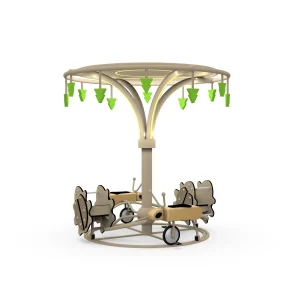
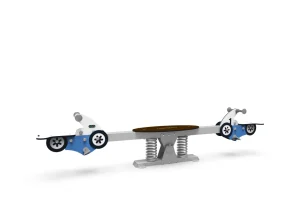
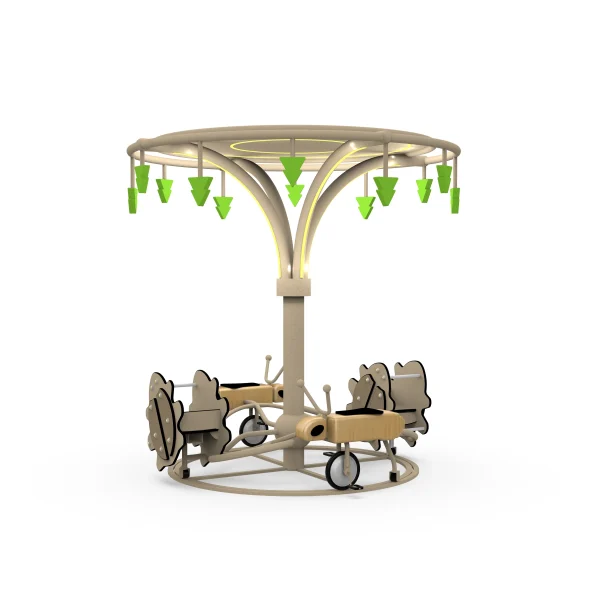
When more children must be accommodated, a multi-person seesaw or a multi-player spinner can serve a small group while keeping the movement visible and controlled. A multi-person outdoor seesaw is typically 300–320 cm long, 39–110 cm wide, and 72–97 cm high, with a maximum fall height of 60 cm. A multi-player spinner may have a diameter of 120–200 cm and a height of 70–220 cm, supporting 6–10 children, with maximum falling heights between 55 cm and 77 cm.
For temporary film sets, the lower-profile versions are usually the better fit. They are less visually intrusive, easier to surround with temporary surfacing, and simpler to reload into a truck at wrap.
<img src="https://lvdongtoys.com/wp-content/uploads/2026/02/Commercial-teeter-totter_20260202_175304.webp" alt="Commercial teeter totter" style="max-width: 600px; height: auto; display: block; margin: 20px auto;" />
Play Panels and Quiet Sensory Options
Play panels provide a quiet alternative when filming is taking place nearby. They can be mounted to temporary frames, lightweight walls, or existing studio barriers, and they add tactile, visual, and cognitive play without constant movement noise. Panels are also easier to disinfect between groups, which supports the hygiene expectations of a workplace childcare setting.
<img src="https://lvdongtoys.com/wp-content/uploads/2026/02/Playground-with-tunnel-slide_20260202_175401.webp" alt="Playground with tunnel slide" style="max-width: 600px; height: auto; display: block; margin: 20px auto;" />
A low-profile slide with a short runout can be added where space allows, but it should be selected for a modest platform height and a controlled exit zone. The key is to keep every piece within one visible play envelope rather than creating a miniature playground that requires scattered supervision.
Safety and Compliance for Pop-Up and On-Set Play Spaces
Temporary does not mean lower-risk. The same fall-height, entrapment, and protrusion concerns apply, but they are managed through mats, placement, and daily checks instead of permanent groundwork. Impact-attenuating mats or tiles should be laid across the fall zone of each piece, with the depth selected according to the equipment fall height. Movable mats are acceptable only if they remain stable, do not slide, and do not create new trip hazards.
Because pop-up play spaces move frequently, documented checks matter more than a one-time installation sign-off. <Playground Equipment Safety Your Essential Self Inspection Checklist> covers the routine checks that keep temporary childcare areas safe between locations.
Sanitizing is also a recurring task on set. Surfaces should be cleanable without aggressive chemicals that damage paint or plastic. Moving parts should be checked for loose fasteners after each relocation. Accessible routes into the play zone should follow applicable ADA provisions where children or caregivers with disabilities are accommodated [3]. No cable, sandbag, or lighting fixture should pass through the play zone or its fall area.
Logistics: Packaging, Rapid Setup, and Turnaround Between Shoots
Equipment intended for production use must be easy to move. Reusable crates or rolling cases, labeled components, and a simple inventory list reduce setup time and prevent parts from being lost between locations. Product instructions often indicate one or two people can assemble the equipment in approximately two person-hours, which supports a small location team without specialized labor.
The surface under the equipment should be protected from scuffs. Rubber matting, non-marking pads, or a temporary deck can prevent damage to studio floors, tent bases, or heritage site interiors. Where anchoring is not permitted, the equipment should be placed on a level surface with adequate ballast or stabilizing mats, and the setup should be checked before children enter.
When a production schedule extends or a festival site becomes semi-permanent, the same “keep or replace” logic applies to mobile units. <Old Playground Renovation Keep or Replace Decisions> covers evaluation criteria for reuse, repair, or replacement.
Procurement Checklist for Production Companies and Studio Facilities
Use the following checklist when evaluating equipment for film studio on-set childcare:
- Confirm the clear floor area, ceiling height, and access route before ordering.
- Match equipment to the expected age range and peak child count.
- Choose pieces with low fall heights and simple supervision requirements.
- Ask for EN 1176 or equivalent compliance documentation [1].
- Confirm setup time, tools required, and whether installers need special training.
- Plan impact-attenuating mats or temporary surfacing for every fall zone.
- Confirm packaging is suitable for repeated transport and storage.
- Establish a daily inspection and sanitation routine for the production schedule.
- Keep a spare parts and fastener kit with the mobile childcare package.
- Record warranty terms and after-sales response commitments.
If you are planning mobile childcare across more than one production site, send the site measurements, child age range, and rough shoot dates to [email protected]. A product specialist can return a shortlist of equipment that fits the available floor area and supervision plan.
Plan Your On-Set Childcare Play Area
Suzhou LvDong Amusement Equipment Co., Ltd. designs and manufactures unpowered play equipment suited to compact, movable childcare settings. Send floor plans, production schedules, or site photos to [email protected] or WhatsApp +8613915684545 for space planning support, product specifications, and compliance documentation.
FAQ
Can on-set childcare equipment be used indoors and outdoors?
Many unpowered pieces can work in both settings if the surface is level and the surrounding area is free from production traffic. Indoor use requires non-marking protection, while outdoor use requires attention to wind, sun exposure, and stable placement.
What surfacing is required for temporary equipment?
Temporary impact-attenuating mats or interlocking tiles should cover the fall zone of each piece. The depth is selected according to the equipment fall height. Mats must not slide or create trip hazards.
How many children can a mobile setup support?
It depends on the equipment selected. Single-user spinners and spring riders support one child at a time, while multi-person seesaws may support 2–10 children and multi-player spinners may support 6–10 children. The total capacity should also reflect the available supervision ratio.
Is it safe to place equipment near film production activity?
Only if the play zone is physically separated from cables, lighting stands, dollies, and moving production vehicles. The childcare area should have a clear boundary and a caregiver who can monitor the entire play envelope without obstruction.
What documentation should a production company keep?
Keep equipment compliance documents, assembly instructions, daily inspection logs, surfacing specifications, and sanitization records. These records support safety continuity across multiple production locations.
References
[1] EN 1176-1:2017, Playground equipment and surfacing — Part 1: General safety requirements and test methods, European Committee for Standardization.
[2] U.S. Consumer Product Safety Commission, Public Playground Safety Handbook.
[3] U.S. Department of Justice, ADA Standards for Accessible Design.
If you’re interested, check out these related articles:
Eco Friendly Playground Equipment SGS REACH RoHS Standards Explained
Large Playground Slide Transport and Crane Planning
Safe Quiet Cleanable Playground Equipment for Hospitals
Playground Spring Rider Materials Steel vs Anti Rust
Top 10 Animal Spring Rider Designs for Modern Playgrounds