Why Discontinued Parts Become a Procurement Problem
Playground equipment often outlives the catalogue that sold it. A slide installed in 2018 may still be safe and serviceable in 2026, but the exact model may no longer be listed, and the original component supplier may have already moved on. For procurement teams, school facility managers, and municipal parks departments, that gap is where operational risk starts. A broken spring, worn bearing, or faded themed panel can shut down a playground if the replacement part cannot be located quickly.
The lifecycle mismatch is common in commercial playground equipment. Structural frames can remain safe for a decade, while springs, bearings, and cosmetic panels wear on shorter cycles. When a manufacturer discontinues a model, the original casting, mold, or powder-coating specification may no longer be in active production. Without a documented replacement path, a small component failure can force a larger retrofit or even the removal of an otherwise sound structure.
Supplier selection therefore matters beyond the initial purchase. A manufacturer that can retrieve original drawings, confirm material grades, and supply a dimensionally compatible part reduces downtime and liability exposure. This is why documented after-sales support should be reviewed before the first order, not after a part breaks.
When a supplier stops supporting previous generations, replacement decisions become expensive and reactive. <Evaluate Commercial Playground Manufacturers 8 Critical Selection Factors> covers after-sales and spare parts considerations within the manufacturer evaluation process.
Lvdong addresses this problem through a structured obsolete part support system. Rather than ending availability at a single date, Lvdong classifies discontinued components by function and maintains stock, tooling, and technical documentation according to the safety role of each part.
How Lvdong Classifies Discontinued Model Support
Lvdong does not treat an entire model as uniformly obsolete. The parts team reviews the original bill of materials and separates components into three support classes. Safety-critical and structural parts receive the longest retention because a failure in those components affects more than one child or one movement cycle.
| Component Class | Typical Parts | Support Approach |
|---|---|---|
| Structural | Posts, platforms, frames, connectors, guardrails | Retained stock or remanufacture from original drawings |
| Mechanical wear | Springs, bearings, pivots, chains, linkages | Planned replacement batches with cross-reference options |
| Cosmetic and thematic | Panels, decals, themed riders, color-matched trim | Case-by-case remake or compatible current design |
This classification follows the same safety logic used in EN 1176-1: if a component affects structural integrity, entrapment clearance, or impact attenuation, it cannot be substituted with a look-alike part of untested dimensions [1]. For projects under Chinese standards, GB/T 34272-2017 also sets material and structural safety requirements, so legacy components must be matched to the same performance class [2].
Stock Windows and Replacement Priorities by Component Class
Because each installation is different, there is no single month count that applies to every part. Lvdong applies a priority matrix based on safety impact and failure frequency. Safety-critical structural components are kept available for the expected operating life of the equipment generation, while common wear parts are maintained in smaller replacement batches. Cosmetic components are assessed for remake feasibility using current materials.
| Priority | Component Type | Lvdong Support Trigger |
|---|---|---|
| P1 | Structural connectors, platform frames, guardrails | Retained stock plus original drawing retrieval |
| P2 | Springs, bearings, pivots, chains | Replacement batch stock and cross-reference review |
| P3 | Panels, themed riders, decals | Remake or scalable retrofit review |
For buyers, the practical first step is to identify the component by function, not by marketing name. Many obsolete part requests are resolved faster when the buyer provides the original installation drawing, plate number, or a clear photograph with a measurement reference. This allows the parts team to match the component to its production batch, material grade, and applicable standard.
Parts support also connects to upgrade decisions. If a discontinued component is no longer economic to remanufacture, phased replacement may be safer than repeated repairs. Lvdong reviews the load path, surfacing, and current age grouping before recommending a repair-only route.
For older installations, replacement decisions should follow a priority sequence rather than a single budget year. <Kindergarten Outdoor Play Equipment Strategic Upgrade Priorities> covers upgrade sequencing for existing playgrounds.
Documentation That Speeds an Obsolete Part Request
Accurate documentation turns an obsolete part request from a long investigation into a fast stock check. Lvdong recommends preparing the following before contacting the parts team:
- Model name or code from the original quotation or equipment plate
- A photo of the component with a ruler or other scale reference
- Installation year and country
- Required quantity and equipment position
- Any current certification or standard requirement for the site
This documentation is not bureaucratic. It allows Lvdong to check archived drawings and production records. Under ISO 9001:2015, document control and product traceability are part of the quality management system, which directly supports long-term spare part retrieval [3].
If you need an obsolete part identified, send the model code, a clear photo, and the required quantity to [email protected]. Lvdong’s team will conduct a stock check and confirm whether a direct replacement, compatible alternative, or remake is available. For urgent closures, include the playground opening date so the request can be prioritized.
Safety Compliance When Replacing Legacy Components
Replacement parts are not just a logistics issue; they are a safety issue. EN 1176-1 requires that equipment, including replacement parts, does not present hazards such as entrapment, sharp edges, or unexpected failure under intended use [1]. A legacy component supplied outside the original specification may meet dimensions but still fail the probe tests or load requirements that applied when the equipment was certified.
Lvdong’s replacement process checks the original material grade, weld specification, coating thickness, and fall zone relationship. Where the original standard has been revised, the parts team evaluates whether the replacement must meet the new requirement or preserve the original certified condition. This prevents a playground from remaining open with a part that looks correct but has not been verified.
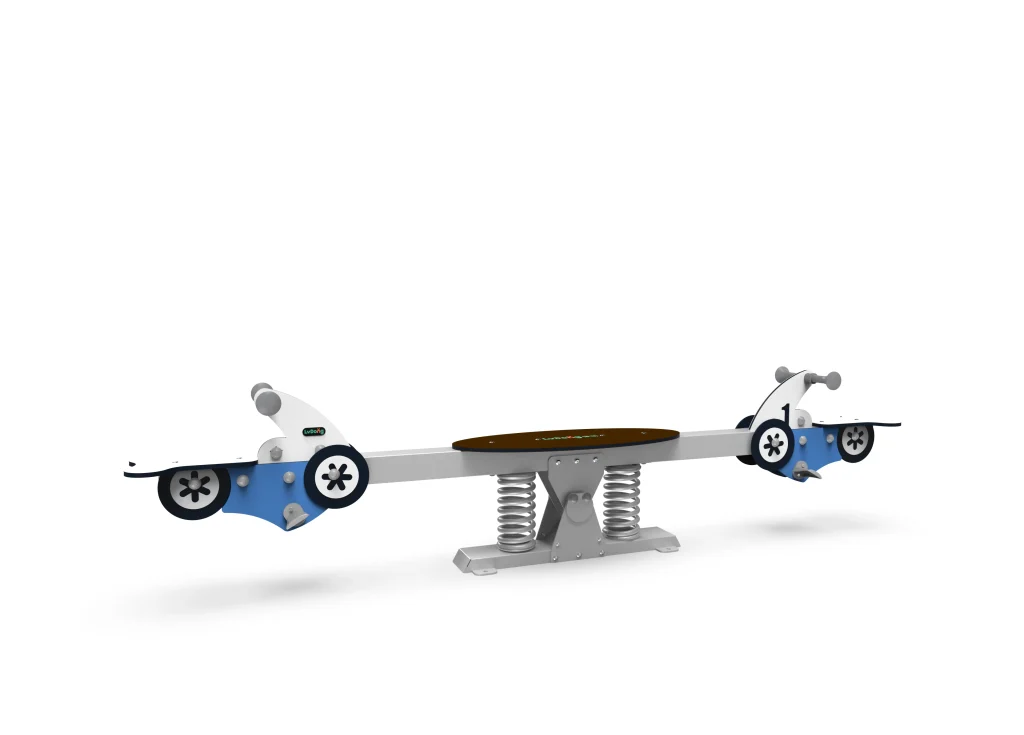
When spring riders or motor-themed units are involved, material choice directly affects fatigue life and corrosion resistance. <Playground Spring Rider Materials Steel vs Anti Rust> covers the material decisions behind long-lasting spring rider components.
In the US market, ASTM F1487-21 sets public playground equipment safety requirements, including general requirements for maintenance of critical dimensions [4]. Lvdong applies the same verification discipline across export destinations, adjusting documentation to the relevant standard without reducing the underlying safety review.
Obsolete Part Inquiry
To request a discontinued component, send the following to Lvdong’s parts team:
- Model code or installation drawing
- Component photo with dimensions
- Required quantity and delivery location
- Certifications required for the site
Email: [email protected]
WhatsApp: +8613915684545
Lvdong confirms stock status and provides a compatibility review before recommending replacement. For structural parts, allow time for drawing retrieval and material verification; for common wear parts, the team can often confirm stock from the replacement batch.
Frequently Asked Questions
Does Lvdong support every discontinued model?
Support is classified by component type and original documentation. Structural and mechanical parts are prioritized, while cosmetic parts may be remade or replaced with current compatible designs. There is no single end-of-life date applied to an entire model.
How should I identify a component if the model plate is missing?
Send a photo with a measurement reference, the installation year, country, and any original drawing or quotation. Lvdong cross-checks archived production records using the traceability system maintained under ISO 9001 [3].
Can Lvdong remanufacture a discontinued part from old drawings?
Yes, for many structural and mechanical parts, provided the original drawings or tooling are available. The parts team verifies material grade and coatings against the applicable standard before approving the remake.
What if the replacement part must meet newer standards?
Lvdong evaluates whether to supply the original certified condition or update to the current standard. Safety-critical clearances are checked against EN 1176-1, GB/T 34272-2017, or ASTM F1487-21 as applicable [1][2][4].
How far in advance should buyers plan for obsolete parts?
Buyers should maintain a spare parts plan for high-wear items and retain model documentation. Early requests reduce downtime, while complex structural parts may require production scheduling and drawing retrieval.
References
[1] CEN. EN 1176-1:2017, Playground equipment and surfacing — Part 1: General safety requirements and test methods. Brussels: European Committee for Standardization, 2017.
[2] SAC. GB/T 34272-2017, Safety requirements for amusement devices. Beijing: Standardization Administration of China, 2017.
[3] ISO. ISO 9001:2015, Quality management systems — Requirements. Geneva: International Organization for Standardization, 2015.
[4] ASTM International. ASTM F1487-21, Standard Consumer Safety Performance Specification for Playground Equipment for Public Use. West Conshohocken, PA: ASTM International, 2021.
If you’re interested, check out these related articles:
Single vs Double Seat Playground Horse Spring Riders A Comparison
Why ISO Certification Elevates Commercial Playground Equipment Manufacturers