When playground equipment fails, the difference between a paid replacement and a rejected claim rarely comes down to whether the buyer is right. It usually comes down to whether the buyer can prove the failure in a way the manufacturer’s quality team can quickly verify. A warranty claim involving a manufacturer based in China is less a dispute about fault and more a review of records.
The process below applies to slides, spinners, spring riders, swings, seesaws, play panels, and multi-activity play structures. It does not replace your contract terms, but it gives you a defensible claim file when equipment fails inside warranty.
Why Documentation Decides Most China Warranty Claims
Many playground equipment manufacturers in China operate quality systems aligned with ISO 9001 and have products certified to standards such as EN 1176 and GB/T 34272-2017 [1], [2], [3]. Certification is valuable, but it shows that a product design was tested. It does not prove that a specific delivered unit failed because of a manufacturing defect.
The claim file closes that gap.
A structured claim file turns a subjective complaint into an engineering record. It connects the failed part to a purchase order, a production batch, an installation date, a maintenance history, and a visual record. Without that chain, the manufacturer cannot easily confirm root cause, and the claim becomes a long email exchange.
Most manufacturers are not trying to avoid valid claims. They are trying to avoid approving claims without enough information to process replacement, retrofitting, or credit through their own quality system.
From complaint to technical review
When a buyer reports a failure, the supplier’s after-sales engineer or quality manager typically asks a predictable set of questions:
- When was the unit delivered?
- Which model and batch number is involved?
- What exactly is the failure mode?
- Has the unit been altered, repaired, or disassembled?
- What inspection or test has been completed?
If the buyer has prepared those answers in one failure report, the claim moves directly into technical review. If not, the process stalls while evidence is collected piece by piece.
What Warranty Coverage Actually Covers in Playground Equipment Contracts
Before documenting a failure, confirm what the contract actually warrants. In most playground equipment export agreements, warranty coverage is divided into three broad areas.
Structural coverage
Structural coverage usually includes the main frame, load-bearing members, platforms, and critical joints. Weld cracks, buckling, severe frame corrosion, spring fractures, and platform loosening are the most common structural claims.
These failures normally require the strongest evidence because the safety implications are highest.
Surface and finish coverage
Powder coating adhesion, premature rust, plastic cracking, and severe UV degradation may be covered for a shorter period than structural components. Surface claims are easier to evaluate when the buyer has baseline photos from delivery and installation.
Operational coverage
Bearings, pivot assemblies, swing chains, spring seats, and moving mechanisms may be covered as functional components. Normal wear is often excluded or limited.
The exact warranty period and excluded parts are contract matters. When the contract is governed by the Civil Code of the People’s Republic of China, the buyer’s obligation to inspect and notify within a reasonable time can affect whether a late claim remains enforceable [4]. That is why documentation timing matters as much as the failure itself.
If you are negotiating a new supply agreement, send the draft warranty and inspection clauses to [email protected] or WhatsApp +86 139 1568 4545. A documentation-readiness review before the order often prevents a weak claim file after installation.
The Core Failure Record: What to Capture
Every claim should begin with a single failure record. Do not open with a long email describing the park’s frustration. Open with a controlled record.
At minimum, capture:
- Purchase order and sales contract number
- Equipment model and production batch or serial number
- Delivery and installation date
- Warranty start date
- Exact location and orientation of the failed part
- Date and time of discovery
- Weather and usage conditions around the time of failure
- Maintenance work performed since installation
- Immediate containment action, if any
Use one record per failure
Do not combine a swing chain issue, a paint blister, and a loose bolt into one claim. Separate records allow each issue to be routed to the correct engineering process. They also prevent a weak element from weakening an otherwise solid case.
Photographic and Video Evidence That Stands Up in a Claim
Photographs are not automatically evidence. A useful claim photo answers who, what, where, when, and scale.
Photo sequence
Take four levels of photos for each failure:
- Overview showing the equipment in its installed context
- Mid-range view showing the failed area
- Close-up of the failure surface
- Macro or detail shot with a ruler or other dimensional reference
Enable date, time, and location metadata on the camera. If a smartphone is used, retain the original file rather than a compressed screenshot.
Video protocol
Video is especially useful for moving parts. A spinner bearing, seesaw pivot, or swing chain may sound and move differently under load. Film the component at rest, during slow movement, and during normal use if safe to do so. Keep the camera steady and describe the sound or movement clearly.
Avoid repairing or modifying a failed component before the supplier authorizes it. A cleaned, repainted, or partly disassembled part can make root cause impossible to confirm.
Professional Inspection and Testing Reports
Some claims can be closed with photos and a clear failure record. Others need independent inspection or lab testing, especially when the failure involves a structural weld, material defect, or recurring pattern.
For playground equipment, the original compliance tests are a useful baseline. Standards such as EN 1176 and ASTM F1487 define requirements for structural integrity, entrapment, protrusions, and impact attenuation [1], [5]. The U.S. Consumer Product Safety Commission’s public playground guidance also describes expected inspection and maintenance principles [6].
When a weld crack is suspected, common non-destructive tests include visual testing, dye penetrant testing, magnetic particle testing, and ultrasonic testing. For coating failures, a coating thickness gauge and adhesion test can show whether the applied finish was outside specification. For material failure, a material certificate tied to the batch number helps identify whether the delivered plate, tube, or spring steel matches the agreed grade.
Third-party reports from recognized inspection bodies usually carry more weight than the buyer’s own statement, but they are not always required. Begin with the manufacturer’s requested evidence and escalate only when the technical question requires it.
If the failure involves a spinner or seesaw, the original load-test record becomes part of the control evidence. <Hurricane Spinner Load Testing Unpacking Playground Safety Standards> covers how playground load-test standards are interpreted and what a credible test report should include.
Root Cause Categories and Evidence Mapping
A strong claim does not simply say what failed. It supports a probable root cause: manufacturing defect, installation error, operational overload, environmental damage, or ordinary wear.
The table below maps common failure categories to evidence that can support a manufacturing cause.
| Failure category | Typical observed condition | Evidence that supports a manufacturing cause | Common missing evidence |
|---|---|---|---|
| Weld crack | Crack along a frame or joint on spinner, swing, or climber | Batch trace, non-destructive test report, base material certificate, weld map | No batch code or photo scale |
| Premature corrosion | Rust under powder coating or at cut edges | Coating thickness reading, adhesion test, delivery photos | Repainting or pressure washing before record |
| Spring fracture | Sagging, cracked, or snapped spring rider | Installation level, usage log, spring material certificate | No maintenance log |
| Plastic cracking or fading | Surface crack, chalking, or colour loss | UV exposure record, batch number, material certificate | No installation date |
| Bearing failure | Noise, play, or seizing in spinner or seesaw pivot | Video under load, runout measurement, commissioning record | Continued use after failure |
| Fastener loosening | Repeated bolt movement in deck or swing joint | Torque record from commissioning and recent inspection | No baseline torque record |
| Surface finish defect | Paint peel, flaking, colour mismatch | Dry film thickness reading, adhesion test, unpacking photos | Late notification |
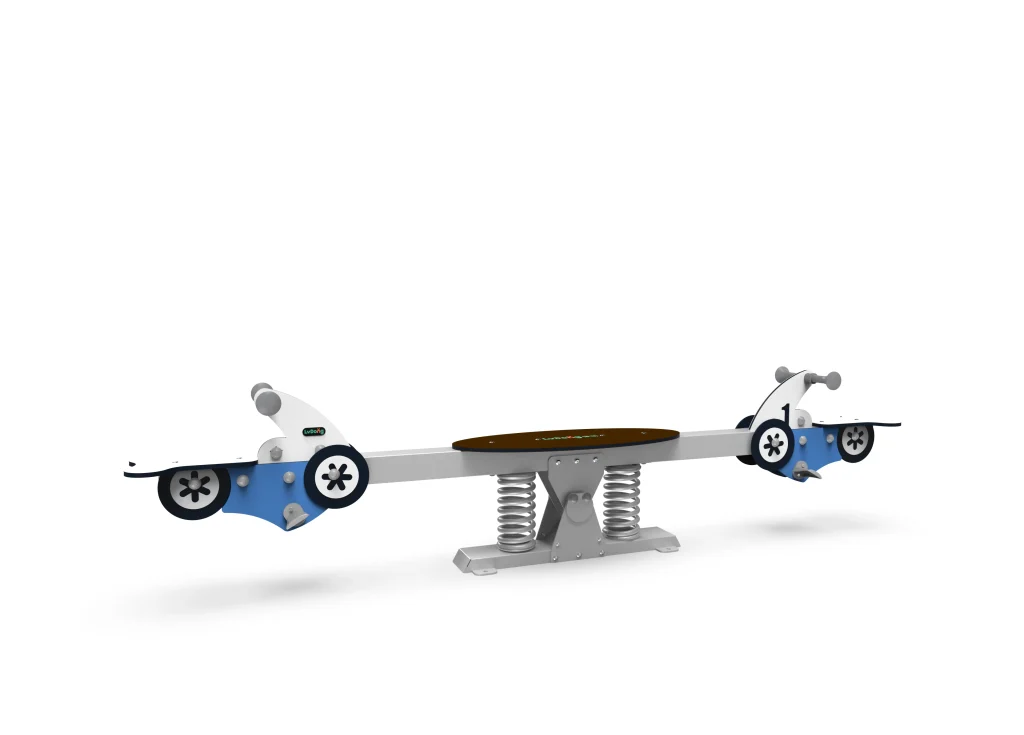
Baseline records begin long before a failure. <Factory Visit Checklist Outdoor Playground Equipment Quality> covers the pre-production and factory inspection points that make a later claim file much harder to dispute.
Communicating the Claim: Sequence and Thresholds
The claim should follow a clear sequence. This reduces back-and-forth and makes the supplier’s internal corrective action request easier to open.
Step one: written notification
Notify the supplier in writing through the address named in the contract. Include the purchase order number, equipment model, batch or serial number, and one paragraph describing the failure. Check the warranty clause for any required notification period.
Step two: preliminary failure report
Attach the core failure record, photo set, and any immediate video. Do not wait for every test to be complete. An early, structured submission starts the supplier’s own clock.
Step three: supplier review and requested evidence
The supplier may issue a corrective action request and ask for additional photos, maintenance logs, or measurement data. Respond in writing and keep a correspondence log.
Step four: joint root cause review
For structural failures, the manufacturer may ask for third-party inspection or arrange a return sample of the failed component. Keep the failed part intact until a decision is made.
Step five: corrective action
The resolution may be repair, replacement, retrofit, price adjustment, or credit, depending on the contract and the confirmed cause. Put the agreed corrective action in writing before parts are shipped or reclaimed.
Service commitments differ sharply from one factory to the next, so they need to be compared before a claim is ever needed. <Effectively Compare Playground Equipment Suppliers Services> covers how response timelines, replacement commitments, and documentation support should be evaluated when selecting a playground equipment supplier.
Common Rejection Triggers and How to Avoid Them
The most common reasons a warranty claim loses force are not technical. They are procedural.
Altered evidence
A failed part that has been welded, repainted, or disassembled before supplier review often loses its value. Do not modify the part unless the supplier approves it in writing.
Missing traceability
A claim without a batch number, serial number, or purchase order reference is difficult to place inside the factory’s production records. Photograph the product nameplate and keep the packaging label.
Late notification
A failure discovered months earlier but reported long after the contract notice period may be rejected as ordinary wear or external damage. Notify the supplier as soon as a material failure is suspected.
Vague or unsupported language
Avoid wording such as “it never worked properly” unless you can support it with commissioning records, maintenance logs, and dated observations. Statements such as “the steel must have been defective” are weaker than a test report or measurable finding.
Mixed claims
Separate multiple issues. A clear single-failure claim is easier to adjudicate than a combined complaint about paint, chains, and fencing.
Practical Claim File Checklist
When the claim is ready to submit, assemble a single file. A complete claim pack usually contains:
- Purchase order and signed sales contract
- Warranty clause or warranty certificate
- Bill of lading, packing list, and delivery receipt
- Product nameplate photo showing model and batch or serial number
- Installation and commissioning report
- Maintenance log since installation
- Incident chronology with dates and personnel involved
- Photo and video evidence with scale, date, and location metadata
- Third-party inspection or test report where applicable
- Written correspondence log
- Written repair approval before any modification
A claim pack built this way is easier for the supplier to route, easier for an engineer to analyse, and faster for both parties to resolve.
Documentation Support for Your Next Warranty Claim
Before you submit a claim, you can send the documentation pack to Suzhou LvDong Amusement Equipment Co., Ltd. for a pre-submission review. Include the equipment model, batch or serial number, delivery date, installation location, photos, inspection report, and a short chronology.
Contact [email protected] or WhatsApp +86 139 1568 4545. If the unit is still in warranty and the evidence supports a manufacturing cause, we will outline the replacement, retrofit, or credit options and request only the tests needed for a decision.
Frequently Asked Questions
Does the Chinese manufacturer have to honor an English-language warranty if the contract is silent?
The written contract, purchase order, and any attached warranty certificate normally govern. A website warranty page is not a substitute for the signed agreement. If the contract is silent, the applicable law and course of dealing between the parties can become relevant, which is why the written warranty clause should be reviewed before ordering.
What if the failure appears after the warranty period but is clearly a design defect?
A genuinely recurring design issue may still be addressed, but the evidentiary standard is higher. The buyer should collect multiple examples of the same failure, keep failed parts intact, and show that the issue is systemic rather than site-specific.
How long should I keep the failed part?
Keep the failed part until the claim is closed in writing. Do not scrap, weld, repaint, or alter it. If the manufacturer requests a sample return, request written shipping and customs instructions before dispatch.
Can I use my own repair contractor before approval?
Avoid doing so unless safety requires immediate action. If immediate action is necessary, photograph the condition first, preserve the removed parts, and notify the supplier in writing as soon as possible.
What is the first document the supplier’s quality team will normally ask for?
Usually the first request is for the purchase order, model and batch or serial number, delivery or installation date, and a clear photo of the failed area. Having those items in the first message speeds up the review.
References
[1] EN 1176-1:2017, Playground equipment and surfacing — Part 1: General safety requirements and test methods, European Committee for Standardization.
[2] GB/T 34272-2017, National standard for unpowered amusement equipment safety, Standardization Administration of China.
[3] ISO 9001:2015, Quality management systems — Requirements, International Organization for Standardization.
[4] Civil Code of the People’s Republic of China, adopted May 28, 2020, effective January 1, 2021.
[5] ASTM F1487-21, Standard Consumer Safety Performance Specification for Playground Equipment for Public Use, ASTM International.
[6] U.S. Consumer Product Safety Commission, Public Playground Safety Handbook, Publication No. 325.
If you’re interested, check out these related articles:
8 Essential Certifications for Playground Equipment Manufacturers
Playground Equipment Quotes Spotting Hidden Costs Explained
Playground Slide Materials LLDPE vs 304 Steel Performance
Safe Quiet Cleanable Playground Equipment for Hospitals