Every containerized playground order is really two deliveries. The first is the equipment itself: slides, swing frames, spinners, spring riders, platforms, and roofs. The second is the spare parts kit that keeps those systems operating after the installers leave. On a 20-foot container, both deliveries share the same expensive space, so the spare parts kit cannot be an afterthought. It has to be deliberate, compact, and tied to the equipment that is actually on board.
A 20-foot general-purpose container offers roughly 33 cubic meters of load volume and a maximum payload near 28 metric tons [1]. Playground equipment rarely presses against that weight limit, but long slide sections, wide platform decks, and assembled swing beams consume volume quickly. That means spare parts gain priority not through bulk, but through consequence: every carton should exist because its failure would stop play, slow an inspection, or force an emergency reorder.
Why a 20-Foot Container Spare Parts Kit Is Different
A small parts box supports a single play area. A container-level kit supports an entire project: multiple equipment families, several installation zones, and maintenance staff who may not be able to reorder quickly from the original manufacturer. The kit should be structured so that one failed bearing, one damaged grip, or one missing anchor does not take a popular unit offline for weeks.
The strongest container-level kits are grouped by risk rather than by product code. High-consequence parts are packed separately from cosmetic spares, and every group is recorded on a master packing list. Buyers who treat the kit as a small after-sales gesture usually discover after installation that they have extra decorative covers but no replacement bearings.
Core Wear Parts and Surface-Contact Hardware
The spare parts mix should match the equipment families in the shipment. For most playground orders, the fastest-moving parts are motion components, hand-contact surfaces, and small attachment hardware. These are the items that suffer daily friction, sun exposure, and the concentrated force of repeated play.
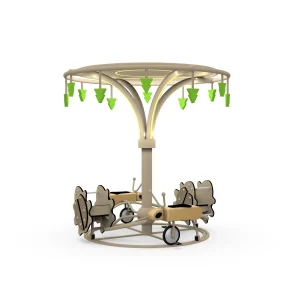
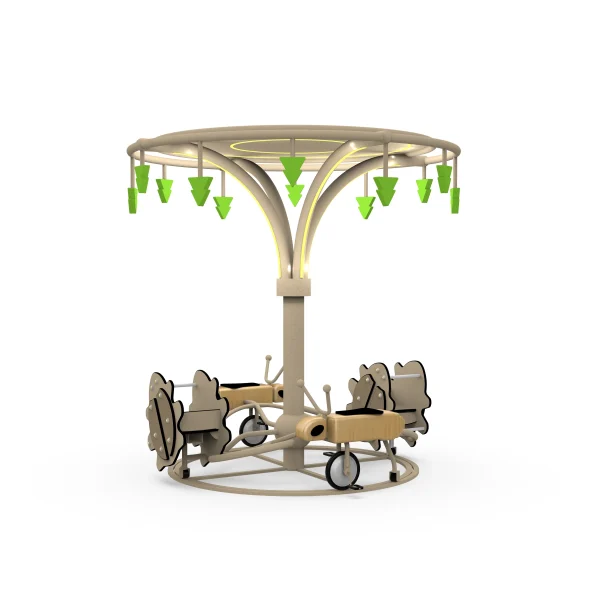
For spinners, the kit should include sealed bearing sets matched to the hub assembly, hub fasteners and washers, anti-slip tread sections, and grip or guard caps. A rough rotation or a thin metallic sound during use is often the first sign that a bearing should be replaced before the next inspection cycle.
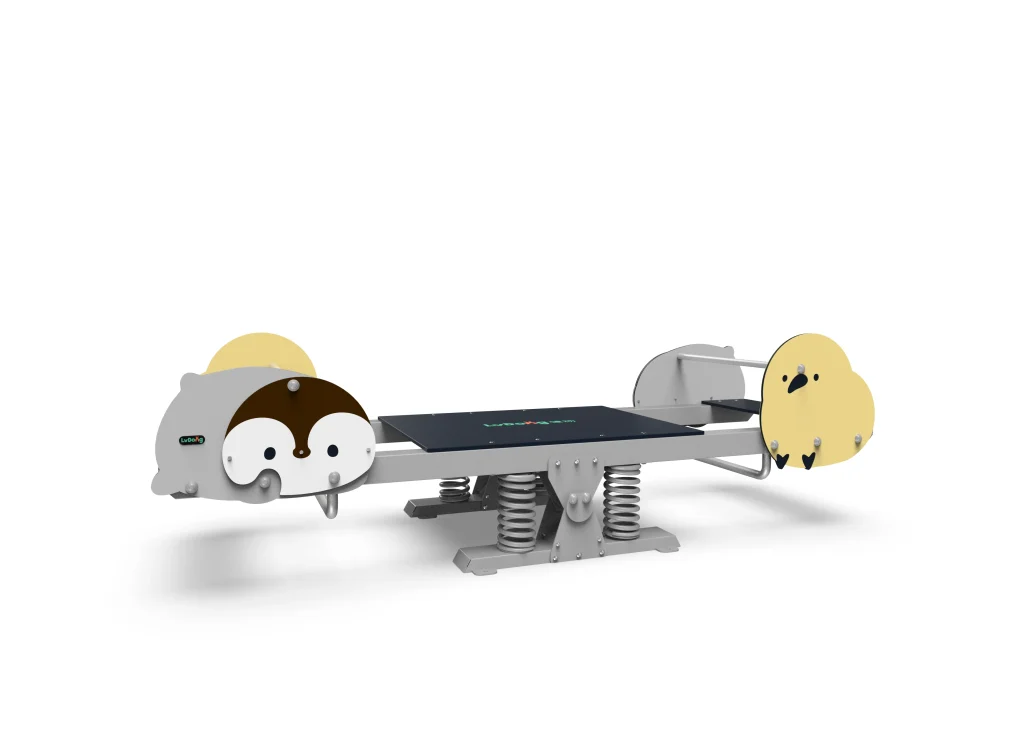
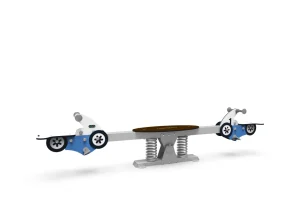
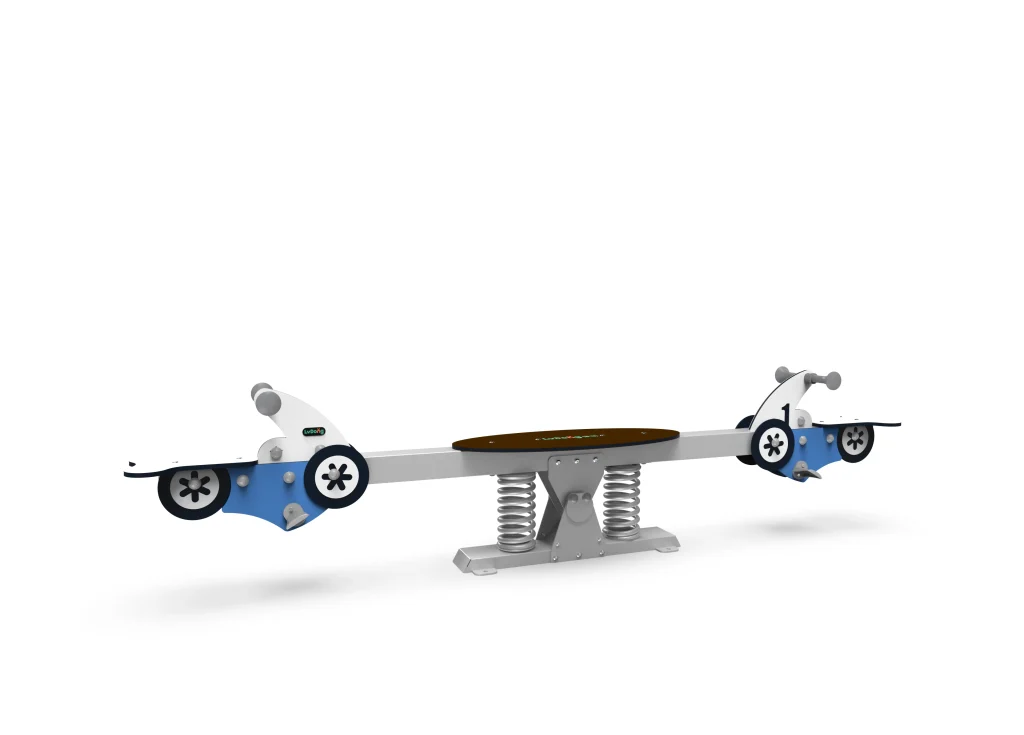
For spring riders, the essential spares are the spring assembly itself, the seat and handle set, base-plate anchors, and protective covers. A sagging spring or a change in the coil gap is a replacement signal, not a repair moment. Spring components should follow the original material specification rather than a generic substitute because the assembly is designed around a specific rebound and fatigue life.
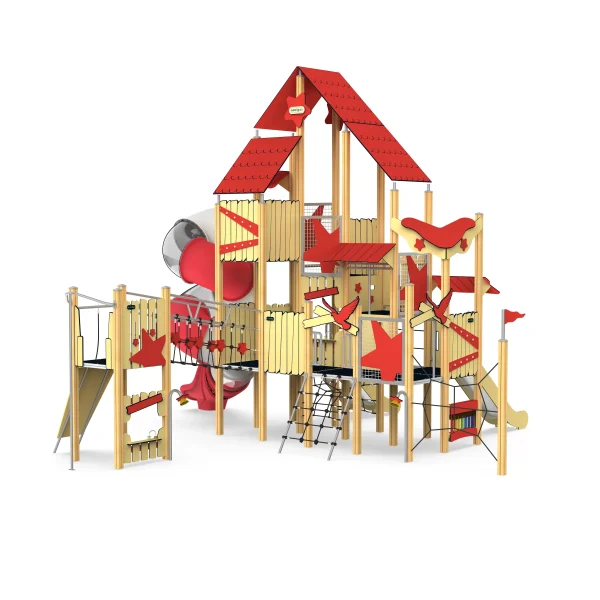
For swing bays, the kit should contain chain sets, swing hangers with bearings, seat assemblies, rubber stops, and the small covers that protect connection points. For slides and multi-level towers, buyers should stock handrail covers, connector sets, step inserts, and exit-zone buffers. These surface-contact parts protect children from the small gaps, edges, and transition points that inspections repeatedly flag.
A simple reference table helps site teams restock before failures compound:
| Equipment group | Essential spare parts | Replacement signal |
|---|---|---|
| Spinners and rotating units | Bearing sets, hub fasteners, anti-slip tread, grip caps | Rough rotation, exposed bolt heads, cracked tread |
| Spring riders | Spring assembly, seat and handle set, base anchors, covers | Sagging spring, visible coil wear, loose base |
| Swing bays | Chain sets, hangers, seats, rubber stops, covers | Fraying, noise, cracked seats |
| Slides and towers | Handrail covers, connector sets, step inserts, exit buffers | Cracked plastic, loose joints, missing caps |
| General hardware | Matched fasteners, caps, locknuts, washers | Rust streaks, missing caps, loosening parts |
Fasteners deserve more attention than they usually receive. A missing cap or an improvised bolt can leave a sharp edge, alter a tested connection, or allow water into a joint. The kit should use the same grades, coatings, and profiles as the original construction so that replacement does not accidentally change the safety behavior of the assembly.
Documentation and Part-Number Traceability
A spare parts kit without documentation is only useful for the first month. After that, the maintenance team must guess which bearing fits which spinner, which chain matches which swing bay, and which fastener belongs in a handrail point. Every item should arrive with a part number, the equipment models it supports, and a note on storage conditions.
A single traceable register is more valuable than rows of loose paper sheets. The register should record each part family, batch or production record, recommended replacement interval, and the quantity that was shipped. When one container carries mixed equipment, visually similar bolts and bearings can carry different load ratings. The paper trail is what makes them distinguishable.
A container-level kit also needs an ordering path. Spare parts should not be treated as a one-time purchase, because wear continues after the initial stock is used.
A parts kit is only the first layer of after-sales readiness. <Optimizing Playground Equipment Spare Parts Lead Time and Stock> covers lead-time planning and minimum stock thresholds for fast-moving playground replacement parts.
Building the Kit and Packing It Into the Container
A practical way to build a container-level kit is to separate parts into two groups. The first group covers safety-critical and motion-critical items: bearings, spring assemblies, swing hangers, handrail components, and matched fasteners. The second group covers protective and cosmetic items: caps, covers, touch-up materials, and nonstructural buffers. The first group should be stocked more heavily and packed with the highest traceability.
Quantity planning should be based on unit count, daily use, and environment. A coastal resort, a high-traffic urban park, and a small kindergarten do not need the same quantities even if they order the same equipment. High-cycle parts should be more available than structural items, which rarely need replacement unless they are damaged during installation or a major weather event.
Replacement quality should never be decided by price alone. A bearing, spring, or handrail component that looks similar but carries a lower material grade may change the load path of the original assembly. In public playground equipment, replacement parts should preserve the tested configuration.
Choosing original-equivalent replacement parts is a long-term costing decision. <Playground Equipment Balancing Price and Quality for Lasting Value> covers how replacement-quality choices affect total ownership cost.
Spare parts should be packed in closed, moisture-resistant crates and placed near the container doors when practical. This lets the installation team remove the spare parts crates first and place them in a dry store before bulky equipment blocks access. A master carton map should show which crate holds which part group, so no one has to open every box on arrival.
If you are preparing a mixed equipment order and need a parts list matched to the final shipment, send your equipment list and destination port to [email protected] or WhatsApp +8613915684545. The final section of this article includes the full inquiry route.
Safety Standards and Replacement Compliance
Replacement parts are not generic hardware. In Europe, the primary playground equipment standard is EN 1176, with Part 1 covering general safety requirements and test methods [2]. In the United States, ASTM F1487 provides the public-use equipment specification [3], and the U.S. Consumer Product Safety Commission offers practical inspection and maintenance guidance in its Public Playground Safety Handbook [4].
When a replacement part changes an assembly dimension, the new configuration may need to be reviewed rather than automatically returned to service. This is especially important for moving parts, entrapment openings, handrails, and fall zones. A part that looks identical can still alter grip height, gap size, or load distribution.
Before accepting a spare parts shipment, a safety-test report review helps confirm that critical parts match the installed units. <Essential Checklist for Playground Equipment Safety Test Reports> covers the report elements to check for replacement and newly shipped equipment.
Plan Your Next 20-Foot Container With a Complete Spare Parts Kit
A good spare parts kit starts with the same documents that built the equipment: models, quantities, materials, and final packing data. Suzhou LvDong Amusement Equipment Co., Ltd. builds container-level kits around the equipment families in each shipment so buyers receive matched hardware, clear part numbers, and an ordering path for restocking.
Send your equipment list, destination port, and the intended usage environment to receive a recommended spare parts structure for the container. Contact Liu Ming at [email protected] or WhatsApp +8613915684545. Include your purchase order or previous packing list so the recommendation follows the same models and batch records.
FAQs About Playground Spare Parts Kits
What should be included in a spare parts kit for a 20-foot container?
A container-level kit should include critical motion parts for each equipment family: bearing sets and fasteners for spinners, spring assemblies and anchors for spring riders, chains, hangers, and seats for swings, handrail and connector parts for slides, and matched fasteners and protective caps. It should also include part numbers and a traceability register.
How many spare parts should be stocked?
There is no fixed percentage that fits every project. Quantity should follow unit count, daily users, operating climate, and how difficult it is to reorder in the project location. High-cycle bearing and surface-contact parts should be stocked more heavily than large structural parts.
Should spare parts ship in the same container as the equipment?
In most cases, yes. Shipping a starter spare parts kit in the same 20-foot container lowers freight cost and avoids a second customs process. The kit should be separately crated, clearly marked, and placed near the doors so it can be unloaded and inspected first.
Do replacement parts need to meet the same standards as the original equipment?
Yes. Critical parts such as bearings, handrails, swing components, and spring assemblies should remain compatible with the tested configuration. Public playground equipment is commonly assessed against EN 1176 in European contexts [2] and ASTM F1487 in the United States [3].
Can LvDong supply spare parts for older or discontinued models?
Yes. LvDong keeps project and part records to support replacement recommendations for older models when buyers provide the model details, photos, part numbers, or the original container packing list. The more complete the record, the faster the match can be confirmed.
References
[1] International Organization for Standardization. ISO 668:2020, Series 1 freight containers — Classification, dimensions and ratings. Geneva: ISO, 2020.
[2] European Committee for Standardization. EN 1176-1:2017, Playground equipment and surfacing — Part 1: General safety requirements and test methods. Brussels: CEN, 2017.
[3] ASTM International. ASTM F1487-21, Standard Consumer Safety Performance Specification for Playground Equipment for Public Use. West Conshohocken, PA: ASTM International, 2021.
[4] U.S. Consumer Product Safety Commission. Public Playground Safety Handbook, Publication No. 325. Bethesda, MD: CPSC.
If you’re interested, check out these related articles:
Negotiating Bulk Playground Equipment Orders Expert Strategies
Mastering Age Inclusive Outdoor Play Equipment Solutions