Curved slide banked turns determine whether a fast descending child stays centered or drifts into the side wall and over the edge. In our design reviews, we treat inclination angle as the first control point for side ejection risk, ahead of exit speed. A properly inclined bank uses the child’s own momentum to press the body into the turn instead of throwing it outward. That means buyers should confirm banked turn geometry, material stability, and inspection points, not just slide height, before approving a curved slide.
Curved Slide Banked Turns Keep Riders Centered Through Inclination
When a child enters a curve, inertia carries the body forward while the slide bed bends away. If the bed stays flat, the rider’s weight moves outward, the hip or shoulder hits the side guard, and a tall or fast child can climb the wall enough to go over it. A banked turn tilts the running surface into the curve. That tilt redirects the reaction force from the slide bed toward the center of the turn, so the child’s weight pushes into the slide rather than only into the guard.
Good containment also reduces supervision pressure. A well banked curve lets children keep both hands down and stay seated through the bend. At Suzhou LvDong, we check bank angle against entry speed and tube diameter because a curve that works for a 4 year old may feel too sharp for a 10 year old moving faster from a taller platform.
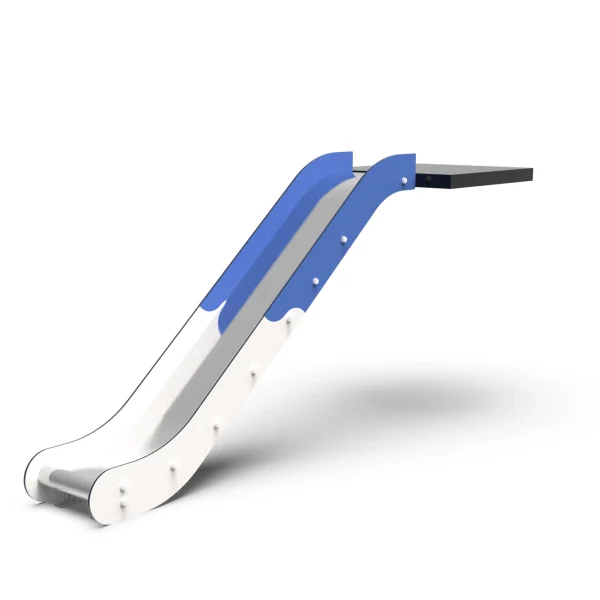
Exit speed changes how hard the child pushes into the banked turn, so platform height cannot be separated from curve design. <Slide Platform Height and Exit Safety Guidelines for Playgrounds> covers how platform height and exit runout interact, which matters when a banked turn ends close to a busy path.
Side Ejection Begins When Banked Turn Geometry Falls Short
A shallow bank angle is the most common problem we find on imported or poorly designed curved slides. With only a few degrees of inward tilt on a tight bend, the surface feels flat to the rider and the side wall becomes the only containment. Once a child’s hip or shoulder contacts that wall, there is no downward slope pulling the body back. The child slides upward and, if the side guard sits below hip height at that point, the risk of ejection rises sharply.
A very steep bank angle creates a different failure. When the slope is too sharp for the speed, the child drops down the bank too early and strikes the inner edge, then rebounds outward. On a curved tube slide where two children may ride close together, that rebound can push one rider into another. The bank angle should match the expected speed range, not simply be set as high as possible.
We also look at the transition zones. A flat entry that suddenly becomes banked can cause a lateral jolt because the child’s body is still upright when the bed tilts. A short transition of 300 mm to 600 mm lets the curve rotate the running surface before the body arrives. The exit needs the opposite treatment. The bank should flatten gradually so the child reaches the runout seated or standing without catching a foot on an angled edge.
Inclination Angle Parameters Predict Safer Curved Slides
Instead of memorizing one angle, we evaluate three numbers together: bank angle, bend radius, and slide width. A wide slide gives a child more room to drift before touching the guard, but it also lets smaller children slide sideways. A tight bend radius demands more banking because the direction change is sharper. The table below summarizes the relationships we use in design review.
| Parameter | Safer range for most curved slides | What happens below range | What happens above range |
| Bank angle inward | 15 to 25 degrees | Rider drifts into side wall | Rider drops toward inner edge |
| Bend radius | At least 1.5 m for tube slides | Sharp lateral jolt at entry | Curve becomes sluggish |
| Exit transition | 300 mm to 600 mm | Rider trips on angled edge | Adds unnecessary length |
| Side guard height | Above hip height in turn | Hip contacts guard | Top edge catches arms |
Bank Angle and Bend Radius Work Together
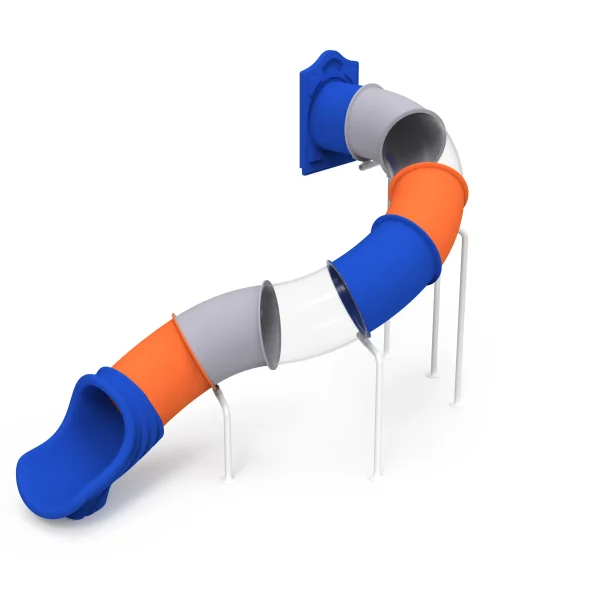
Bank angle responds to bend radius, not to a single rule. If the radius is generous, the rider changes direction slowly and needs less inward tilt. If the radius is tight, the same speed produces stronger outward acceleration, so the bed tilts more. The exact value depends on entry speed, rider size, and whether the slide is open or enclosed. We keep the bank angle under roughly 25 degrees for most children because beyond that the inner edge becomes a tripping point rather than a stable surface.
Exit Runout and Side Guard Height
At the exit, the child should be moving straight ahead, not sideways. The final 600 mm of the run should be flat and aligned with the surrounding safety area. Side guards in the curved section need to be high enough to contain a child when the body is rolled outward, but the top edge should not catch arms or clothing. We inspect the guard height at the point of maximum bank, not at the flatter entry, because that is where containment is actually tested.
If your site uses a bend radius under 1.5 m or places older and younger children on the same curved slide, it is worth confirming the bank angle and side guard height before finalizing the order. Send your layout drawing and intended age range to [email protected] or WhatsApp +8613915684545.
Materials, Fabrication, and Inspection Preserve Banked Turn Safety
The bank angle on the drawing only matters if production holds it and installation keeps it stable. A small change in the bed near the bend can turn a safe curve into an ejection risk months later.
Material Choices Hold the Bank
Rotomolded LLDPE forms the complex curved bed in one piece and holds its shape after repeated use, but it expands and softens under direct heat. Stainless steel beds hold tighter dimensional control and handle heat well, yet they need accurate welding and jig setup to keep the exact tilt through the curve. We check welded or bolted supports at every quarter of the bend because a support that settles by 10 mm can change the bank angle enough to alter the ride.
Fasteners and anchors matter just as much. Outdoor temperature cycles work on steel connection points, and a loose inner support lets the bed flatten gradually. That flattening produces the exact condition that leads to side ejection months after installation. For coastal or high humidity sites, stainless fasteners and isolated contact points between dissimilar metals reduce corrosion that would otherwise loosen the banked turn structure.
The same banked geometry performs differently depending on slide surface material and surface temperature. <Playground Slide Materials LLDPE vs 304 Steel Performance> compares how LLDPE and steel affect friction, speed, and heat behavior on curved runs.
Inspection Checks Catch Early Movement
After installation, the banked turn is the first place we inspect. We look for four changes that usually appear before a visible crack or looseness.
- Place a straightedge across the bed at the midpoint of the curve and compare the tilt to the drawing. More than 2 degrees of flattening points to base movement.
- Pull the side guard inward and outward by hand. If the guard flexes more than 3 mm, check the connection points behind it.
- Watch children entering and exiting under normal use. If a child repeatedly touches the outer wall or comes out sideways, note the speed and age range and share it with the supplier.
- Inspect the transition zones for wear or cracks. These are the highest stress points in plastic components.
A banked turn will not keep its geometry if fasteners loosen or supports settle. <Annual Maintenance Calendar for Outdoor Play Equipment A Guide> covers the seasonal checks that catch those shifts before containment problems appear.
Buyers Should Confirm Curved Slide Banked Turn Safety Before Installation
An ejection injury is rarely caused by one big design mistake. It usually starts with a shallow bank, a side guard set too low, or a support that settles after the first summer. The buyer who only compares slide height and color misses the part of the design that does the real safety work.
The next step is to look at the curved slides in your shortlist and ask the supplier for the bank angle drawing, the side guard height at the midpoint of the bend, and the exit transition dimensions. If the supplier cannot show those values, that is a useful signal about how the slide was engineered. LvDong prepares those details for our curved slide projects and reviews them against the intended age range and fall height before production.
Send your slide layout and the widest age range you expect to [email protected] or WhatsApp +8613915684545. We will check the banked turn geometry and confirm the containment details that match your site, so the curved slide arrives ready for safe use rather than as a problem to fix after installation.
Curved Slide Buyers Ask These Questions Before Ordering
What is the minimum bank angle for a curved slide?
A practical minimum is about 15 degrees of inward tilt on a tight bend, but that number only works when the bend radius and entry speed are known. A slide with a generous radius can be safe with a slightly lower angle. A slide with a tight bend and a tall platform may need more. The best check is to ask the manufacturer for the bank angle at the midpoint of the curve and compare it with the side guard height and the intended age range. One number without the adjoining dimensions tells you very little.
Do tube slides need different bank angles than open slides?
It depends on the tube diameter and sight lines. A fully enclosed tube can tolerate a slightly lower bank angle because the tube wall itself contains the child, while an open slide relies more on the bed tilt and side guard. The trade off is supervision. If the tube is opaque or has a sharp bend, a steeper bank angle keeps the rider seated before the curve disappears from view. A wide open slide may need more tilt because there is more room for the body to drift before anything stops it.
Can a curved slide be safe without side guards?
A common assumption is that side guards are optional if the bank angle is high enough. In practice, guards are a backup rather than the primary containment. The bank should do the main work of keeping the child centered, but the guard catches the unexpected movement that comes from a sudden push, a wet surface, or a child changing posture. Leaving them off may save cost, but it removes the second layer of protection. We would not accept that trade on a public playground with mixed age groups.
How often should banked turns be inspected?
In the playground projects I review, I prefer a visual check during the first month and a quarterly detailed look after that. The first month catches installation settlement before it becomes visible to children. The quarterly check covers fastener tightness, bed alignment, and guard flex. Heavy use sites near schools or theme parks need monthly checks in summer. If the slide sits on sandy or unstable ground, move to monthly checks until the base proves stable. Share your slide configuration and the expected daily user count with [email protected] and we will recommend an inspection schedule that fits your site.
If you’re interested, check out these related articles:
Mastering Age Inclusive Outdoor Play Equipment Solutions
Playground Spring Rider Foundations Expert Installation Guide
Bike Spring Riders Realistic Design Safety Engineering
Custom Playground Slide Design From Vision to 3D Reality
Playground Turntable Safety EN1176 vs ASTM Standards Unpacked