When playground equipment fails, the question is rarely whether a design, manufacturing, or maintenance issue caused the harm. The harder question is who carries the financial and legal weight. For buyers sourcing playground equipment across borders, product liability insurance is one of the most direct signals that a manufacturer stands behind its engineering, materials, and installation support. This guide breaks down the coverage a playground equipment supplier should carry, the certificate language to request, and the safety standards that connect directly to legal exposure.
Why Product Liability Insurance Is Not a Paperwork Detail
Playground equipment creates a specific risk profile. It is designed for children, placed in public or semi-public spaces, and expected to function under repeated dynamic loads. A single fastening failure, weld defect, entrapment point, or material fatigue issue can lead to a serious injury claim months or years after installation. That is why product liability coverage must cover not only the premises where the supplier operates, but also the completed products after they leave the factory.
In the European Union, the Product Liability Directive establishes strict producer liability for defective products, meaning a buyer does not always need to prove negligence to pursue a claim [4]. In the United States, the ASTM F1487-21 standard and the CPSC Public Playground Safety Handbook create the technical benchmarks that insurers, courts, and consultants use when evaluating whether a product was defective or misused [2][3]. These documents do not replace insurance, but they define the failure conditions that trigger claims.
Buyers therefore need to verify that the supplier’s policy is designed for manufactured products used far from the supplier’s own facility. A basic commercial liability policy covering only the supplier’s office or warehouse is not enough.
The Coverage Structure a Strong Supplier Should Maintain
Insurance terminology can be confusing, but the coverage elements relevant to playground equipment buyers are well defined.
Commercial General Liability and Products-Completed Operations
The most important section is products-completed operations coverage. This responds when a completed product causes bodily injury or property damage after it has been delivered, installed, or handed over. For playground slides, spring riders, swings, and multi-user spinners, this is the coverage that matters most.
A supplier should be able to show a commercial general liability form that includes products-completed operations, not only premises liability. The certificate should state the per-occurrence limit and the aggregate limit separately. A buyer should also confirm whether defense costs are included inside or outside those limits [5].
Product Recall or Withdrawal Cover
Product recall coverage is not automatic in many general liability policies. If a supplier discovers a weld specification error or a component hardness problem after shipment, recall or withdrawal cover can pay for notifications, removal, replacement, and associated logistics. Not every small manufacturer carries this, but for large public tenders and multi-site orders, buyers should ask whether recall-related costs are covered or excluded.
Worldwide Jurisdiction and Additional Insured Endorsements
A Chinese supplier selling to a buyer in Dubai, Sydney, or Toronto needs territory language that includes the buyer’s project country. A certificate limited to mainland China will not protect a claim raised in the buyer’s market. The buyer should also be named as an additional insured on the supplier’s policy for the specific project. This gives the buyer direct defense and indemnity access under the supplier’s coverage.
A waiver of subrogation endorsement is equally important. Without it, the supplier’s insurer may pay a claim and then try to recover that money from the buyer, the buyer’s landlord, or the buyer’s installation contractor.
| Coverage element | What it protects | Buyer verification point |
|---|---|---|
| Products-completed operations | Injuries after handover or installation | Confirm aggregate limit is included |
| Additional insured endorsement | Buyer named under supplier policy | Request a copy of the endorsement, not just the certificate |
| Waiver of subrogation | Blocks insurer recovery from buyer | Confirm the waiver is contractually required |
| Worldwide territory | Claims in the project country | Match territory wording to final site |
| Product recall or withdrawal | Notification, removal, replacement costs | Ask if excluded or sub-limited |
What Minimum Limits Are Commonly Requested
Coverage limits vary by project type, country, and the buyer’s own risk policy. Many municipal tenders and commercial property operators in North America set a common threshold of at least USD 1 million per occurrence and USD 2 million in aggregate for products-completed operations. In some private hotel, school, and airport projects, buyers request USD 5 million or more because of public exposure.
These amounts should not be treated as universal legal requirements. They are procurement norms that reflect the severity of a serious child injury claim. The correct approach is to match the insurance requirement to the project’s risk profile, the contract value, and the buyer’s own insurance advisor.
Regional Safety Standards That Trigger Liability
Insurance and standards work together. A manufacturer that cannot demonstrate compliance with the relevant standard for the project region creates an avoidable coverage problem.
In Europe, EN 1176-1 through EN 1176-7 set safety requirements and test methods for playground equipment and surfacing [1]. In the United States, ASTM F1487-21 is the primary public-use standard, while the CPSC Public Playground Safety Handbook provides inspection, layout, entrapment, and fall-height guidance [2][3]. Saudi Arabia, Australia, and Canada have additional local certification and documentation layers, but EN 1176 and ASTM F1487 remain common technical reference points.
When a claim occurs, the insurer will usually look for evidence of design review, material traceability, manufacturing records, and installation guidance. A supplier that produces equipment to EN 1176 and GB/T 34272-2017, and that can show test reports, is in a much stronger position than one that treats compliance as a marketing phrase.
Insurance verification belongs inside a broader factory and documentation review. <Evaluate Commercial Playground Manufacturers 8 Critical Selection Factors> covers the non-insurance checks that keep high-risk sourcing decisions manageable.
Verifying a Certificate of Insurance
A certificate of insurance is only a summary. It is not the actual policy, and it does not guarantee that a specific endorsement has been issued. Buyers should ask for the following:
- The policy number and insurer name.
- The named insured matching the supplier’s legal manufacturing entity.
- Products-completed operations aggregate visible on the certificate.
- Per-occurrence and aggregate limits in the currency relevant to the project.
- Additional insured wording or a copy of the endorsement.
- Waiver of subrogation endorsement.
- Worldwide territory or the specific project country listed.
- Policy period that covers manufacturing, shipment, installation, and a reasonable completed-operations tail.
- A cancellation notice commitment, commonly 30 or 60 days.
A supplier that cannot or will not provide these items may still have a valid policy, but the buyer cannot rely on it for project-specific protection.
If you are preparing a tender and need to align certificate wording with the buyer’s contract, our engineering team can review the insurance language together with the equipment specification. Direct inquiries: [email protected] or WhatsApp +86 13915684545.
Five Supplier Insurance Questions That Expose Hidden Gaps
- Does the policy cover products-completed operations outside your home country? If not, the buyer may be unprotected after delivery.
- Can the buyer be added as an additional insured for this specific project? The answer should be yes for most commercial playground orders.
- Who pays defense costs? A policy where defense costs reduce the available limit creates a smaller pot for the actual injury claim.
- Is product recall coverage included or available by endorsement? For multi-site school or franchise projects, this is worth confirming.
- Does the insurer have the right to cancel without notifying the buyer? Buyers should require cancellation notice language tied to the contract.
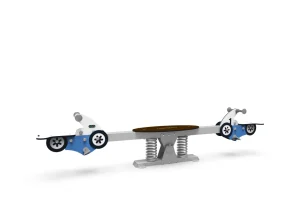
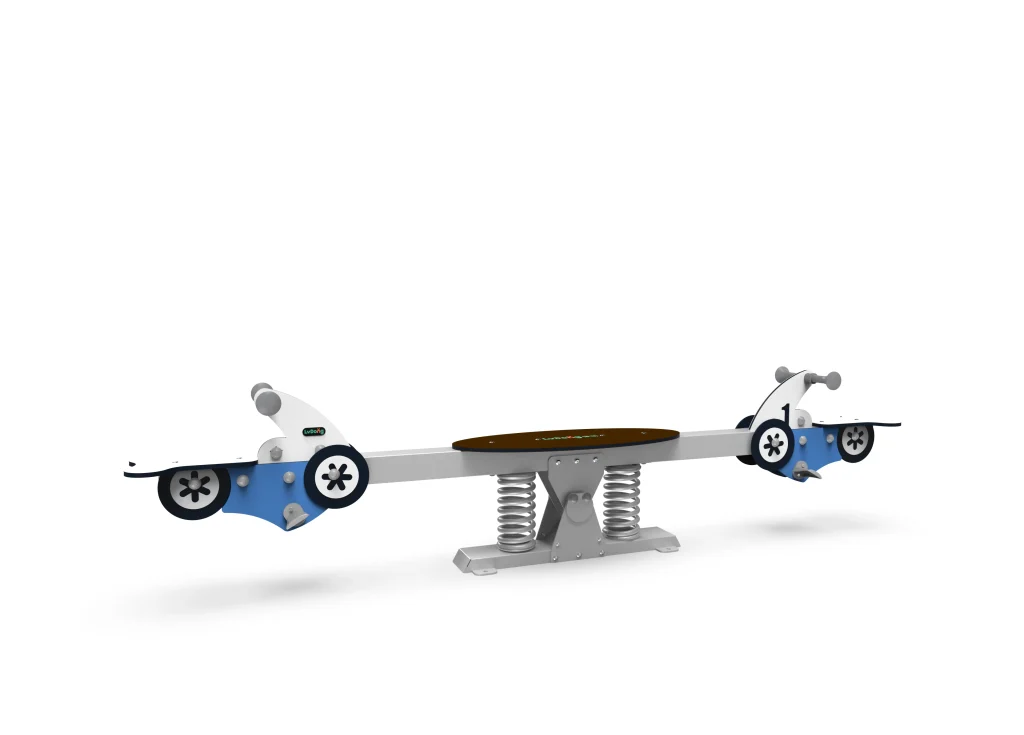
A spring rider is a useful example of a component where a weld, seat, or handgrip defect can create a contained but serious exposure. <Bike Spring Riders Realistic Design Safety Engineering> covers the design and safety details that shape that liability picture.
Documentation Beyond the Certificate
The insurance certificate should sit alongside a larger safety file. Buyers should keep test reports, material certificates, installation manuals, inspection checklists, and maintenance logs in one project record. If a claim arises years after installation, the ability to show that the supplier followed EN 1176 or ASTM F1487 design criteria, and that the operator followed the manual, becomes critical.
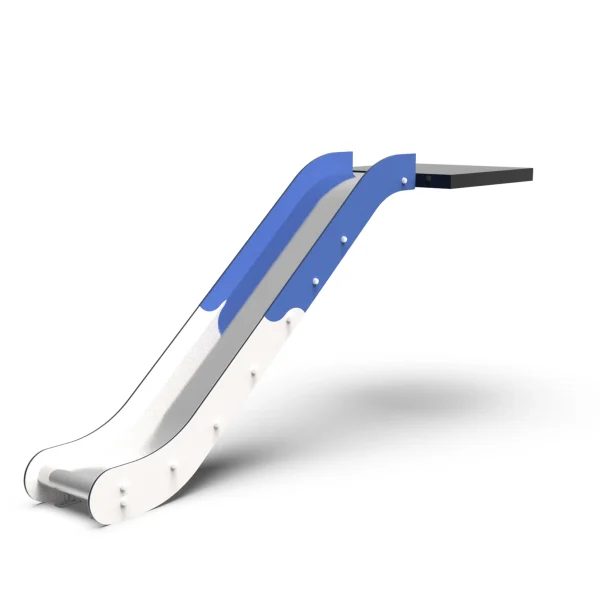
Maintenance also changes the liability picture. A well-documented replacement schedule for chains, bearings, springs, and fasteners can show whether a failure came from normal wear or from a manufacturing defect.
After a claim occurs, parts history and replacement discipline often determine whether the manufacturer or the operator absorbs the cost. <Replacing Chains Bearings Springs Lifespan Guide Strategies> covers the maintenance side of that risk equation.
Plan Your Coverage Review With a Playground Equipment Specialist
Suzhou LvDong Amusement Equipment Co., Ltd. supports buyers in aligning equipment specifications, safety documentation, and insurance requirements before orders are confirmed. Our project team can help you match EN 1176, ASTM F1487, or project-specific standards to the coverage language your client or insurer requires.
Contact Suzhou LvDong Amusement Equipment Co., Ltd.
- WhatsApp: +86 13915684545
- Email: [email protected]
Frequently Asked Questions
Does EN 1176 compliance replace product liability insurance?
No. Compliance with EN 1176 or ASTM F1487 helps demonstrate that the equipment met recognized safety criteria, but it does not pay for legal defense, settlements, recalls, or business interruption after a claim. Insurance answers the financial exposure; standards answer the technical and legal benchmark.
Should the buyer be named as an additional insured on the supplier’s policy?
Yes, for project-based purchases this is a standard and reasonable request. Additional insured status gives the buyer direct access to the supplier’s coverage for claims arising from the supplier’s product. Ask for the actual endorsement, not only a certificate line.
What coverage is missing from a basic manufacturer’s certificate?
A basic certificate may show only premises liability or a narrow products limit. Buyers should verify products-completed operations, aggregate limits, worldwide territory, additional insured wording, waiver of subrogation, and any recall or withdrawal endorsement. The certificate is only a summary and does not amend the real policy.
Does product liability insurance cover shipping damage or installation errors?
Not automatically. Product liability coverage responds to bodily injury or property damage caused by the product, but cargo damage and installation mistakes are separate risk areas. Buyers should arrange marine cargo insurance for transit and confirm that installation is covered by the installer’s own liability policy or the supplier’s contract.
How long should completed operations coverage remain in force?
The policy should cover the period in which the product is in use. Because playground equipment can remain in service for many years, buyers should confirm that the supplier maintains completed operations cover beyond the immediate shipment date. Some tender contracts require the supplier to carry cover for a defined tail period or until project handover is complete.
Can a Chinese supplier’s policy protect a US or EU project?
Only if the policy territory includes the project country and the insurer is able to respond there. A mainland China-only policy will not effectively protect a claim brought in the buyer’s jurisdiction. Buyers should request worldwide territory or project-country-specific wording before signing.
References
[1] EN 1176-1:2017, Playground equipment and surfacing — Part 1: General safety requirements and test methods, European Committee for Standardization.
[2] ASTM F1487-21, Standard Consumer Safety Performance Specification for Playground Equipment for Public Use, ASTM International.
[3] U.S. Consumer Product Safety Commission, Public Playground Safety Handbook, Publication No. 325.
[4] Council Directive 85/374/EEC concerning liability for defective products, European Union.
[5] Insurance Services Office, Commercial General Liability Coverage Form CG 00 01, products-completed operations and additional insured provisions.
If you’re interested, check out these related articles:
Unlocking Developmental Growth Combining Outdoor Slides Playhouses
Spinning Playground Equipment Age Suitability and Safety Standards