For eco-resort developers, a playground is a small line item with an oversized visibility problem. Guests who book a low-impact lodge notice immediately whether the children’s area matches the resort’s sustainability promise, and procurement teams that ignore material and carbon documentation inherit risk long after the opening ceremony. A defensible eco-resort playground strategy comes down to two verifiable decisions: where materials come from and how manufacturing carbon is measured, disclosed, and reduced. If you are preparing a supplier shortlist for a new resort playground or reviewing an existing range, use the verification criteria in the material and documentation sections below as the screening baseline.
Why Eco-Resorts Need a Different Playground Sourcing Standard
Conventional playground procurement optimizes for three variables: purchase price, delivery lead time, and safety certification. An eco-resort procurement has to add two more without weakening the first three: embodied carbon and material origin. Embodied carbon is the greenhouse gas released during raw material extraction, component processing, manufacturing, and transport to the site. Local material sourcing means favoring materials whose extraction and primary processing occur within a practical regional distance, which reduces transport emissions and makes supply-chain claims easier to audit.
The trap for buyers is that both terms are widely used and loosely defined. A supplier can describe powder-coated steel as eco-friendly without disclosing where the steel was rolled or how the coating plant manages energy. That is why the next section treats carbon-neutral manufacturing as a measurement process rather than a marketing phrase.
What “Carbon-Neutral Manufacturing” Actually Requires
For playground equipment, a credible carbon-neutral claim starts with a product carbon footprint calculated across a defined boundary. ISO 14067 provides the requirements and guidelines for quantifying the carbon footprint of products [1]. The GHG Protocol Product Life Cycle Accounting and Reporting Standard sets out how to allocate emissions across materials, production, and logistics stages [2]. PAS 2050 offers a widely recognized method for assessing life-cycle greenhouse gas emissions of goods and services [3]. Under these frameworks, carbon neutral does not mean zero emissions from the factory; it means the measured footprint is reduced where possible and the remaining balance is addressed through verified offset or inset programs with transparent documentation.
For a buyer, the practical test is whether the supplier can produce a footprint report that states the boundary, the allocation method, the data sources, and the verification status. A one-page certificate that says carbon neutral without a stated boundary and calculation method does not meet the documentation standard above. When a resort operator asks for this document before shortlisting, weak claims usually fall away quickly.
Local Material Sourcing and Material Comparison
Local sourcing is not simply about finding the nearest supplier. A material that ships a short distance but fails after four years in a humid coastal environment can carry a higher life-cycle carbon burden than a more durable material shipped from farther away. The table below compares the materials most commonly specified for resort playgrounds across local sourcing potential and durability in demanding environments.
| Material | Typical Application | Local Sourcing Potential | Coastal / Humid Durability |
|---|---|---|---|
| Hot-dip galvanized steel | Frames, posts, swing supports | High — regional steel processors | High when zinc coating is correctly specified |
| 304 stainless steel | Fasteners, slide beds, coastal hardware | Moderate — depends on regional supply | Very high — strong chloride resistance |
| LLDPE | Slide decks, rider seats, activity panels | Moderate — depends on polymer availability | High — UV-stabilized grades resist fading and cracking |
| FSC-certified hardwood | Decks, natural play elements | High — regional certified forests | Moderate — requires treatment; salt air accelerates surface wear |
| Recycled HDPE | Panels, edging, decking | High — regional recycling streams | High — low moisture absorption, no rot |
FSC certification is the most direct way to confirm that wood comes from responsibly managed forests [4]. For any material, the sourcing claim should be linked to a named processor or certified supply chain rather than a general statement of origin.
Material choice determines both local sourcing potential and service life. <Playground Slide Materials LLDPE vs 304 Steel Performance> covers how LLDPE and 304 stainless steel compare under UV exposure, corrosion, and long-term maintenance demands.
Verification Documents Eco-Resort Buyers Should Request
The most effective way to separate credible suppliers from green marketing is to request a short list of documents before tender. The table below groups the documents by what they verify and why they matter for an eco-resort.
| Document / Certification | What It Verifies | Relevance to Eco-Resorts |
|---|---|---|
| Product Carbon Footprint Report | Life-cycle GHG emissions by production stage | Confirms scope of a carbon-neutral claim |
| Environmental Product Declaration (EPD) | Independently verified life-cycle impact data | Allows like-for-like comparison [5] |
| REACH declaration | Restricted substances compliance | Child-contact chemical safety [6] |
| FSC Chain of Custody | Certified wood traceability | Confirms sustainable forest origin [4] |
| Nordic Swan / EU Ecolabel criteria | Product-group sustainability requirements | Third-party eco-label evidence [7] |
| LEED material disclosure | Recycled content, regional materials, low-emitting | Supports resort green-building credits [8] |
| EN 1176 certificate | Playground safety compliance | Mandatory safety baseline [9] |
Requesting all seven at once is reasonable only for large tenders. For smaller orders, the two highest-value documents are the carbon footprint report and the EN 1176 certificate, because they cover the resort’s two most exposed positions: sustainability claims and child safety. The EPD follows, because it converts marketing language into comparable numbers. ISO 14025 defines the principles for these Type III environmental declarations [5]. REACH sits apart from green claims and is closer to a safety obligation, but resorts in the EU should treat it as a hygiene factor rather than a differentiator [6].
Equipment Selection, Maintenance, and Life-Cycle Carbon
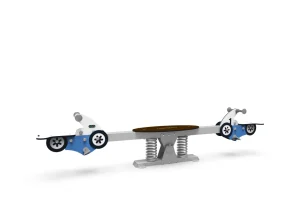
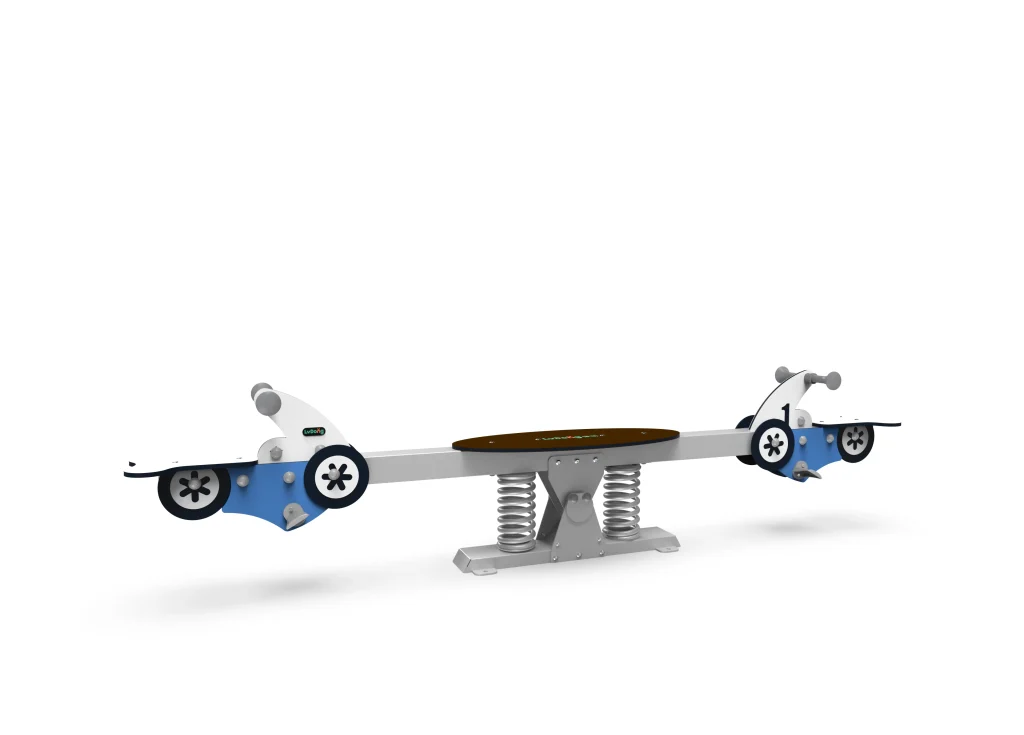
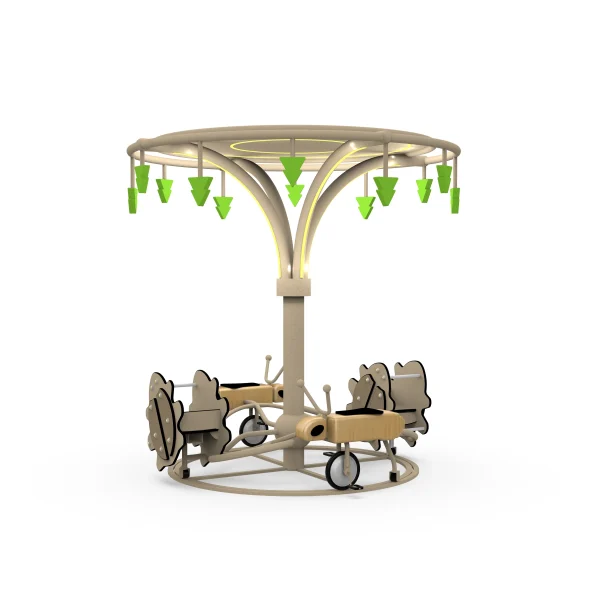
Unpowered playground equipment already aligns well with a low-carbon resort program because it consumes no electricity in daily operation. Within that category, material efficiency matters: a multi-user seesaw or spinner that supports several children at once uses fewer kilograms of steel and less surfacing area per play opportunity than a row of single-user units. For example, a multi-person seesaw designed for 2–10 children with a maximum fall height of 60 cm delivers group play within a compact footprint, reducing both material demand and site preparation work. This is one reason resorts with constrained footprints often specify multi-user units rather than rows of solo riders.
Equipment selection also affects how much material is committed to the project. <Pre Configured vs Custom Designed Playground Play Sets A Strategic Guide> covers when a custom layout genuinely reduces material waste and when a standardized module set is the lower-carbon choice.
Maintenance is the quieter half of the carbon equation. Life-cycle carbon includes every replacement part, repaint, and full-unit swap over the service life. A galvanized frame that is inspected and re-coated on schedule avoids the embodied carbon of an early replacement. In coastal resorts, salt mist accelerates corrosion; in forest resorts, high humidity and organic debris do similar work on unprotected edges. The operational habit matters as much as the original material spec.
Carbon accounting that stops at the factory gate misses the operational phase. <Annual Maintenance Calendar for Outdoor Play Equipment A Guide> covers the seasonal inspection and care routines that extend equipment life in humid, coastal, and high-UV resort environments.

For a technical carbon calculation or material comparison tied to a specific site, send your layout requirements and climate data to [email protected] for a documentation review before tender.
Plan Your Eco-Resort Playground
Eco-resort playground procurement is a documentation exercise as much as a product decision. Suzhou LvDong Amusement Equipment Co., Ltd. manufactures unpowered playground equipment against EN 1176 and GB/T 34272-2017, including multi-user spinners, spring riders, and seesaws suitable for high-humidity and coastal resort settings. For a carbon documentation review, material specification, or tender support, contact the team at [email protected] or on WhatsApp at +8613915684545.
Frequently Asked Questions
What does carbon-neutral manufacturing actually mean for playground equipment?
It means the supplier has measured the product’s life-cycle greenhouse gas emissions within a stated boundary, typically using ISO 14067, PAS 2050, or the GHG Protocol Product Standard, and has documented how remaining emissions are offset or reduced [1][3][2]. A credible claim always comes with a report, not just a label.
Which material is best for a coastal eco-resort playground?
For metal frames and hardware, 304 stainless steel offers the strongest corrosion resistance in salt-laden air, while hot-dip galvanized steel is a more economical choice when the zinc coating is specified correctly. For plastic components, UV-stabilized LLDPE and recycled HDPE resist moisture and fading well. The right choice balances local availability and intended service life rather than any single material being universally best.
How can I verify that a supplier’s local sourcing claim is real?
Ask for the name and location of the processing facility for the main structural material, and cross-check whether wood carries FSC Chain of Custody documentation [4]. A geographic statement without a named facility or certified supply chain is not verifiable.
Do I need a separate carbon footprint report if the resort already has a sustainability certification?
Yes, if carbon neutrality is being claimed for the playground itself. Resort-level certifications such as LEED cover building and site performance, but a product-level claim still requires a product carbon footprint report or an Environmental Product Declaration [5][8].
Does choosing unpowered playground equipment improve a resort’s carbon position?
Unpowered equipment avoids daily electricity consumption and supports a lower operational carbon profile, but the bigger life-cycle factor is durability. A unit that serves for many years without major part replacement avoids the embodied carbon of early remanufacturing, so specification quality and maintenance discipline matter more than the absence of electronics alone.
References
[1] International Organization for Standardization, “ISO 14067:2018 Greenhouse gases — Carbon footprint of products — Requirements and guidelines for quantification,” ISO, Geneva, Switzerland, 2018.
[2] World Resources Institute and World Business Council for Sustainable Development, “Product Life Cycle Accounting and Reporting Standard,” GHG Protocol, Washington, DC, 2011.
[3] British Standards Institution, “PAS 2050:2011 Specification for the assessment of the life cycle greenhouse gas emissions of goods and services,” BSI, London, U.K., 2011.
[4] Forest Stewardship Council, “FSC-STD-40-004 Chain of Custody Certification,” FSC, Bonn, Germany.
[5] International Organization for Standardization, “ISO 14025:2006 Environmental labels and declarations — Type III environmental declarations — Principles and procedures,” ISO, Geneva, Switzerland, 2006.
[6] European Parliament and Council, “Regulation (EC) No 1907/2006 concerning the Registration, Evaluation, Authorisation and Restriction of Chemicals (REACH),” Official Journal of the European Union, 2006.
[7] Nordic Ecolabelling Board, “Nordic Swan Ecolabel criteria for playground equipment,” Nordic Ecolabelling, Stockholm, Sweden.
[8] U.S. Green Building Council, “LEED v4.1 Building Design and Construction,” USGBC, Washington, DC.
[9] European Committee for Standardization, “EN 1176-1:2017 Playground equipment and surfacing — Part 1: General safety requirements and test methods,” CEN, Brussels, Belgium, 2017.
If you’re interested, check out these related articles:
Slide Platform Height and Exit Safety Guidelines for Playgrounds
Single vs Double Seat Playground Horse Spring Riders A Comparison
Evaluate Commercial Playground Manufacturers 8 Critical Selection Factors
Selecting Commercial Playground Manufacturers A Step by Step Guide