A space center visitor complex is not a standard community playground. The site brand already carries strong visual expectations: clean metallics, deep blues, capsule-like forms, launch imagery, and a sense of controlled motion. When the play zone echoes that language, it feels like part of the visitor journey rather than a disconnected afterthought. When it does not, even well-built equipment can read as generic and off-brand.
For buyers, the goal is not to bolt rocket graphics onto ordinary slides and call the job done. The most credible space-themed play areas translate aerospace concepts into equipment form, material, movement, and spatial rhythm while keeping every component compliant with public playground safety standards. That balance is what this guide explains.
The Role of Theming in a Space Center Visitor Complex
Space center visitor complexes serve mixed audiences: school groups, families with young children, international visitors, and guests who may spend only part of the day in the play area. The play zone therefore operates as a short-duration experience, a soft transition between exhibits, and a brand statement all at once. That is a different operational profile from a neighborhood park where the same children return daily.
Strong theming does several practical jobs. It visually connects the play area to the larger aerospace campus. It gives children a narrative to enter: mission control, launch countdown, orbital spin, capsule climb, or lunar surface crossing. It also supports wayfinding and helps parents understand what each play component offers before their child uses it. This is not decorative excess; it is a form of visitor communication.
The best aerospace-themed playgrounds are designed as a sequence rather than a cluster of themed objects. A child might start at a ground-level mission panel, move to a low-height spring unit that mimics a pre-launch vibration, then climb a structured tower that reads as a launch pad. That sequencing creates a calm, orderly circulation pattern, which matters in high-traffic visitor settings.
Matching Equipment Forms to Aerospace Visual Language
Aerospace branding favors streamlined curves, capsule silhouettes, grid structures, and exposed hardware that looks engineered rather than fanciful. Play equipment that follows those cues will almost always fit the site better than equipment with unrelated animal or cartoon motifs.
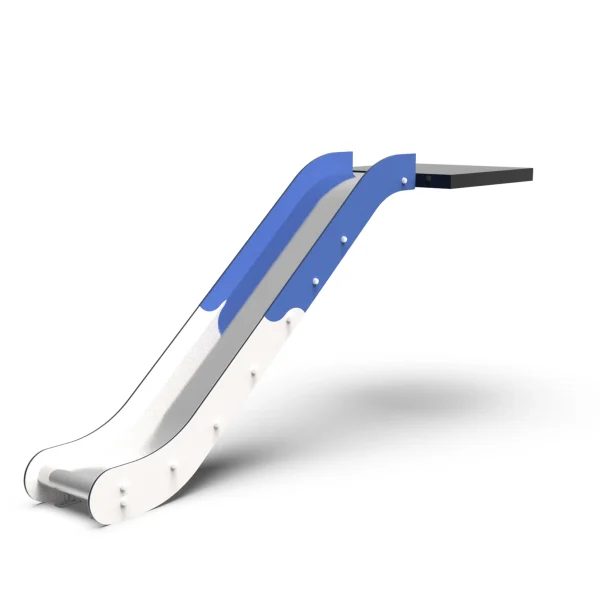
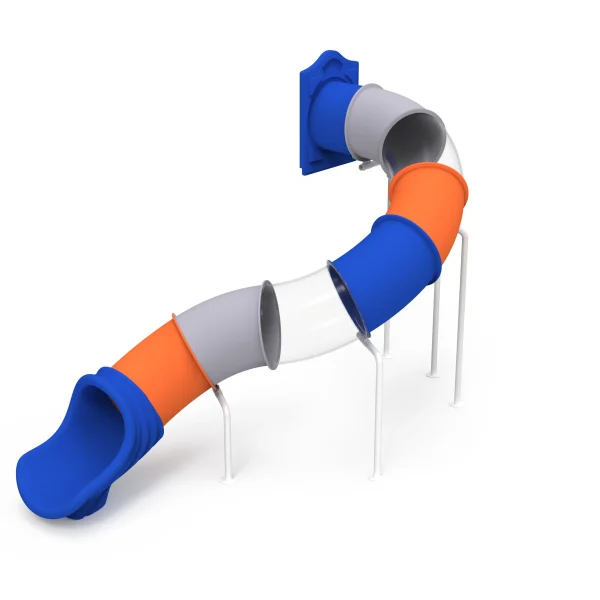
Enclosed tube slides are one of the most direct fits for space themes. A curved tunnel slide with a polycarbonate viewing band can suggest a crew transfer tube or a capsule window. The enclosed form also reduces visual clutter in a public plaza and contains movement in a predictable exit path. For larger installations, a two-level structure with a curved slide and a climbing transition can function as the visual anchor of the play zone.
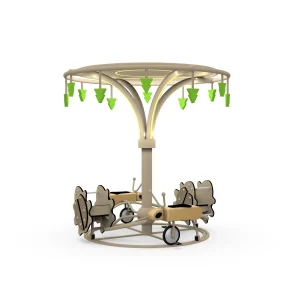
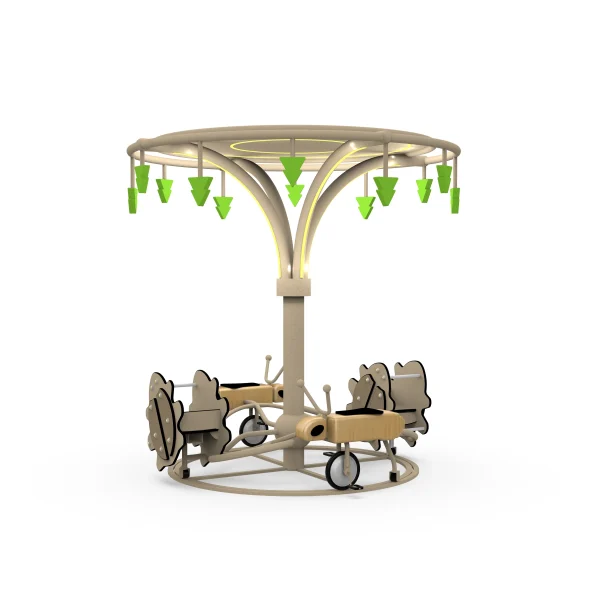
Multi-player spinning equipment translates naturally into orbital or centrifuge language. A round spinner with a central mast and handhold nodes gives children the sensation of controlled rotation, similar in feeling to a training module or orbital hub. When the finish is neutral silver with deep blue or graphite accents, the unit reads as equipment rather than a carnival ride. This supports the brand tone of a space center, where playful is good but chaotic is off-message.
Ground-level play panels are equally important for younger visitors and for inclusive play. A panel grid can be configured like a flight deck, star map, or maintenance interface. Tactile, visual, and low-sound interactive features work well in this context because they create short engagement cycles without requiring a queue. Aerospace-themed panels also allow a visitor complex to include educational content about planets, orbits, or mission roles without adding fragile electronics to every surface.
Themed panel arrays need the same material and anchoring discipline as any other public play surface. <Playground Play Panels Material Selection and Secure Installation> covers material selection and secure installation for long-lasting public displays.
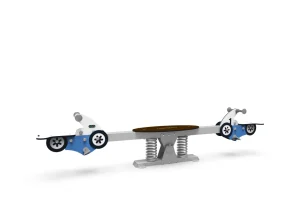
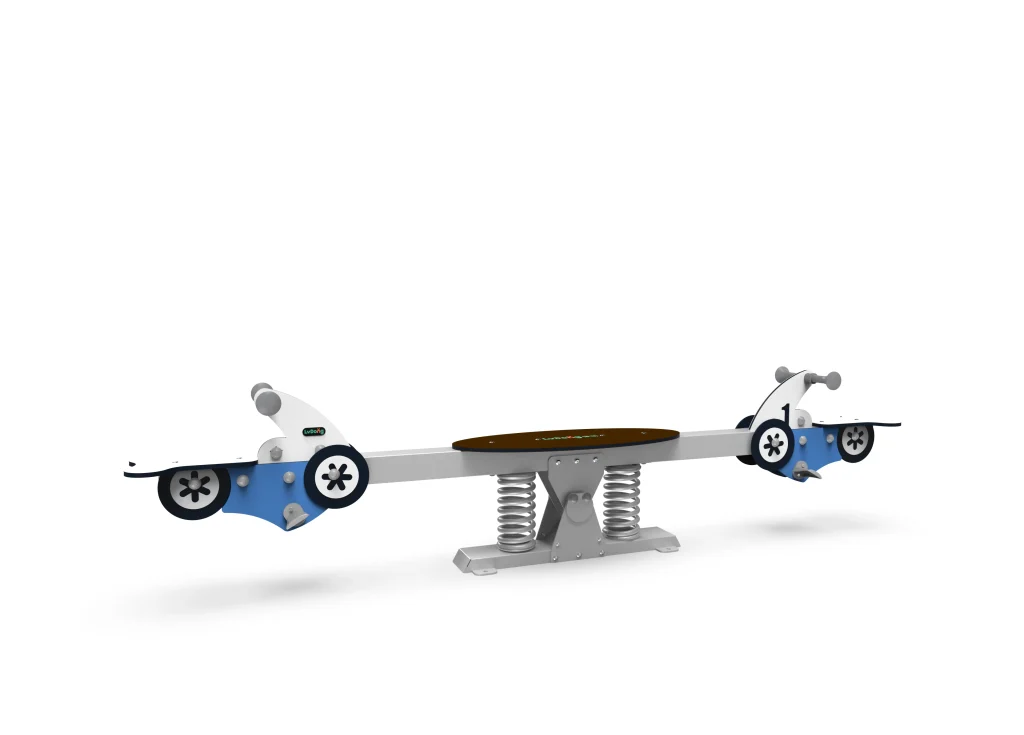
Spring riders can be styled as small launch capsules, rover units, or pre-flight training seats. Because they occupy a compact footprint and have a low fall height, they are useful near queuing areas or as a transition device between a toddler zone and older-child equipment. The key is restraint: one or two well-designed capsule forms work better than a row of mismatched riders competing for attention.
Material and Finish Choices That Reinforce the Brand Without Compromising Safety
Aerospace branding often pushes toward high-gloss panels, bright LED effects, and mirror-like surfaces. Playground equipment has different constraints. Surfaces that look premium in a photographer’s render can become hot, slick, or high-glare in direct sun, especially in visitor complexes with large open plazas.
The safer approach is to work with matte or satin powder-coated metals in graphite, titanium gray, deep blue, and off-white, with a restrained accent color such as safety orange or mission red. These tones support the aerospace identity without creating mirrored glare or excessive heat absorption. Rotomolded plastic components should be UV-stabilized and selected in colors that do not fade unevenly after a single high-sun season.
For high-traffic coastal or humid sites, stainless steel hardware and sealed bearings reduce the maintenance burden. Where steel substructures are specified, hot-dip galvanizing followed by a durable powder coat gives the best balance between hidden corrosion resistance and outward finish quality. The themed skin should never hide a weaker substructure; it should be specified and documented as part of the same safety system.
Space center visitor complexes often have architecture with strong horizontal lines, curved canopies, and technical material palettes. Playground posts, decks, and climbing grids can match that language by using consistent color blocking and minimal decorative overlay. A subdued visual system tends to age better than high-contrast graphic wraps, especially on equipment that receives thousands of contact cycles each month.
Safety Standards and High-Traffic Operations for Themed Equipment
Theming is not a substitute for compliance. In the United States, public playground equipment should meet CPSC guidance [1] and, where specified, ASTM F1487-21 performance requirements for public use [2]. In European and many international markets, EN 1176-1 serves as the core safety reference for equipment and surrounding surfacing [3]. These apply just as fully to a space-themed spinner as to a generic community swing set.
Fall height, head and neck entrapment, moving-part clearances, and impact attenuation under and around equipment all remain primary. The most visually successful space theme can create hidden problems if a themed enclosure reduces the tunnel diameter below entrapment limits or if a decorative fin introduces a sharp edge or catch point. Procurement teams should request compliance documentation for the actual configured unit, not only for a base product family.
Visitor complexes also operate differently from local parks. A surge of school groups may place several hundred children into the play area over a short window. Equipment should therefore be selected for short play cycles, clear entry and exit paths, and low queue dependence. Spinners with multiple handhold positions, multiple spring riders, and panel arrays with several stations all help spread user load without reducing engagement.
Accessibility should be considered at the same time as theming. Ground-level panels, transfer points, and wheelchair-accessible surfacing support inclusive use under ADA accessibility standards [4]. In many successful installations, the most heavily used inclusive components are not segregated into a separate “accessible corner” but integrated into the main play sequence so that all children can enter the same narrative loop.
High-traffic themed playgrounds need routine checks that go beyond visual inspection. <Playground Equipment Safety Your Essential Self Inspection Checklist> covers self-inspection routines for fast-moving visitor environments.
If you are evaluating themed spinners, panels, or slides for a space center visitor complex, request a standards-compliance sheet and a sample finish panel before production. For direct guidance on matching the equipment set to your site and expected visitor numbers, send the site plan, target age range, and brand reference images to [email protected] and ask for a technical review.
Procurement and Customization for Aerospace-Branded Installations
Custom aerospace theming can be approached in two ways. The first is to select proven modular equipment with brand-compatible finishes and limited custom panels. This path usually shortens lead time and lowers cost while still producing a coherent site identity. The second is to commission a fully custom design with shaped cladding, themed decks, and bespoke color mapping. That path offers more distinct branding but requires a longer design review and stronger factory coordination.
Before committing to custom work, buyers should verify that the manufacturer can provide 3D models, structural calculations, and production samples for the proposed theme layer. The design should be reviewed for cleanability, hardware access, panel replacement, and repairability after high-use operation. A space theme that looks sharp at opening but cannot be maintained will quickly become a liability.
Long-term cost depends heavily on component replacement planning. <Replacing Chains Bearings Springs Lifespan Guide Strategies> covers replacement intervals and strategies for high-cycle playground components.
For international projects, the procurement discussion should include installation support, spare-part kits, and whether the themed elements are factory-fitted or field-assembled. Factory-fitted panels and welded subassemblies tend to be more consistent than complex graphics applied on site. This is especially true in visitor complexes where installation downtime must be minimized around operating hours.
Work With a Playground Manufacturer That Understands Themed Visitor Complexes
Suzhou LvDong Amusement Equipment Co., Ltd. designs and manufactures unpowered playground equipment for kindergarten, municipal, cultural tourism, and themed visitor settings. The team works with buyers to connect site branding, target age ranges, safety standards, and high-traffic operational needs into a single equipment plan.
For a space center visitor complex, the most useful first step is a technical review built around four points:
- Overall site dimensions and available play-zone footprint
- Target age range and expected peak visitor volume
- Brand reference images or interior/exterior architecture finishes
- Required standards, such as ASTM F1487, EN 1176, or local equivalents
Contact the team by WhatsApp at +86 13915684545 or by email at [email protected] to request a review, sample finish confirmation, or preliminary equipment layout.
Frequently Asked Questions
What equipment works best for a space center visitor complex?
The most effective combinations usually include a curved or tunnel slide as the visual anchor, one multi-player spinner as the social and physical centerpiece, several ground-level interactive panels for younger and inclusive use, and a small number of themed spring riders for low-height motion play. This mix spreads user load and keeps the play sequence moving.
How do you keep aerospace theming from looking like a cheap rocket replica?
Avoid literal rocket illustrations and oversized character features. Use restrained aerospace colors, capsule-like forms, technical grid patterns, and clear motion-based play narratives. A slide can feel like a transfer tube, a spinner can feel like an orbital module, and a panel can feel like a flight deck without any single object turning into a cartoon prop.
Are themed playground structures still required to meet EN 1176 and ASTM F1487?
Yes. Theming does not exempt equipment from structural, entrapment, fall-height, or impact-attenuation requirements. Compliance must be confirmed for the actual configured unit, including themed enclosures, cutouts, cladding, and attached graphics. A fully custom theme layer should be reviewed for sharp edges, catch points, and access to maintainable components.
How long does a custom space-themed playground take from sketch to installation?
A restrained custom theme based on proven modular equipment may move from sketch and approvals to production in a shorter window than a fully bespoke themed structure. Fully custom shaped cladding, themed decks, and complex panel graphics add design review, prototyping, and factory coordination time. The realistic schedule should be confirmed after the scope, finishes, and required certifications are fixed.
References
[1] U.S. Consumer Product Safety Commission, “Public Playground Safety Handbook,” Publication No. 325. https://www.cpsc.gov/s3fs-public/325.pdf
[2] ASTM International, “ASTM F1487-21 Standard Consumer Safety Performance Specification for Playground Equipment for Public Use.” https://www.astm.org/f1487-21.html
[3] European Committee for Standardization, “EN 1176-1:2017 Playground equipment and surfacing — Part 1: General safety requirements and test methods.” https://standards.cencenelec.eu/
[4] U.S. Access Board, “ADA Accessibility Standards.” https://www.access-board.gov/ada/
If you’re interested, check out these related articles:
Effectively Compare Playground Equipment Suppliers Services
Outdoor Childrens Slides Age Grading 2-5 Versus 5-12
Playset Ground Leveling and Drainage Solutions for Outdoor Slides
Outdoor Playground Set Layout Strategic Design for Optimal Play
Playground Equipment Quotes Spotting Hidden Costs Explained