Play spaces in conflict-affected and high-threat environments require a difficult balance: maintain normal developmental value while reducing fragment, blast, and structural-collapse risks. Baseline safety standards such as EN 1176-1 [1] and ASTM F1487 [2] do not define blast loads; they set the structural, impact-attenuation, and entrapment requirements that any playground must still meet. A conflict-zone play-area specification therefore starts with those requirements and adds site-specific hardening, standoff planning, and material selection — not a claim of complete protection.
Reading the Threat: Blast and Fragment Risks in Play Areas
Conflict-zone play areas face multiple hazard paths: direct blast pressure, primary fragmentation, secondary debris, and structural collapse of equipment or adjacent elements. Most playground injuries in such settings are not caused by hardened military targets; they come from ordinary playground components that become projectiles or obstacles when surrounding site features are damaged. For this reason, the most defensible technical response is not a “bombproof” product label. It is a layered design approach that keeps normal playground safety functions intact while reducing how much debris the space produces and how far fragmenting materials travel.
Threat-based design literature such as the U.S. Department of Defense minimum antiterrorism standards treats standoff distance as the primary protective measure [3]. FEMA’s primer for safe school design extends similar site-security logic to facilities occupied by children [4]. For playgrounds, this translates into three priorities: keep people away from the most exposed lines of sight where site conditions allow; use ductile or fragment-mitigating materials rather than brittle components; and anchor structures so they resist overturning and progressive failure.
Blast-Resistant Foundation Principles for Playground Equipment
Foundation selection changes how a play structure behaves when the ground experiences shock or nearby structures fail. A surface-mounted spring rider or spinner anchored with short bolts can become a moving hazard if the supporting pad cracks or an adjacent wall falls against the equipment. A deep, continuously reinforced concrete footing with embedded anchor plates is generally more stable because it ties the equipment into the ground plane and reduces the likelihood of overturning or lateral displacement.
Specifications for high-risk settings should require:
- Continuous concrete elements rather than isolated pads for multi-post structures.
- Anchor bolts embedded at sufficient depth to resist uplift and shear, with stainless steel in corrosive or post-disaster environments.
- Detail drawings showing rebar placement, edge distance, and connection points.
- Verification of soil bearing capacity before equipment is approved for installation.
- A documented repair path for partial foundation damage so play areas can return to service quickly.
Foundation anchor embedment, soil compaction, and supplier-managed installation all influence how well a play structure survives abnormal lateral loads. <DIY vs Supplier Playground Equipment Installation Guide> covers when supplier-managed installation reduces long-term structural risk.
Shrapnel-Resistant Material Selection: What to Specify
The term “shrapnel-proof” is best understood as a risk-reduction target, not an absolute material property. Brittle materials such as unreinforced castings, ordinary annealed glass, and thin ceramic panels can produce fast-moving sharp fragments. More suitable components use ductile metals, laminated or polycarbonate transparent elements, and high-toughness polymers that deform rather than shatter.
For playground equipment in conflict-affected settings, material specifications should address:
| Component | Blast-related consideration | Procurement note |
|---|---|---|
| Steel frame and posts | Ductile failure behavior after overload; requires corrosion protection | Specify minimum yield strength and hot-dip galvanizing or appropriate duplex coating |
| Anchors and fasteners | Uplift, shear, and crevice corrosion after damage | Use stainless steel grade A4/316 or better where moisture or coastal exposure is expected |
| Rotational-molded plastic panels | Impact absorption without brittle fracture; UV aging control | Request UV-stabilization data and avoid recycled-content levels that reduce toughness |
| Transparent viewing sections | Sharp fragment projection if glass fails | Specify laminated or polycarbonate systems and reference relevant arena blast tests such as ISO 16933 [5] |
| Impact surfacing | Falls still matter after a blast event; blast debris may become embedded | Include drainage, cleanability, and replacement access in the specification |
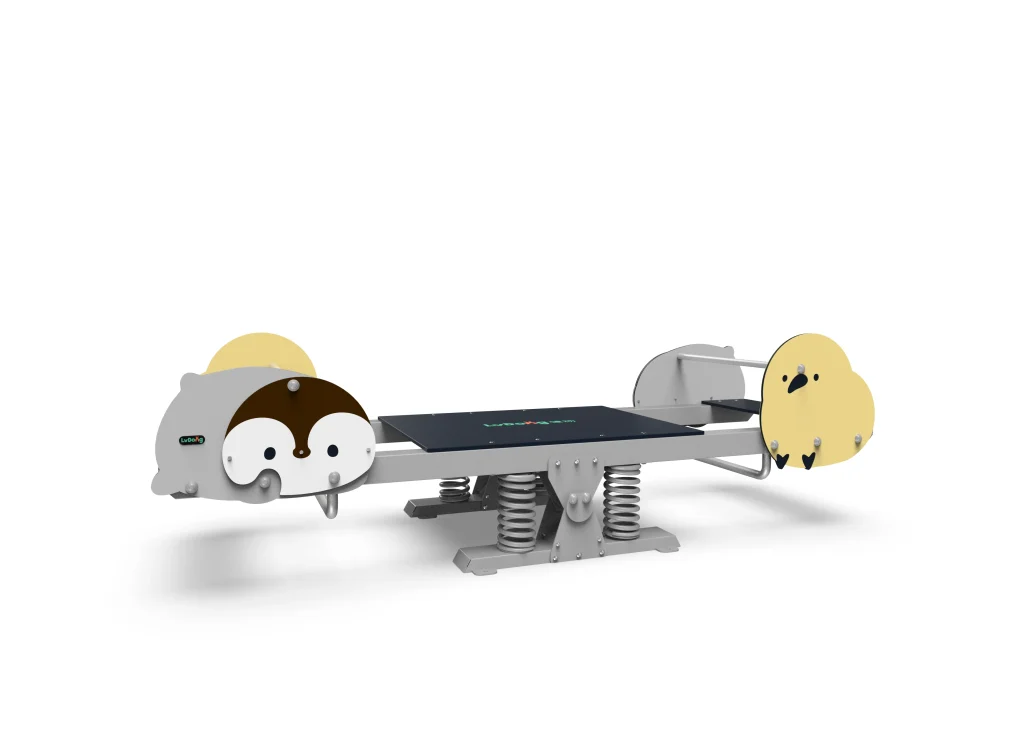
For example, a seesaw frame that combines a ductile steel weldment, stainless anchor bolts, and UV-stabilized rotomoulded seats addresses both abnormal-load fracture risk and ordinary corrosion. This is the same logic that applies across slides, spinners, and spring riders: choose materials that maintain normal play performance while lowering the chance of sharp, high-velocity fragmentation.
Moving parts still need to meet ordinary safety and structural verification, even when the project adds blast-related material requirements. <Playground Turntable Safety EN1176 vs ASTM Standards Unpacked> covers how EN 1176 and ASTM requirements overlap for rotating equipment.
Standoff, Layout, and Passive Site Protection
Site planning often does more than material substitution. Standoff distance between play structures and possible blast sources or vulnerable facades reduces pressure and fragment load on occupied areas [3]. Open sight lines, low boundary walls, and avoidance of debris traps help maintain passive security without turning the play space into a defensive installation.
Layout principles for high-risk sites include:
- Position play structures away from glazed building faces and unsecured storage areas.
- Use landscaping or reinforced elements to slow ballistic fragments where feasible.
- Keep circulation and exit paths visible and unobstructed from all play zones.
- Avoid enclosed decorative elements that can trap secondary debris or conceal damaged components.
- Provide multiple access points for evacuation and emergency response.
Procurement Checklist for High-Risk Play Projects
Buyers should request documentation that goes beyond standard catalog sheets. A high-risk procurement file should include material certifications, weld inspection records, fastener grade data, anti-corrosion treatment details, and installation sequencing. The supplier should also show how the chosen equipment continues to meet EN 1176-1 [1] and ASTM F1487 [2] after blast-related substitutions are made.
Key verification documents:
- Certified drawings with foundation and anchor details.
- Material test certificates for steel, fasteners, and plastic components.
- Weld inspection or non-destructive testing records for critical joints.
- Coating and corrosion protection data.
- Spare parts availability and replacement lead times for damage-prone components.
- A written statement on which structural substitutions differ from the standard catalog.
For initial technical review of site-specific high-risk requirements, send the site drawings, expected threat level, age group, and installation window to [email protected] or WhatsApp +8613915684545. The inquiry should include the required equipment list and any access constraints so the response can cover anchoring, material compatibility, and delivery planning.
In high-risk procurement, supplier evaluation must weigh documentation quality, replacement turnaround, and site-support capacity as heavily as price. <Effectively Compare Playground Equipment Suppliers Services> covers service-level comparisons that matter when response times and spare parts are critical.
Technical Review and Next Step
A conflict-zone playground specification only works when it is site-specific. Suzhou LvDong Amusement Equipment Co., Ltd. supports early-stage technical review for high-risk and humanitarian play projects, including foundation anchoring requirements, material substitution logic, documentation preparation, and phased delivery planning. Send the project location, available drawings, target age group, and any threat assessment to:
- Email: [email protected]
- WhatsApp: +8613915684545
The technical team can prepare a specification response covering suitable equipment, anchoring recommendations, material options, and lead times.
FAQ
Can any playground equipment be truly blast-proof?
No. A credible specification uses the terms blast-resistant or shrapnel-resistant to describe defined risk-reduction measures. No playground manufacturer can guarantee zero injury or total structural survival in every blast scenario.
Are EN 1176 and ASTM F1487 enough for conflict-zone projects?
They are necessary but not sufficient. EN 1176-1 [1] and ASTM F1487 [2] establish normal playground safety and structural requirements. High-risk projects still need a site-specific threat assessment and additional documentation for foundations, materials, and installation.
What materials best reduce shrapnel risk?
Ductile steel, stainless fasteners, high-toughness polymers, and laminated or polycarbonate transparent panels are generally preferable to brittle castings, thin glass, and unreinforced ceramics. The final choice depends on site environment, maintenance capacity, and cost.
How do foundations reduce blast risk in a play area?
Continuous reinforced concrete footings and deeply embedded anchors reduce overturning and lateral displacement when the ground shakes or nearby structures are damaged. Surface-mounted equipment with short bolts has a lower threshold for becoming a moving hazard.
What documents should buyers request for high-risk projects?
Certified drawings with anchor details, material test certificates, weld inspection records, coating data, spare parts availability, and a written statement on substitutions from the standard catalog.
References
- European Committee for Standardization. EN 1176-1:2017, Playground equipment and surfacing — Part 1: General safety requirements and test methods.
- ASTM International. ASTM F1487-21, Standard Consumer Safety Performance Specification for Playground Equipment for Public Use.
- U.S. Department of Defense. UFC 4-010-01, DoD Minimum Antiterrorism Standards for Buildings.
- Federal Emergency Management Agency. FEMA 428, Primer to Design Safe School Projects in Case of Terrorist Attacks.
- International Organization for Standardization. ISO 16933:2007, Glass in building — Explosion-resistant security glazing — Test and classification for arena air-blast loading.
If you’re interested, check out these related articles:
Top 10 Animal Spring Rider Designs for Modern Playgrounds
Pre Configured vs Custom Designed Playground Play Sets A Strategic Guide
Playground Spring Rider Materials Steel vs Anti Rust
Effectively Compare Playground Equipment Suppliers Services
Swing Set Components Advanced Material Selection for Durability