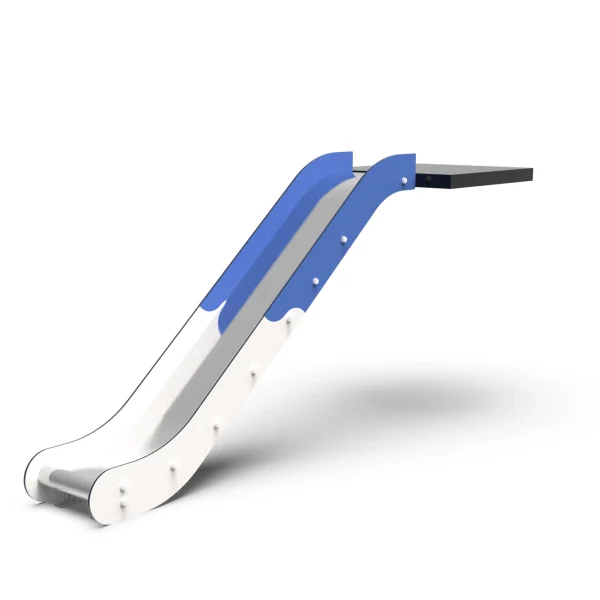
Slide exit runout length is not a line item that should be left to default grading. When a child exits a slide, forward momentum carries them beyond the end of the chute before they stand, regain balance, and move aside. The next child is often already on the way down. A 1.5-meter clear buffer between the slide exit and any queue rail, wall, fence, or crossing path gives the first child enough room to clear the landing, and it significantly lowers the chance of a second child colliding into them from behind. I treat that 1.5 meters as the practical minimum for a busy slide, not the number to shrink when space gets tight.
Slide Exit Runout Length Is the Real Traffic Control Measure
Most slide injuries I review are not caused by the slide chute itself. The real risk builds at the exit when the child who has just landed stops in the impact area and the next child arrives too fast to avoid them. Slide exit runout length is therefore less about the slide’s physical dimensions and more about managing child flow. If the runout is too short, every slide cycle becomes a merge conflict between two moving bodies. If it is adequate, the child has space to decelerate without stepping onto unapproved surfacing. The exit zone should feel open, level, and free of visual clutter, so children naturally clear it without being told.
The 1.5-Meter Buffer Zone Does Three Jobs at Once
The 1.5-meter buffer zone is not only a clearance dimension. It creates deceleration room, visual space, and queue separation at the same time. Deceleration room lets a child slide, stand, and move forward without immediately stopping on the edge of the surface. Visual space lets the child see the path ahead and choose a safe direction. Queue separation keeps the next slider from entering the exit area before the previous child has vacated it. When I assess a playground layout, I look for these three functions together. A slide can have the correct fall height and still fail the exit if the space in front of it is interrupted by a bench, a planting edge, or a crossing walkway.
Site Measurement Starts From the Slide Exit Lip, Not the Post
One common mistake is measuring the runout from the slide support post instead of the actual exit lip. The post may sit behind the chute, so a plan that looks compliant can lose 400 to 600 millimeters before the child even reaches the landing. I always start the measurement at the outermost edge of the exit lip, then mark 1.5 meters outward in the direction of travel. The surface across that entire zone must be a continuous impact-attenuating material, not grass, not decking, and not a sand edge that ends halfway through the landing. The direction of travel also matters on curved slides because the exit is often angled away from the line of the platform.
Grading and drainage are part of the same exit zone problem, because a low spot at the exit lip can turn a clean landing into a slippery puddle. <Playset Ground Leveling and Drainage Solutions for Outdoor Slides> covers how slope and drainage detailing keep the slide approach and exit clear of standing water, which is easy to miss on plan drawings.
If your site has mixed age groups or a high-capacity queue, confirm the exit queuing distance before the layout is fixed. Send your site plan and user count to [email protected] and we will check whether your runout needs adjustment.
Common Exit Runout Errors Create Rear-End Collision Risk
The most damaging error I see is placing the slide where children approach from behind the exit. When the queue leads from the platform side, children waiting become a wall directly in the exit path. Another error is treating the 1.5-meter runout as a decorative strip rather than a completely clear zone. A bench, bike rack, or low planter inside that area creates exactly the stop point that causes a collision. A third error is compressing the exit on indoor plans, where space is tight and the slide is angled toward a wall. Rear-end collision risk rises sharply when the exit is blind, and a slow first slider leaves the second slider with no clear escape.
| Site condition | What happens without enough runout | What to check |
|---|---|---|
| Lost queue separation | Next slider enters before first clears | Keep 1.5 meters clear in the direction of travel |
| Crossing path at exit | Lateral traffic intersects the landing | Shift the path or place a barrier |
| Low spot or poor drainage | Water ponds on the impact surface | Grade away and verify surfacing depth |
| Wall too close | Child cannot move aside safely | Increase the buffer or redirect the exit |
For indoor venues and compact plans, the same exit clearance has to work inside a smaller footprint. <Maximizing Space Strategic Designs for Mall Indoor Playgrounds> covers how slide placement and queuing can be arranged without squeezing the landing, which matters when a wall or column sits close to the runout.
Your Next Step Is a Site-Specific Slide Runout Check
Most rear-end collision incidents trace back to a drawing issue, not a hardware failure. The slide body and the exit runout are specified together, and a site with poor grading, a crossing path, or mixed age queuing can invalidate the clearance you planned on paper. If you share the site plan, fall height, surfacing depth, and expected peak user count, we will review the exit runout and confirm what needs to change before production. Send those details to [email protected] or WhatsApp +8613915684545.
Common Questions About Slide Exit Runout Length
Does the 1.5-meter runout apply to curved slides as well as straight slides?
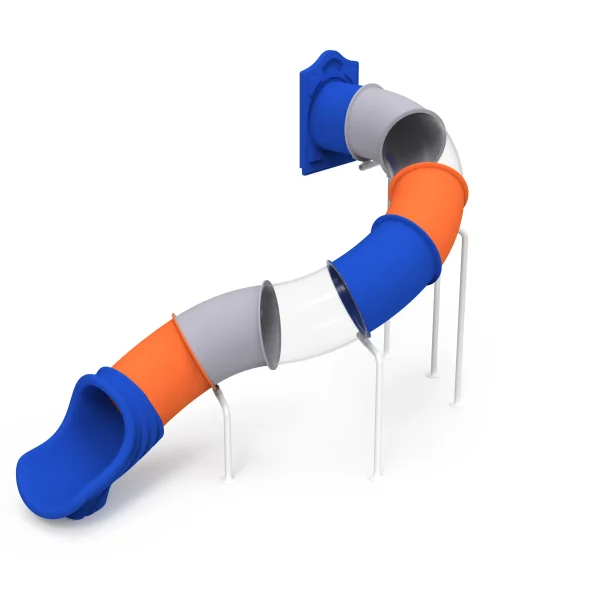
Yes. The 1.5-meter buffer applies to curved and straight slides alike because exit speed depends largely on fall height and bedway friction, not the curve itself. A curved slide often exits at an angle, so the clear zone must be measured in the actual direction of travel, not along the main platform line. I would keep the full 1.5 meters on the exit side and add a wider landing if the curve makes the exit path harder to anticipate.
What surfacing depth is required in the slide exit zone?
It depends on the slide’s fall height. The exit zone is part of the overall impact area, so the same surfacing depth required under the slide should extend through the runout and beyond the 1.5-meter buffer where the fall height demands it. For many toddler slides, a properly installed poured rubber or loose-fill system at the manufacturer’s tested depth is sufficient. For higher slides, the depth increases and the loose-fill containment edge must sit outside the runout, not across it.
Can a fence or wheel stop mark the boundary of the runout buffer?
A fence is not a safe way to mark the boundary. If a child slides into a rigid marker at the end of the runout, the fence becomes the hazard the buffer was meant to prevent. The 1.5-meter zone must be open and clear. If you need to discourage children from walking into the exit path, place a low marker several meters beyond the buffer or route the queue behind a barrier, always outside the measured landing.
How does exit runout change for tunnel slides with limited visibility?
In tunnel slides we have delivered, the visibility issue makes the exit buffer even more important. A child inside the tube cannot see who is still in the landing area, so the exit must be treated as a blind landing. I would rather increase the buffer than shorten it when the slide exit has restricted sight lines. Keep the immediate landing fully clear and consider a visual marker well beyond the runout. If your site has a tunnel slide with a tight approach or a crossing path, share the layout and we will confirm a compliant exit runout for that configuration.
If you’re interested, check out these related articles:
Mastering Metal Slide Heat Prevention Strategies for Playgrounds
Why ISO Certification Elevates Commercial Playground Equipment Manufacturers
Multi Function Playhouse with Slide and Swing Commercial Solutions
Kindergarten Outdoor Play Equipment Strategic Upgrade Priorities
Playground Equipment Balancing Price and Quality for Lasting Value
To discuss slide exit and runout planning, contact the LvDong team with your project requirements.