Playground equipment that performs well in a city park can develop hairline cracks, stiff bearings, and frozen drainage within one season at a ski resort base village. Ski resort playground equipment has to manage repeated freeze-thaw cycles, strong reflected UV from snow, heavy wet snow loads, and parents in bulky winter clothing watching children move fast downhill. At Suzhou LvDong Amusement Equipment we start from a simple position: at altitude, mechanical reliability and cold-rated materials matter more than visual complexity. That principle guides material selection, structural planning, and maintenance design for every mountain project.
Cold Weather Material Choices for Ski Resort Playground Equipment
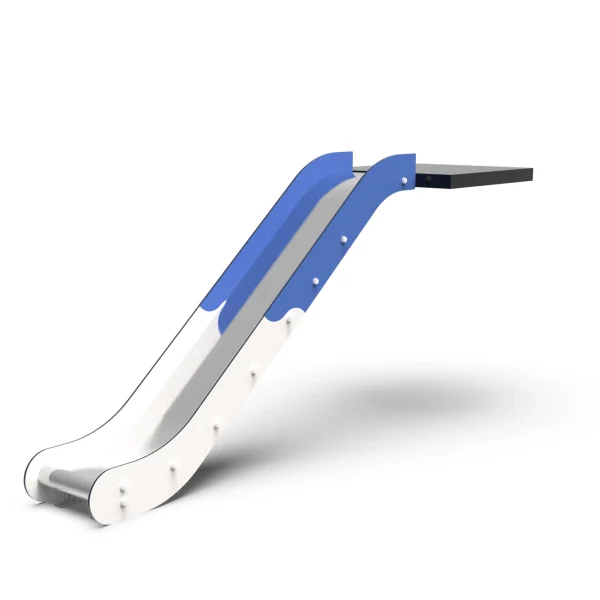
Low temperature changes how materials fail. A plastic panel that flexes at 10°C can become stiff and crack prone at -20°C, while steel that tolerates summer humidity may corrode under repeated thaw water and road salt. We choose materials for the alpine environment, not for the showroom photograph. Rotationally molded LLDPE handles low temperature impact better than many low-cost recycled compounds, and hot-dip galvanized steel frames hold up where powder-coated alternatives fail along scratches and joint edges.
| Component | Preferred Choice | Why It Matters in Alpine Use | Maintenance Signal |
|---|---|---|---|
| Slide bed and shell | Rotational molded LLDPE | Holds toughness at low temperature and resists snow abrasion | Hairline cracks near bolt holes |
| Frame and posts | Hot-dip galvanized steel | Handles meltwater and de-icing salt without edge rust | Scratch damage, exposed steel |
| Bolts and connectors | 304 stainless | Keeps strength in wet-cold cycles and reduces galvanic corrosion | Loose joints, white powder or rust |
| Springs and moving parts | Sealed stainless assemblies | Keep motion smooth without attracting grit | Stiff movement, darkened grease |
On slide material decisions, the choice between LLDPE and 304 stainless is rarely about initial price alone. <Playground Slide Materials LLDPE vs 304 Steel Performance> covers how each material behaves under stress, UV, and regular cleaning, and why mixed-material construction often creates fewer long-term problems in exposed sites.
Steel and Fastener Choices for Freeze-Thaw Sites
Frame material gets less attention than slide color, but it is the first place alpine conditions show. Galvanized steel frames need careful attention at joints and welds. We specify stainless fasteners and isolation washers at dissimilar metal contacts because meltwater and road salt create an electrolyte that accelerates corrosion. In our factory checks and site reviews we monitor torque values at joints because freeze-thaw movement loosens bolts faster than static structures.
Why UV Exposure Intensifies at Altitude
At 2,000 meters, UV levels rise, and snow reflects solar radiation back into the underside of panels and slides. Color fade is one issue; structural degradation of unstabilized plastic is the bigger one. We request UV-stabilized pigments and protective coatings for alpine projects because a panel that looks faded after two seasons also tends to lose toughness. The product library confirms wear-resistant materials suitable for outdoor sun and rain exposure and high-frequency use.
Snow Load and Drainage Planning for Base Village Sites
Snow load and drainage sit behind the temperature problem. A roofed play structure at a base village has to carry wet snow that compacts during the day and refreezes at night. We plan support spacing and roof slopes for regional snow load rather than a generic catalog assumption. Surface drainage matters just as much: if meltwater pools under a spinner and refreezes, the equipment base and the impact surface both suffer.
Foundation Details That Prevent Frost Heave
We prefer concrete footings set below the local frost line where site conditions allow. Frost heave does not push a whole structure evenly; it lifts one post while the adjacent post stays still, twisting frames and loosening connections. In mountain projects we ask for soil bearing and drainage information before the design freeze. That prevents the installation team from guessing at underground conditions. Anchors, base plates, and the surrounding surfacing should move as one system.
Motion Equipment That Works Through Freeze-Thaw Cycles
Moving parts expose weak choices. Spinners, seesaws, and spring riders need bearings and spring assemblies that stay controllable after temperature swings and wet gloves. Our multi-player spinning wheel uses a stable round spinning structure with smooth, controlled rotation and a user capacity of 6 to 10 children. Its maximum falling height is 55 to 77 cm depending on model, which keeps the layout within EN 1176 and GB/T 34272-2017 calculations. The single-player spinner has a lower 34 cm falling height and a compact footprint, useful for tight base-village corners.
Bearings and Springs in Subzero Conditions
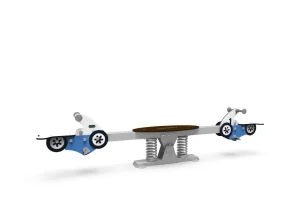
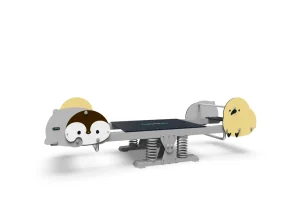
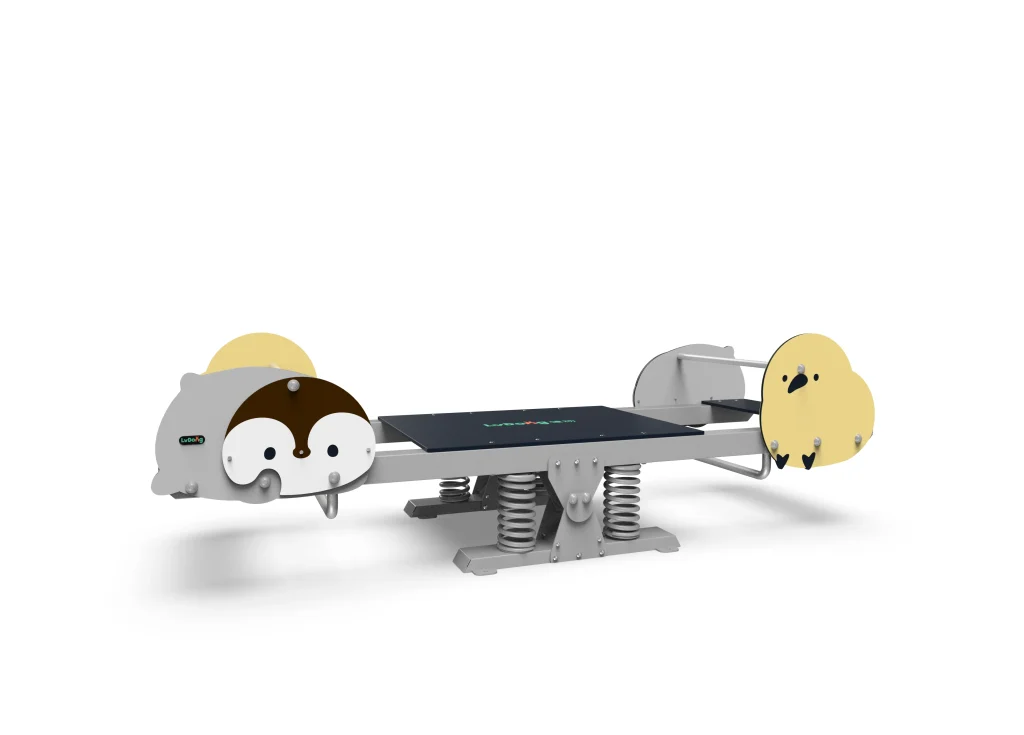
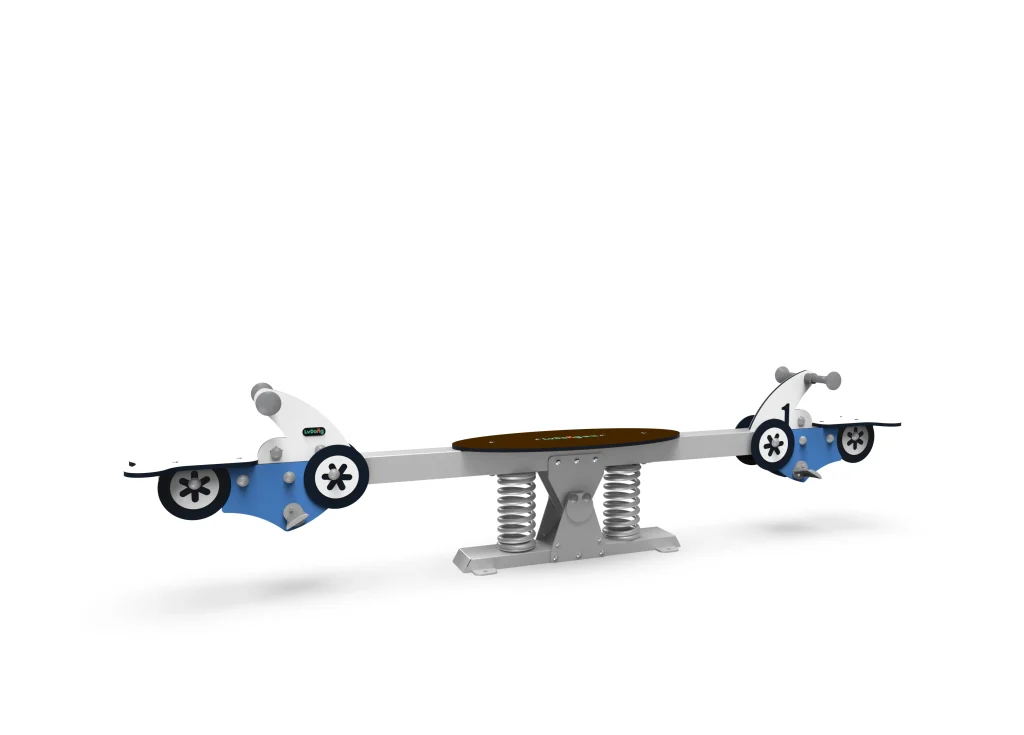
Below freezing, ordinary grease thickens and bearings start to feel stiff. We choose sealed bearing assemblies that keep moisture and grit out and retain movement in cold weather. Spring riders follow the same logic: the high-strength steel spring is built for stable rebound and controlled rocking, and our seesaw models use a spring-assisted base to manage smooth motion for two to ten children. Sealed units cost less to maintain across a season than open units that need repeated cleaning.
Operators planning a base village should not assume standard grease and standard bearings will behave at -15°C. If your site regularly drops below freezing, confirm the bearing seal specification and the spring material before finalizing the equipment list: [email protected].
Maintenance Routines for Alpine Playgrounds
Alpine sites need maintenance planned around seasons. Before first snowfall, we recommend clearing drainage channels and checking that no water can pool and refreeze under equipment. In spring, after melt, the priority shifts to surface checks, fastener torque, and visible weld inspection. The product library descriptions for our outdoor equipment note wear-resistant materials suitable for high-frequency use, but wear resistance does not replace seasonal attention.
Seasonal planning reduces the number of urgent repairs. <Annual Maintenance Calendar for Outdoor Play Equipment A Guide> covers monthly, quarterly, and annual tasks so operators can schedule work around snow cover and peak visitor periods instead of reacting to failures.
Before reopening after winter, a systematic check catches more than a walk-through. <Playground Equipment Safety Your Essential Self Inspection Checklist> covers the points most likely to cause downtime or injury after freeze-thaw exposure.
Confirming Mountain-Ready Playground Equipment for Your Base Village
Base village projects fail when generic playground packages meet specific snow, wind, and temperature conditions. We would rather clarify the specification before production than replace the wrong parts after the first winter. The practical next step is to send the site elevation, expected snow load, equipment list, and any local surfacing or certification requirements. Suzhou LvDong Amusement Equipment Co., Ltd. can then confirm which materials, foundations, and finishes suit the site. Send those details to [email protected] or WhatsApp +8613915684545.
Common Questions About Ski Resort Playground Equipment
What temperature range should ski resort playground equipment be rated for?
Start with the site’s lowest expected operating temperature, not a general cold climate label. For most base villages we plan for repeated exposure below -10°C, and for Nordic or high-altitude projects we plan lower. The key checks are plastic toughness, low-temperature grease or sealed bearings, galvanized or stainless steel, and drainage that does not let meltwater refreeze under the equipment.
Does a thicker steel frame mean the equipment is cold resistant?
Many buyers assume a thicker steel frame automatically makes equipment cold resistant. Thickness helps with structural load, but fastener corrosion, brittle plastic, and ice-blocked drainage cause more winter failures. Cold resistance comes from material compatibility and sealed moving parts, not from one dimension. A galvanized or stainless frame paired with the wrong fasteners can still corrode at the contact point, so we review the whole assembly.
Which alpine sites need the most protective specifications?
It depends on whether your site receives dry powder snow or repeated wet snow and melt cycles. Dry snow loads are often lighter, but high winds and drifting can pile snow unevenly against equipment. Wet snow is heavier and refreezes into ice. For wet snow regions we prioritize roof slopes, drainage, and galvanized or stainless contact points; for dry windy regions we focus on foundation depth and wind load.
What goes wrong most often in mountain playgrounds?
In mountain projects we have seen more failures from trapped meltwater than from severe cold alone. A bearing or anchor that sits in a small pool of water will freeze and thaw every day, and that cycle pushes components apart. The fix is rarely a stronger part. It is usually better drainage, sealed bearings, and an inspection routine after spring melt. These details are less visible than slide color, but they determine whether the playground opens on the first warm day. Share your site’s drainage and temperature profile and we’ll confirm which sealed components are needed.
If you’re interested, check out these related articles:
Factory Direct Playground Spring Riders Unbeatable Value Quality
Hurricane Spinner Load Testing Unpacking Playground Safety Standards