Salt air and confined deck spaces change how playground equipment performs. On a cruise ship, kids club equipment must resist chloride exposure while fitting into layouts with narrow corridors, emergency egress routes, and strict fall-zone clearances. Marine-grade stainless kids club equipment addresses the corrosion risk, and compact multi-use pieces resolve the space constraint. I look for 316 stainless on exposed metal, isolation between dissimilar materials, and equipment dimensions that work in zones as small as 40 square meters. The result is a kids club that stays visually clean, passes marine inspections, and keeps replacement cycles longer than powder-coated carbon steel alternatives.
Marine-Grade Stainless Steel for Cruise Ship Kids Club Equipment
Salt air on open decks carries chlorides that settle on every surface. On land, a powder-coated carbon steel frame can last for years. In a cruise ship kids club, the same frame begins to show rust at joint edges or around bolt holes after one or two seasons. That is the practical difference I consider first.
Marine-grade stainless steel is not a single material. For most interior kids clubs, 304 stainless resists ordinary humidity and cleaning chemicals well. When the space sits near an open deck, pool, splash zone, or salt spray path, 316 stainless is the safer choice because molybdenum improves pitting resistance in chloride environments. The cost difference is real, but it matters most on small metal parts rather than the whole equipment footprint. We often specify 316 for brackets, grab rails, and exterior panels, while using 304 only for fully enclosed interior zones with no direct sea air exchange.
| Component Position | Recommended Material | Reason |
|---|---|---|
| Exposed grab rails and handrails | 316 stainless | Pitting resistance in salt air |
| Brackets and bolts | 316 stainless or coated marine-grade | First failure points |
| Slide beds and small rider bodies | UV-stabilized HDPE | No rust risk with less weight |
| Fully interior panels away from doors | 304 stainless | Good corrosion resistance at lower cost |
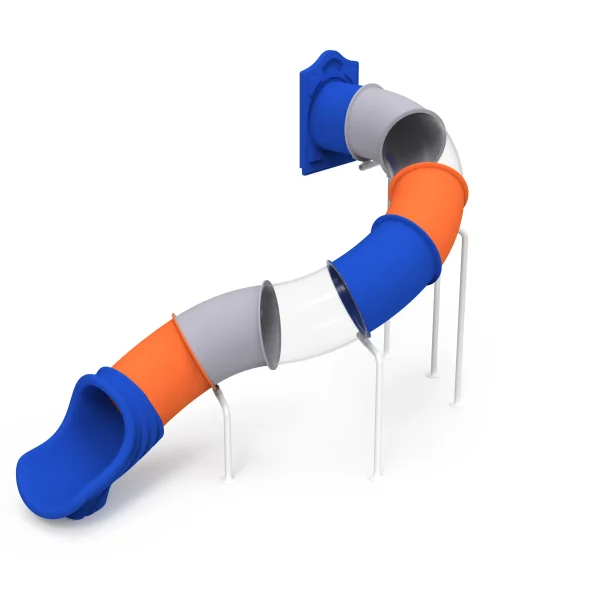
For crawl tubes and slides, we use rotationally molded or HDPE surfaces that do not rust, but the structural cage and fasteners still need marine-grade metal. If buying a pre-configured set, check whether the manufacturer gives you a material schedule for every exposed part. A “stainless steel frame” does not cover the galvanized brackets and carbon bolts that often ride along with it. On a cruise ship, those hidden parts are the first to fail, not the slide bed.
Space Efficient Layouts for Enclosed Kids Club Decks
Space on a cruise ship is different from a park. The kids club may have a six meter by seven meter activity room, a narrow entry corridor, and a partition wall that cannot move. I treat every piece as part of a movement path first and a play station second. The clearance around each item still has to satisfy EN 1176, but the layout can be tighter if you use equipment with low maximum falling heights and controlled motion.
Falling height drives surfacing requirements. A spring rider with a 50 cm maximum falling height needs a smaller safety surface than a multi-level play structure with platform heights over one meter. In a cruise kids club, choosing several compact pieces with low fall heights is often better than one large tower. It also lets staff supervise the room with line of sight across the entire space.
Equipment like the single-player spinner with a footprint around 60 cm by 60 cm and a maximum falling height of 34 cm can sit close to seating or storage without creating a large restricted zone. Multi-player spinners in our range run from 120 cm to 200 cm in diameter, so they need more planning, but they also serve six to ten children at once. That matters when a children’s program brings in a full group at the same time.
Space planning in enclosed play areas often comes down to fall zones and supervision sight lines. <Small Space Solutions for Restaurant Childrens Play Areas> covers how to choose compact commercial pieces that keep the required safety surface small while still giving children enough movement choice.
If your kids club is located below a pool deck or near an exterior door used by crew, confirm whether brackets and exposed fasteners need 316 stainless instead of 304 before you finalize the equipment list. Send the deck plan and a note on the nearest salt water exposure point to [email protected] and we will mark the components that should be upgraded.
Compact Equipment Choices for Cruise Ship Kids Club Spaces
The product mix should match age groups and the peak number of children. For toddlers, spring riders take up little space and let children practice balance and coordination. Our outdoor spring riders are roughly 60 cm to 99 cm long and 79 cm to 110 cm tall, with a maximum fall height of 50 cm. They install quickly, a useful advantage when a ship’s engineering crew has only a short port window for deck or interior upgrades.
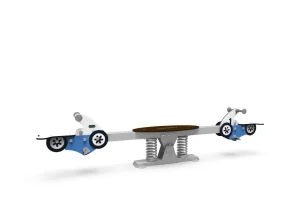
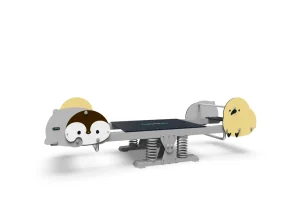
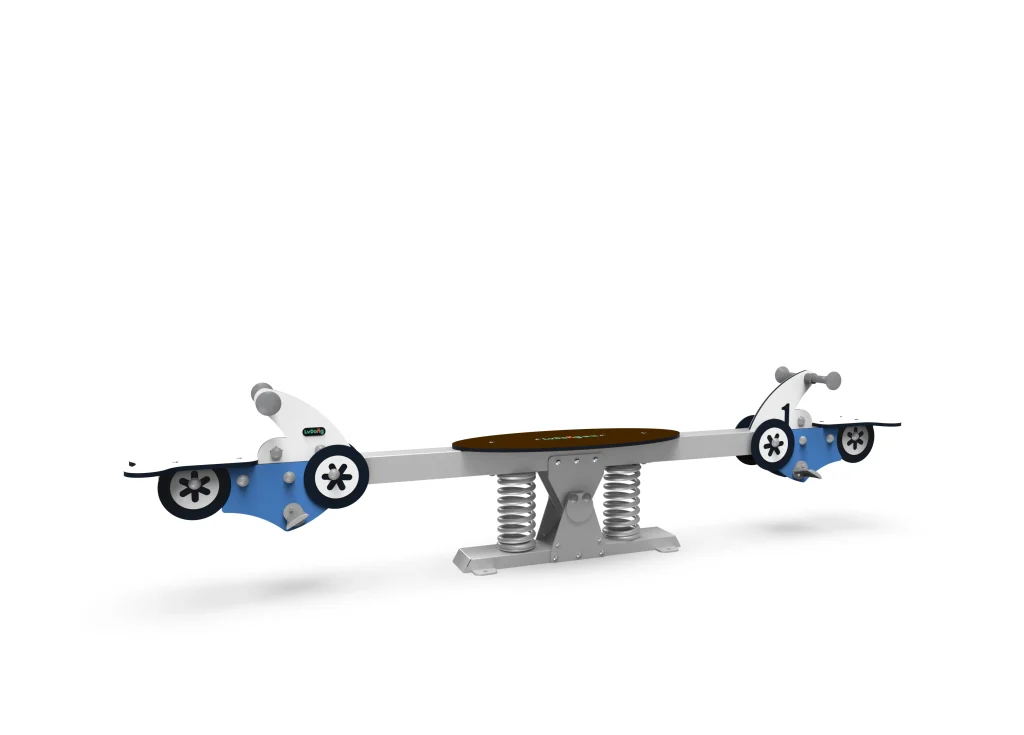
For mixed-age groups, a multi-person seesaw can keep two to ten children engaged in the same footprint. The longest seesaws in our product range are around 300 cm to 320 cm, so they need a straight clear zone at both ends, but the width can be as narrow as 39 cm. That long and narrow footprint often fits along a wall where a wider tower would block circulation.
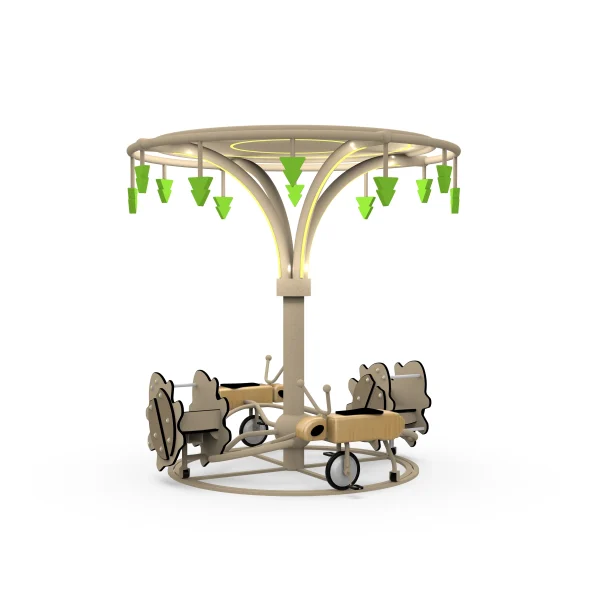
Spinners are useful on cruise ships because they produce a lot of play value without requiring a runway. A multi-player playground spinning wheel with a diameter of 120 cm to 200 cm can be placed against a corner with the required safety perimeter. The fall heights range from 55 cm to 77 cm, which keeps surfacing requirements manageable. If the club serves younger children only, a single player spinner with a fall height of 34 cm is even easier to place.
Salt Air Protection for Coatings, Fasteners, and Bearings
On a ship, the visible panel is rarely the first failure point. I look at the bracket, the bolt shank, the bearing seal, and the place where stainless meets a less noble metal. When two different metals touch in a salt air environment, the more active metal corrodes faster. The fix is isolation: nylon washers, no direct contact between carbon steel hardware and stainless panels, and sealed bearing cartridges where moisture cannot sit.
Paint and powder coating have their place, but they are not a corrosion strategy on their own. A scratch from a toy or a cleaning cart breaks the seal and lets salt air reach the steel. Stainless does not depend on a coating to survive that scratch, which is why it is worth the added cost on exposed surfaces. We still use powder coating as a color layer, not as the primary protection.
Children’s clubs are cleaned frequently, often with disinfectants. The wrong disinfectant can dull some coatings. Stainless handles most marine cleaning agents, but it still needs a rinse schedule to remove chloride residue. In high humidity, I ask for smooth, closed tube ends and no water traps, because standing water with salt turns small gaps into corrosion cells.
Corrosion resistance is only one part of the compliance picture. <8 Essential Certifications for Playground Equipment Manufacturers> covers the documentation buyers should collect before shipping equipment into marine projects. We use the same checklist for cruise ship orders that must pass safety review.
Marine Kids Club Specification Support
I know how much specification overlap exists between marine engineering and playground safety standards. A kids club order has to satisfy EN 1176, shipboard fire and material requirements, and the operator’s cleaning and maintenance schedule. That can leave procurement teams holding a spreadsheet with no clear owner for stainless grades, anchoring details, or fall surface data.
We resolve that at Suzhou LvDong Amusement Equipment by preparing a material schedule for every exposed component and a layout drawing with clearance dimensions marked for the ship’s safety review. If you are specifying a new kids club or replacing equipment during a dry dock window, send your deck plan, age group, and door or column locations to [email protected] or WhatsApp +8613915684545. We will return a space plan and a stainless upgrade list for the components that actually need it.
Questions Owners Ask Before Ordering Cruise Ship Kids Club Equipment
Which stainless steel is best for a cruise ship kids club?
For most cruise ship kids clubs, 316 stainless is the safer choice if the space has any salt air exposure, pool splash, or exterior doorway. The molybdenum content improves resistance to pitting and crevice corrosion. Fully enclosed rooms with stable climate control can use 304 stainless on interior panels, but I would still check every bracket and fastener because those parts sit closer to cleaning water and hand contact. If you are unsure which zones need the upgrade, mark the nearest salt water and service door locations on your plan and we will return the correct material split.
Does stainless steel mean the whole structure is corrosion proof?
No. The grade and the fasteners matter just as much as the visible panels. A 316 stainless handrail attached with carbon steel bolts will still rust around the bolt hole once the coating on the bolts wears thin. Sealed bearings, isolation washers, and closed tube ends all play a role. We treat corrosion as an assembly problem rather than a material problem. If a quote only names the visible metal as stainless, ask for the fastener and bracket schedule before signing.
How much space should I leave around each piece?
It depends on the maximum falling height and the movement arc of the equipment. A spring rider with a 50 cm falling height needs less protective surfacing than a multi-level tower. The largest dimension matters for rotating and seesaw pieces because the clearance must cover the full motion, not just the static footprint. We mark these zones on the factory layout drawing for each item. If you are working within an existing room, send the column and door positions and we will make the layout around them.
What is the most common layout mistake in cruise kids clubs?
In cruise and resort projects we have reviewed, the most common mistake is treating a kids club like a normal indoor classroom. The equipment gets pushed toward the walls without accounting for fall zones, supervision sight lines, or the path staff use to clean. A slide exit or spinner arc often ends up in the walking lane. The result is either a safety violation or equipment that gets blocked off during busy hours. For ship spaces, I plan the circulation route before placing any play item.
Will a compact play set be enough for a full children’s group?
Before asking if a piece will fit, the better question is what clear zone the equipment needs and how many children can use it safely at the same time. A single-player spinner serves one child and fits tight corners. A multi-player spinner can serve six to ten children in a 120 cm to 200 cm diameter footprint, but it needs more room around it. Mixed age groups do better with several small pieces than one large set because staff can direct different ages to different activities. Send your deck plan and age mix to [email protected] and we will confirm which components need 316 stainless and what certification documents ship with the order.
If you’re interested, check out these related articles:
Eco Friendly Playground Equipment SGS REACH RoHS Standards Explained
Sensory Playground Panels Touch Visual Audio Options
To discuss cruise-ship kids-club equipment requirements, contact the LvDong team with your project requirements.