Security-grade play equipment for prison visitor centers starts where ordinary playground design stops. A reunion space has to feel warm enough for children and controlled enough for correctional staff. Every fastener, seam, opening, and surface must be checked for concealment, tampering, and cleaning. I approach these projects as a playground equipment designer, so my first question is always how the equipment will be supervised and searched during a normal visit window. That question shapes material choice, equipment type, and placement long before color or theme.
What Counts as Security-Grade Play Equipment for Prison Visitor Centers?
In a prison visitor center, security-grade does not mean prison-looking. It means the equipment gives staff clear sightlines, gives children a soft place to play, and gives no one a place to leave an object behind. That is a stricter envelope than a public park.
Three features matter first. The equipment should be low enough to observe over, open enough to search under, and fixed enough that no part can be detached without a tool. I ask for flush or capped fasteners, closed seams, and no hollow cavities that cannot be opened. If a panel has a gap, a child may store a small toy there during a visit, and staff may not find it until the next search.
I have seen a well-designed visitation room lose its play corner because a panel had an open-backed pocket no one could search quickly. Staff had to kneel and use a mirror to check the void. That one detail turned a warm reunion space into a daily search burden.
Security-grade also changes the surrounding surface. Loose fill is a poor choice. Loose chips, sand, or rubber crumbs make it too easy to hide objects and too hard to rake through between sessions. A sealed rubber surface or a clean finished floor works better in a small room.
Which Equipment Types Fit Family Reunion Spaces?
Most visitation rooms are small, rectangular, and tightly scheduled. That rules out large multi-level structures and long slide run-outs. I usually narrow the selection to four types: wall-mounted play panels, spring riders, single-player spinners, and low-height multi-person seesaws.
| Equipment type | Security advantage | Main supervision concern | Typical fall height |
|---|---|---|---|
| Wall-mounted play panel | Flat face with no loose parts, quick visual search | Mounting bolts must be capped or welded | Ground level |
| Spring rider | Fixed base and confined rocking motion | Anchor bolts need tamper-resistant covers | 50 cm |
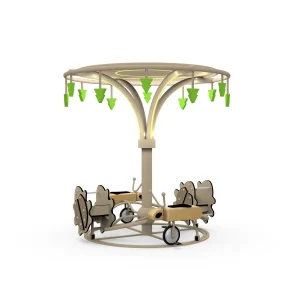
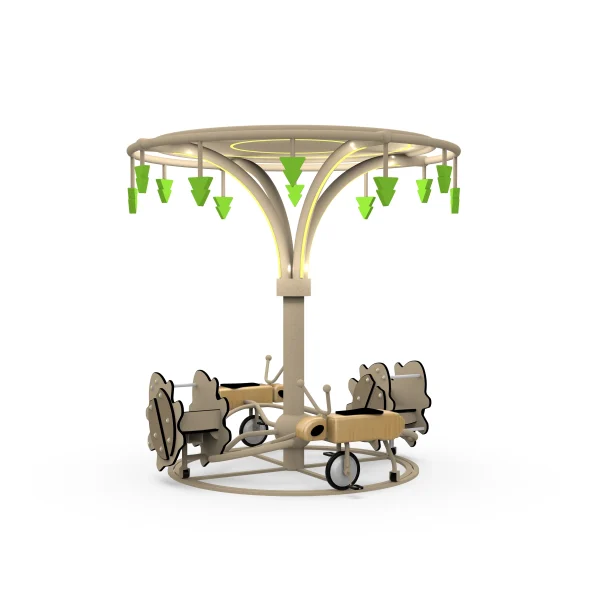
| Single-player spinner | Low platform, controlled rotation, small footprint | Requires open sightline around the unit | 34 cm |
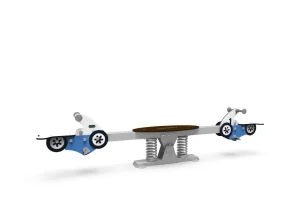
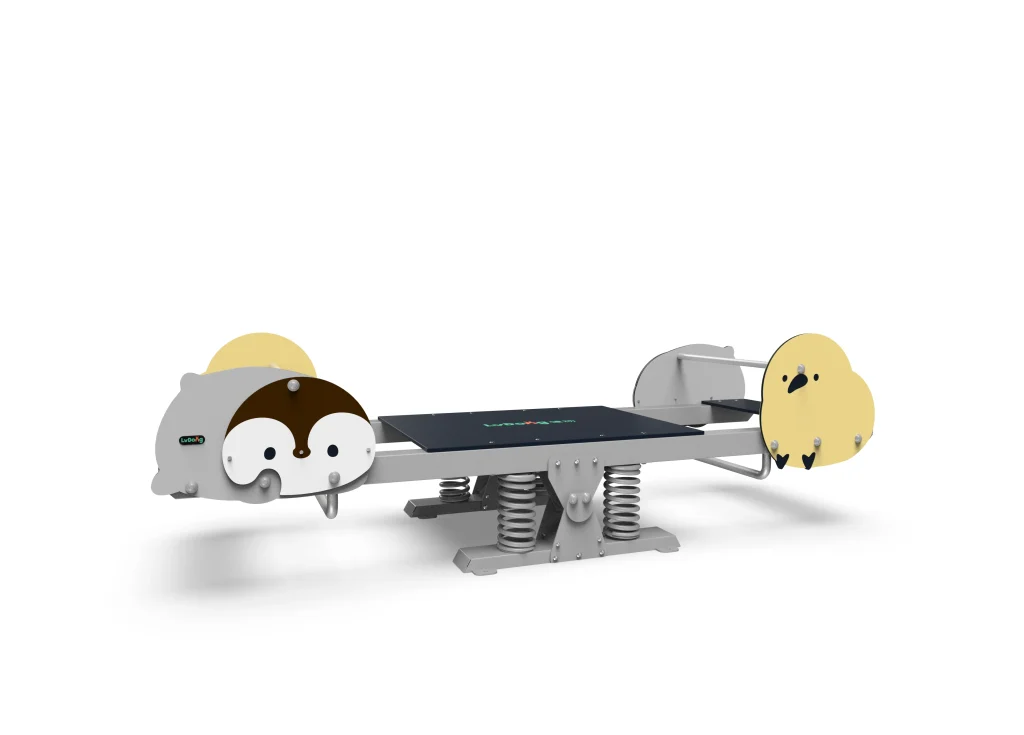
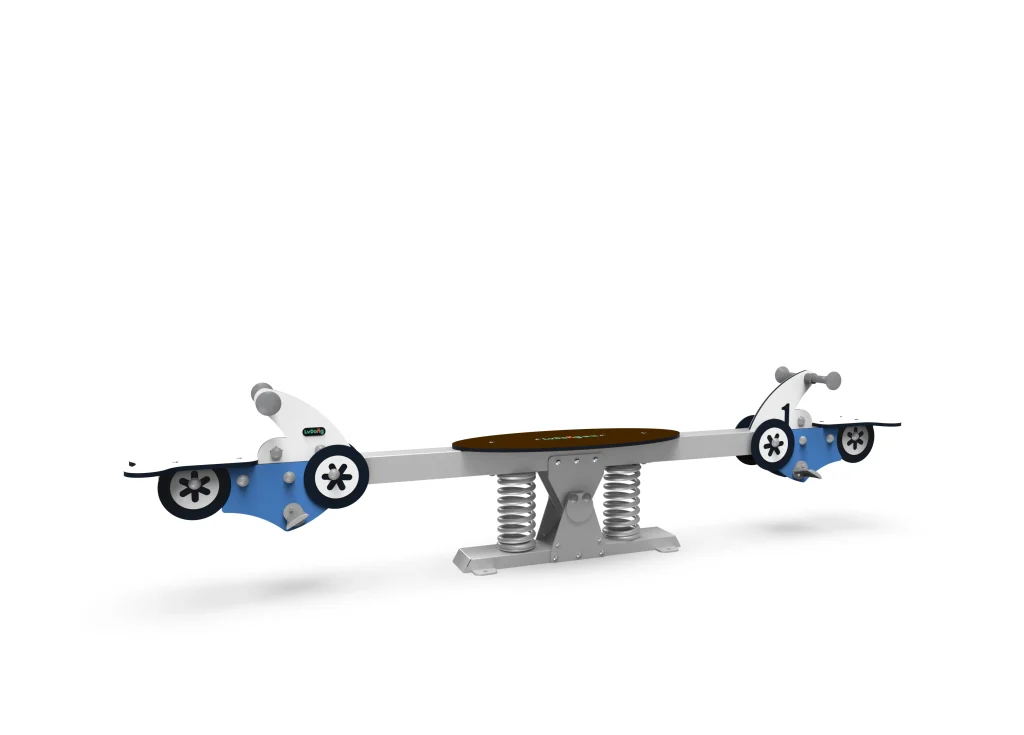
| Multi-person seesaw | Good for caregiver-child interaction | Pivot points must be shielded from fingers | 60 cm |
Of these, I prefer panels and spring riders for the smallest rooms. They give a clear activity without creating a moving clearance zone that disrupts circulation. A spinner can work if the room has at least a 2-meter clear ring around the unit, measured from the rotating outer edge. The seesaw earns its place in family rooms where an adult and child may want to sit together, but I keep it away from the main entry.
Wall-mounted panels solve one part of the security puzzle by keeping the play surface visible above the search line. <Sensory Playground Panels Touch Visual Audio Options> covers how touch, visual, and audio options can be selected without adding protruding hardware, which matters when a facility wants sensory value with a low concealment profile.
How Should You Specify Materials for Contraband Control and Low Maintenance?
Material selection is not about color. It is about what a surface hides, what a joint retains, and what a cleaning crew can reach. I start with stainless steel or fully encapsulated galvanized steel for frames, high-strength steel springs where motion is required, and molded plastic or coated panel faces that do not trap moisture.
Powder-coated frames need a closed-cell cap or welded plug at every tube end. An open tube end is a small opening that looks harmless and becomes a catch point for paper, wrappers, and plastic. If the design uses hollow sections, I require the supplier to seal them at both ends and to show that in the shop drawings.
Touch points should be smooth enough to wipe with a disinfectant without damaging the finish. I avoid rope, netting, and fabric on these projects. They absorb liquids, they hide particles, and they are difficult for staff to inspect quickly between visits.
If your visitor center has a fixed search lane or a single staff line of sight, it is worth confirming the clearance ring and mounting detail before you lock the equipment list. Email [email protected].
What Installation and Inspection Checks Keep a Prison Visitor Center Play Area Safe?
Installation errors can undo a good security specification. I break the handover into five checks that a facility manager can repeat.
- Anchor every unit to the structural slab or wall. Surface-mounted equipment is not acceptable because it can be shifted and creates a gap beneath the base.
- Confirm that all fasteners are capped, recessed, or one-way. Record the tool type required for future maintenance.
- Run a sightline test from the staff desk and the entry door. If any panel or frame blocks a corner, change the layout or choose a lower unit.
- Check every opening after installation. Close or fill any gap that could hold a small object, a finger, or a piece of clothing.
- Set a monthly inspection routine that includes torque, surface wear, and a concealed-item search under and inside equipment.
These checks are not extra. They are the difference between a play corner that stays open and one that gets closed after the first incident report.
When a prison visitor center buyer tells me the equipment must be security-grade, I treat that as a manufacturer qualification exercise rather than a product search. <Evaluate Commercial Playground Manufacturers 8 Critical Selection Factors> covers the evaluation factors that reveal whether a supplier can handle tamper-resistant hardware and clear documentation.
What Should You Ask a Manufacturer Before Finalizing Security-Grade Play Equipment?
Security-grade play equipment procurement should start with documentation, not with a catalog. I ask manufacturers five questions before the layout is drawn.
- Will you cap or weld every fastener and supply a hardware schedule?
- What is the maximum fall height and the associated impact surface depth?
- Do you prepare installation drawings with clearance zones?
- Which standards cover the unit: EN 1176, GB/T 34272-2017, or ASTM F1487?
- What is the spare parts lead time for the spring, bearing, or panel face?
Narrowing the supplier list before you compare price sheets changes the entire procurement conversation. <20 Essential Questions Choosing a Playground Equipment Supplier> covers the questions that separate manufacturers who document testing from those who only quote a catalog description.
Prison visitor center projects rarely fail because the equipment is not playful enough. They fail when the specification omits a daily search routine, a tamper-resistant detail, or a realistic clearance zone. If your project has fixed supervision lines or a narrow recessed corner, it is worth confirming the exact sightline clearance before you finalize the layout. Tell us the room dimensions and the number of children per visit window. Send the details to [email protected] or WhatsApp +86 13915684545, and we will return a shortlist of equipment with security notes.
What Questions Do Buyers Ask About Prison Visitor Center Play Equipment?
Can play panels be used in a supervised visitation room without creating blind spots?
Yes, if they are mounted flush against a wall or on a solid post and the top edge stays below the staff sightline. Wall-mounted panels keep the play surface visible and leave the floor under the panel easy to inspect. The main risk is a side gap where small objects can be tucked behind the panel. We specify closed side returns or seal the panel to the wall with tamper-resistant hardware. A low-profile panel face also works well in narrow rooms because it does not create a moving clearance zone around children.
Why do spring riders work better than swings in a prison visitor center?
The reason is not that swings are unsafe. It is that a swing adds free-moving parts, a wider clearance zone, and more pinch points than most visitation rooms can accommodate. A spring rider keeps the child in one place and lets staff see the whole motion path. Its rocking movement is confined, and the base can be anchored directly to the floor. In our production reviews, we treat the spring anchor cover as the main security point, because that is where a loose bolt or an exposed plate would create both a maintenance risk and a search problem.
What surface is easiest to search under and around equipment?
It depends on whether the room is indoors or outdoors. Indoors we prefer a clean, sealed floor with no loose surfacing. Outdoors we prefer poured-in-place rubber or dense rubber tiles rather than sand, wood chips, or loose rubber crumbs. Loose fill hides small objects and makes regular raking necessary between visit windows. A sealed surface also remains usable for wheelchairs and strollers, which matters in a family reunion space where caregivers may bring young children and mobility equipment through the same door.
Do we need impact testing documentation for a small indoor play corner?
In project documentation I have reviewed, the impact documentation still matters because the authority signs off the room as a public play area, not as a private nursery. A single spring rider with a 50 cm fall height still requires a suitable impact surface. We prepare the same fall height and surface documents for a small visitor center as for a community park. If your authority asks for a specific test report, send the document name and we will confirm whether the equipment file already includes it.
If you’re interested, check out these related articles:
Playground Turntable Safety EN1176 vs ASTM Standards Unpacked
Factory Direct Playground Spring Riders Unbeatable Value Quality
Global Import Regulations for Playground Equipment by Country
High Traffic Durability Tips for Airport Playground Equipment
Age Appropriate Playground Sets for Child Development