
European procurement teams evaluating playground equipment now face two documentation systems at once: safety compliance under EN 1176 and climate disclosure under evolving EU sustainability rules. A tender is no longer decided only by price, delivery, and safety certification. Increasingly, the buyer must show how supplier emissions fit into its own reported value chain, and that requires data that can survive audit.
Why Carbon Disclosures Are Moving Into Tender Evaluation
The European Green Public Procurement framework encourages contracting authorities to treat environmental impact as a formal award consideration rather than a background question [1]. At the same time, the EU Taxonomy Regulation requires certain large undertakings to disclose how much of their activity is climate-aligned [2]. For many contracting authorities and private operators, the Corporate Sustainability Reporting Directive turns supplier emissions into a direct reporting obligation, because purchased goods and capital equipment sit inside the buyer’s value chain [3]. The ESRS E1 climate standard makes those value-chain categories explicit: a buyer cannot simply ignore supplier carbon data if the playground equipment is material to its Scope 3 inventory [4].
For manufactured goods, the Greenhouse Gas Protocol’s supply-chain categories show that most emissions frequently sit outside the buyer’s own operations: raw material extraction, processing, surface treatment, packaging, and inbound logistics [5]. That means a playground manufacturer without a structured carbon data response can become a compliance risk for an otherwise strong tender submission.
The Carbon Data You Should Request From a Playground Supplier
A playground supplier should be able to separate organizational data from product data and support both with evidence. The minimum request package should cover the factory boundary, material composition, production energy, and logistics assumptions.
| Data field | Why it matters | Acceptable evidence |
|---|---|---|
| Organizational boundary | Defines what the footprint includes | Site address and production location list |
| Scope 1 and Scope 2 data | Aligns with ESRS E1 reporting needs | Energy bills, meter records, refrigerant logs |
| Scope 3 categories | Usually the largest share for manufactured goods | Purchased materials, upstream transport, waste data |
| Material mass by type | Enables product-level allocation | Bill of materials, CAD weight table |
| Steel and aluminum grades | Raw material carbon intensity varies by grade and recycled content | Mill certificates, material specifications |
| Plastic type and recycled content | Affects fossil-based material burden | Resin datasheets, recycled content declarations |
| Surface treatment | Galvanizing and powder coating carry process emissions | Process data, coating specifications |
| Packaging weight and material | Affects transport and end-of-life emissions | Packing list, pallet and film specifications |
| Logistics route and mode | Sea, rail, and road assumptions change the product footprint | Port of loading, destination, distance, transport mode |
| Product carbon footprint | Needed for tender comparison | ISO 14067 report or product EPD |

Request the data in a structured format, not as a narrative email. A supplier may describe itself as environmentally responsible without supplying usable numbers. For ESRS E1 reporting, the buyer needs boundaries, units, base year, and allocation method, not a marketing statement [4].
Moving From Marketing Estimates to Auditable Evidence
The difference between a credible response and a weak one usually appears at the evidence stage. ISO 14064-1 gives clear rules for organizational boundaries and quantification [6]. ISO 14067 sets the requirements for product carbon footprint studies [7]. For construction-related products, EN 15804 provides the EPD framework that many European procurement teams already recognize [8].
When a supplier submits a carbon figure, ask how the figure was calculated. If the answer does not identify a standard, a boundary, and an allocation method, the number should not be treated as auditable. Energy bills and material certificates are stronger than self-declared emission factors. A supplier should be able to show the raw data behind the final footprint: purchased electricity, natural gas or other fuels, material weights, transport distances, and waste disposal routes.
Many supplier claims fail at the evidence stage because the reporting boundary is undefined. <Factory Visit Checklist Outdoor Playground Equipment Quality> covers inspection points for verifying material and process claims without relying on marketing documents.
Product Material Choices That Change the Carbon Profile
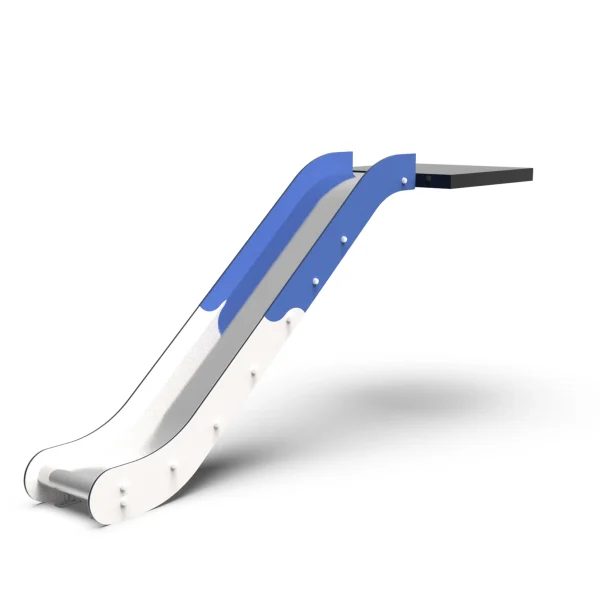
In playground equipment, material decisions usually have more influence on the carbon result than many buyers expect. A large slide system may combine steel tube, stainless components, LLDPE panels, fasteners, and powder coating. Each material carries a different upstream burden and a different replacement interval.
Steel products often dominate the mass in large structures, so recycled content and mill efficiency matter. LLDPE and other plastics are lightweight and durable but carry fossil-based material inputs unless recycled content is specified. Galvanizing and powder coating protect the product and extend service life, but they also add process emissions that should be included rather than omitted. Stainless steel may have higher initial embodied carbon in some comparisons, while its corrosion resistance can reduce replacement and maintenance in coastal or high-humidity environments.
Material choice is often the largest carbon lever in play equipment. <Playground Slide Materials LLDPE vs 304 Steel Performance> covers how LLDPE and 304 stainless compare on performance, which also shapes replacement and maintenance emissions.
Structuring the Supplier Carbon Questionnaire
Before sending the questionnaire, fix the evaluation rules. Ask every supplier to state the following for each reported figure:
- Reporting standard and version
- Data year
- Organizational or product boundary
- Allocation method
- Units and emission factors used
- Third-party verification or assurance status
- Whether the data covers the full product or only selected components
A supplier that answers with a brochure instead of a data file has not answered the question. For a worked example of how playground product data can be assembled for a tender, use the contact details in the final section.
Red Flags in Weak Carbon Data
Experienced procurement teams watch for patterns that indicate the carbon number may not survive audit:
- No base year or data boundary
- Intensity ratios without underlying activity data
- No material weight table
- Carbon neutrality claims without offset documentation
- Exclusion of freight or packaging
- No stated allocation method for multi-product factories
ISO 14064-1 and ISO 14067 both require transparency about boundaries, data sources, and allocation [6][7]. If those elements are missing, the supplier may be well-intentioned but not yet audit-ready.
Durability and Replacement: The Missing Half of the Footprint
A carbon footprint that stops at the factory gate can mislead the tender evaluation. The use phase and service life matter because frequent replacement multiplies the upstream burden. A playground component that requires early replacement may have a worse whole-life performance than a heavier but longer-lasting alternative.
Buyers should therefore ask for the expected service life of major components, maintenance requirements, and replacement intervals. This is especially relevant for public playgrounds where equipment may remain in use for a decade or more.
Carbon reporting should include the replacement interval, not only the initial purchase. <Old Playground Renovation Keep or Replace Decisions> covers the practical factors to weigh before buying new equipment, a key input for whole-life carbon calculations.
Making Supplier Data Comparable Across Shortlisted Bids
Raw carbon totals are rarely comparable across suppliers unless the boundary and functional unit are standardized. Ask suppliers to express the product carbon footprint per declared unit, such as per complete product, per expected service year, or per material mass. State the functional unit in the tender documentation so that all bids answer the same question.
Procurement teams should also decide how to weigh verified data against incomplete data. A supplier with third-party verification may justify a higher score than one with a larger but unverified claim. The best response is specific, evidence-backed, and aligned with the buyer’s reporting standard.
Request a Carbon Data Pack for Your Tender
If you are preparing a European playground tender and need supplier data structured to the fields above, Suzhou LvDong Amusement Equipment Co., Ltd. can provide a carbon data pack covering material weight breakdowns, production energy data, surface treatment, packaging, and shipment assumptions. Contact us at [email protected] or WhatsApp +8613915684545 with your tender reference and the reporting standard you must satisfy. Specify whether you need a product-level or organizational-level response, and we will assemble the evidence file accordingly.
FAQ
Is a supplier carbon footprint the same as a product carbon footprint?
No. A supplier carbon footprint usually covers the whole organization, including all production lines and products. A product carbon footprint allocates emissions to a specific product or project. For European tenders, buyers often need both: product data for tender comparison and supplier data for value-chain reporting under ESRS E1 [4][6][7].
Which standard should we request for playground equipment?
Request ISO 14067 for product carbon footprint quantification and ISO 14064-1 for organizational data [6][7]. If the tender uses construction-sector environmental product declarations, EN 15804 is the relevant framework [8]. Check the tender text first, because the accepted standard may already be specified.
How can we verify supplier data without visiting the factory?
Ask for underlying evidence: energy bills, production logs, mill certificates, material datasheets, transport documents, and mass calculations. Third-party assurance is useful, but the underlying records matter more than the summary claim. A factory visit can help, but it is not the only control.
What if a supplier cannot provide complete Scope 3 data?
Start with Scope 1 and Scope 2 data plus material weights and logistics information. Then ask for a documented improvement plan. In public procurement, treat the response as incomplete unless the tender allows staged data submission. Never convert an estimate into a verified figure simply because the supplier submitted it.
References
[1] European Commission. Buying Green! A Handbook on Green Public Procurement. Publications Office of the European Union.
[2] European Parliament and Council. Regulation (EU) 2020/852 on the Establishment of a Framework to Facilitate Sustainable Investment (Taxonomy Regulation). Official Journal of the European Union.
[3] European Parliament and Council. Directive (EU) 2022/2464 as Regards Corporate Sustainability Reporting (CSRD). Official Journal of the European Union.
[4] EFRAG. European Sustainability Reporting Standards: ESRS E1 Climate Change.
[5] WBCSD / WRI. The Greenhouse Gas Protocol: A Corporate Accounting and Reporting Standard.
[6] ISO. ISO 14064-1:2018 Greenhouse Gases — Part 1: Specification with Guidance at the Organization Level for Quantification and Reporting of Greenhouse Gas Emissions and Removals.
[7] ISO. ISO 14067:2018 Greenhouse Gases — Carbon Footprint of Products — Requirements and Guidelines for Quantification.
[8] CEN. EN 15804:2012+A2:2019 Sustainability of Construction Works — Environmental Product Declarations — Core Rules for the Product Category of Construction Products.
If you’re interested, check out these related articles:
Free 3D Design for Community Park Playground Equipment Solutions
Educational vs Entertainment Play Panels A Strategic Guide
Choosing a Soft Play Specialist Indoor Playground Equipment Expertise
Double Slide Playground Design for Optimal Traffic Flow Strategies
Playground Equipment Safety Your Essential Self Inspection Checklist