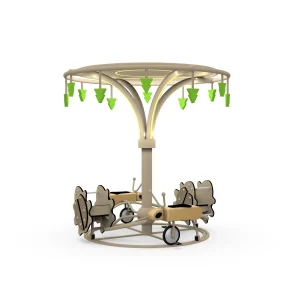
A double-layer green ring spinner solves a familiar playground bottleneck: when six children want to spin at once, the usual single-level wheel leaves them pushing, crowding, and competing for the same handholds. The double-layer layout gives each child a distinct occupied plane and predictable grip, so active players can stand on the upper ring while shorter or less confident children sit or lean on the lower ring. This split does not remove supervision or fall-surfacing requirements, but it changes the social mechanic from competition for one position into parallel rotation on two connected levels.
Why Six Children on One Spinner Usually Creates Conflict
The conflict does not start because children are difficult. It starts because a single-level spinner offers one circle of handholds, one standing radius, and one direction of travel. When six children approach the same rail, the child who arrives late tries to squeeze between two users, the child who wants to spin faster pushes, and the child who feels insecure grips harder or stops the rotation. The result is not always an injury, but it is a consistent supervision problem: the equipment’s capacity does not match its available position count.
Similar crowding appears on multi-user equipment that advertises capacity without giving each user a clear position. A child who cannot see a safe place to hold will usually grab the nearest available edge, which is often already occupied.
How the Double-Layer Ring Structure Distributes Six Players
The double-layer ring changes the occupancy problem by stacking two play planes. The upper ring gives standing or leaning children a rail and foot position above the lower ring, while the lower ring gives seated and shorter children a lower centre of gravity and an easier hold. Because users occupy different vertical levels, they are not reaching for the same handhold at the same time. That separation is the main reason a six-child group can rotate without the pushing that occurs on a single-level wheel.
Upper ring for standing and leaning players
The upper ring works best for children who want to stand, lean, or shift their weight while the unit spins. It places the upper body above the lower users and leaves enough separation for hands and feet to stay clear. In the multi-player spinning-wheel range, the overall height from 70 to 220 cm supports different upper-ring positions, so the configuration can be matched to the site’s age group and reach height.
Lower ring for seated and shorter players
The lower ring gives a more stable position for children who prefer to sit or who cannot comfortably reach the upper rail. Because the centre of mass remains close to the base, the lower position reduces the feeling of being thrown outward. That is useful in mixed-age settings where a six-child group may include smaller and larger children using the same unit at different levels.
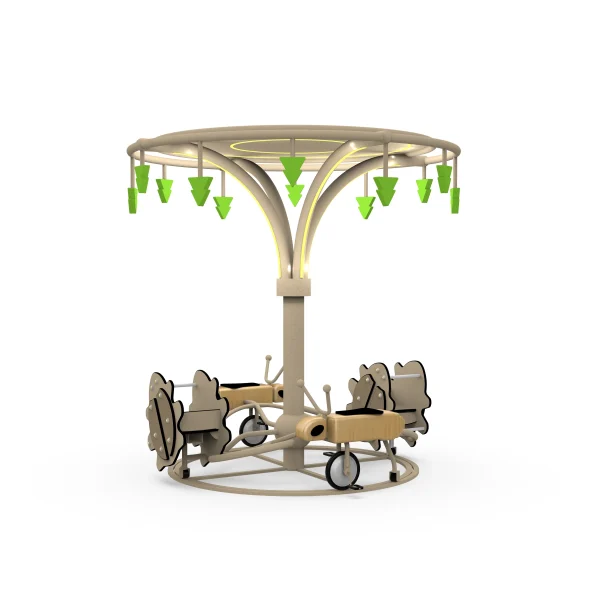
How the Green Ring Works as a Visual and Sensory Zone
The green ring is not simply a decorative colour. In a double-layer configuration, the continuous green band gives children a visible boundary between the upper and lower zones and helps them see where the next available position is. This visual cue reduces the hesitation that occurs when children stop to search for a handhold while the spinner is already moving. A high-contrast colour zone also makes the spinning structure easier for supervisors to scan from a distance.
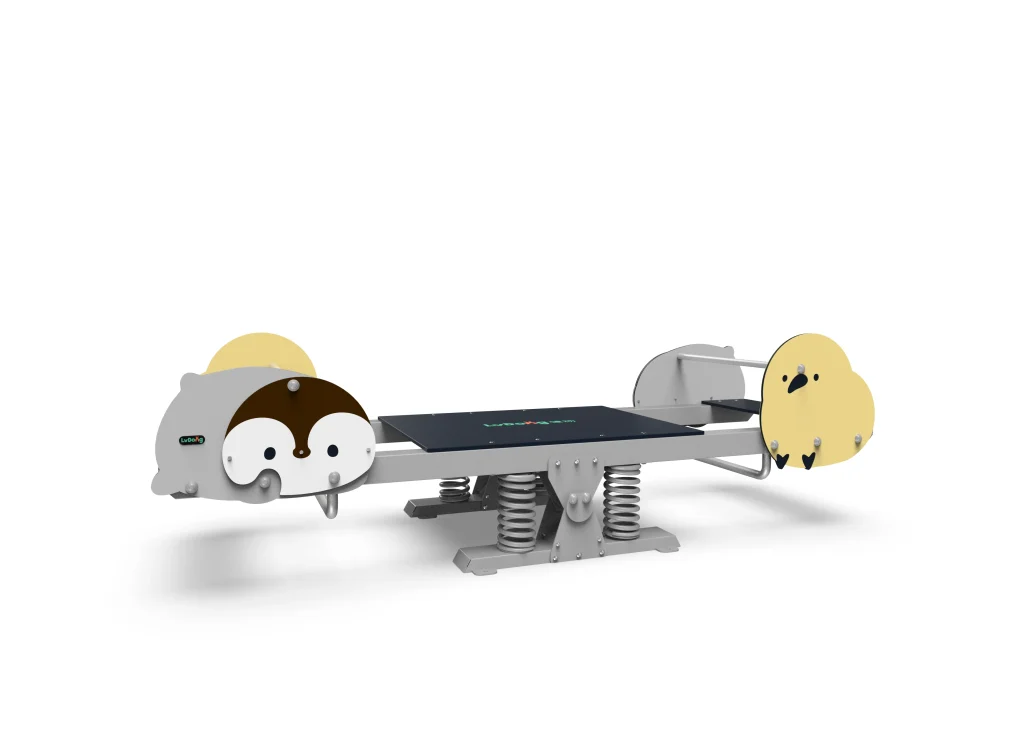
The same visual logic applies to other multi-user equipment: a clearly defined seat or position lets children choose a place instead of grabbing the nearest edge.
Speed Control and Fall-Height Limits That Keep Group Play Safer
Group capacity is only useful when the movement stays predictable. The spinner’s round base and controlled rotation keep acceleration gradual, so children are less likely to be thrown into each other. In the multi-player range, the maximum falling height is 55 to 77 cm depending on model and configuration. That number is not a safety promise on its own. It determines the required impact-attenuating surface around the unit and should be checked against the site’s installed surfacing depth.
| Design feature | What it supports in six-child play | What it does not prove |
|---|---|---|
| Two-level upper and lower ring | Separates handholds and reduces competing for the same rail | Does not remove the need for age-appropriate supervision |
| Continuous green ring | Gives children a visible zone cue and position choice | Does not replace fall surfacing or use-zone planning |
| Controlled rotation | Keeps acceleration gradual during group movement | Does not eliminate all rotational risk |
| 55 to 77 cm maximum falling height | Defines the fall height for impact attenuation | Does not mean every configuration has the same clearance |
| Stable round spinning base | Supports seated and standing play on one unit | Does not prevent misuse or overloading |
The supplied product range is stated as compliant with EN 1176 and GB/T 34272-2017. Compliance supports a design baseline, but it still has to be paired with correct installation, surfacing, and operational checks.
What to Check Before Specifying a Six-Child Spinner
Before accepting a supplier’s capacity label, confirm three site-level details. First, check the age range and model configuration. The spinning-wheel range covers children from about 2 years and up depending on model, so the unit must fit the actual children using it. Second, check maximum falling height against the installed surfacing. Third, ask how the upper ring is fixed and whether handholds are continuous or segmented, because a gap in the rail can become the next contention point.
A six-child capacity claim should be supported by a clear safety-standard reference and the site-specific fall-height calculation. If the quote only states compliance without the test report or installation checklist, keep the decision open until those documents are supplied.
A capacity label is not the same as verified test data. <Essential Checklist for Playground Equipment Safety Test Reports> covers the documents buyers should request before accepting a spinner.
Supplier selection matters because a spinner is a moving assembly, not a static sculpture. Ask how the manufacturer controls welding, bearing quality, and surface finishing, and request the inspection records that apply to rotating components. These questions are more predictive of long-term performance than a colour photo or a single price line.
Moving play equipment depends on supplier process controls more than catalogue presentation. <20 Essential Questions Choosing a Playground Equipment Supplier> covers the questions that separate documented manufacturing control from verbal assurance.
Daily Supervision and Maintenance for a Busy Multi-User Spinner
Even the best two-level design needs a brief daily check. Before the playground opens, confirm the upper ring and lower ring are free of debris, the handholds are secure, and the base rotates without grinding. Because six children can load the unit quickly, the supervisor should also watch for children entering the rotation path from behind or kneeling on the lower ring while the upper ring is occupied.
A five-minute daily check can prevent most bearing and fastening problems before they interrupt play. <Annual Maintenance Calendar for Outdoor Play Equipment A Guide> covers seasonal maintenance tasks for playground operators.
Plan a Six-Child Spinner for Your Site
Tell us your age-group split, available surfacing depth, and expected peak group size. We can check the double-layer configuration against the site’s falling-height and use-zone requirements and recommend the right upper-ring and lower-ring layout. Contact Suzhou LvDong Amusement Equipment Co., Ltd. at [email protected] or WhatsApp +8613915684545.
FAQ
Is the double-layer green ring spinner suitable for mixed ages?
The multi-player spinning-wheel range is designed for children from about 2 years and up depending on model, with a capacity of 6 to 10 children per unit. Mixed-age groups work best when younger children use the lower ring and older children use the upper ring, but the actual age split should match the installed fall surfacing and the site’s supervision plan.
Does the two-level design require more fall surfacing than a single-level spinner?
Surfacing is based on maximum falling height, not the number of levels. The multi-player range has a maximum falling height of 55 to 77 cm, so the surfacing thickness and area should be confirmed against that figure and the use zone required for the installed configuration.
How many children can use it at one time without crowding?
The product range supports 6 to 10 children per unit depending on model. The double-layer ring is intended to reduce conflict at six-child occupancy by giving users separate upper and lower positions, but actual comfort still depends on age mix and whether children stay in their selected zones.
What maintenance does the upper ring require?
Inspect the upper ring handholds, fasteners, and connection points daily, and check the rotation of the whole base during the same walkthrough. Debris between rings, loose bolts, or a change in rotation noise should be addressed before the equipment returns to service.
Can the spinner be used in an indoor play centre?
Indoor use is possible for models with the right clearance and surfacing. Confirm ceiling height, fall surfacing under the unit, access to the spinner, and the supplier’s installation checklist before making the placement final.
If you’re interested, check out these related articles:
Playground Slides Buying Guide Height Slope and Critical Safety
Sensory Playground Panels Touch Visual Audio Options
Replacing Chains Bearings Springs Lifespan Guide Strategies
DIY vs Supplier Playground Equipment Installation Guide
Key Contract Clauses for Commercial Playground Equipment Purchase