University campus daycare centers have a different mandate from most community playgrounds. The equipment must be safe, durable, and engaging, but it also needs to function as a consistent environment for observation, research, and developmental assessment. A climbing structure is not only a place to play; it can be a setting where graduate students record gross motor patterns, where faculty study peer interaction, and where equipment decisions themselves become part of an evidence base. Selecting equipment for this context benefits from a research-backed approach that balances child development goals, safety documentation, and long-term operational clarity.
Why the Campus Daycare Context Changes Equipment Decisions
In a university-affiliated daycare, playground equipment often serves multiple stakeholders. Researchers may need predictable play conditions. Early childhood educators need equipment that supports the curriculum. Facility managers need clear maintenance and compliance records. Parents expect the same safety and comfort they would find in a high-quality community setting.
A research-grade playground is not necessarily more expensive or more complex. It is simply selected with more attention to repeatability, observational access, and documentation. Researchers studying vestibular development want a spinner with controlled, stable motion rather than an unpredictable or aggressive ride. Researchers studying social negotiation want a seesaw or multi-child platform where turn-taking and communication naturally occur. In each case, the equipment choice should be transparent and explainable.
Motor Development and Physical Activity: What the Evidence Suggests
Physical activity guidance for young children is clear. The World Health Organization recommends that children aged 3–4 accumulate at least 180 minutes of physical activity spread throughout the day, with a portion of that time involving energetic play [1]. By ages 5–17, the recommendation shifts to at least 60 minutes of moderate-to-vigorous physical activity daily [1]. Campus daycare playgrounds can support these targets when equipment invites repeated movement instead of passive waiting.
Slides, spring riders, spinning equipment, and climbing transitions each engage different motor systems. A slide supports proprioceptive input, sequencing, and postural control. Spring riders encourage balance reactions, core activation, and rhythmic movement. Spinning equipment stimulates the vestibular system while requiring the child to maintain body position. A well-planned playground offers these movement types without forcing every child into the same path.
<img src="https://lvdongtoys.com/wp-content/uploads/2026/02/playground-tube-slides-for-sale_20260202_175352.webp" alt="playground tube slides for sale" style="max-width: 600px; height: auto; display: block; margin: 20px auto;" />
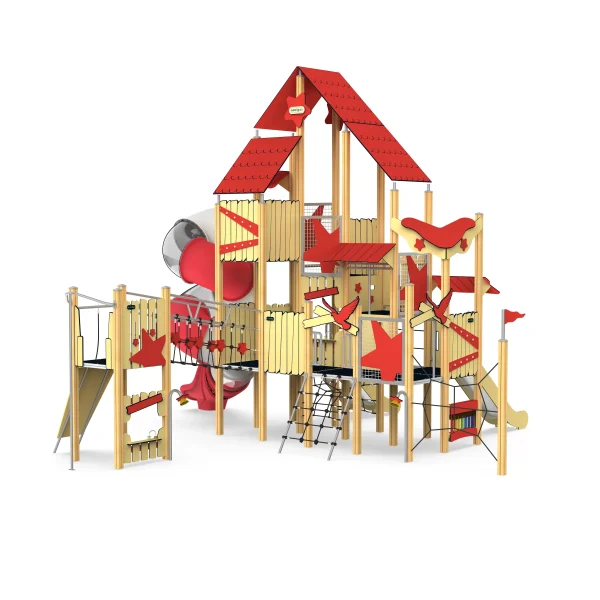
Enclosed tunnel slides add spatial awareness and motor planning demands. The child must anticipate the bend, adjust body position, and tolerate a brief change in visual input. For research settings, this kind of movement can be valuable when the study focuses on sensory integration or motor confidence.
<img src="https://lvdongtoys.com/wp-content/uploads/2026/02/Playground-with-tunnel-slide_20260202_175401.webp" alt="Playground with tunnel slide" style="max-width: 600px; height: auto; display: block; margin: 20px auto;" />
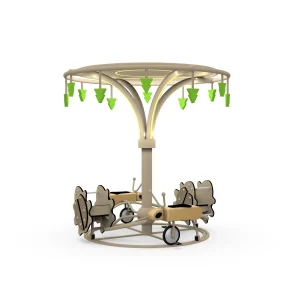
Spinning play deserves particular attention. Rotary movement supports vestibular and sensorimotor regulation, but equipment quality matters. The motion should be smooth and predictable, with hand grip positions and a stable base. Product parameters for multi-user spinning equipment commonly list user capacities of 6–10 children, with maximum falling heights near 55–77 cm depending on the model. Those figures should always be reviewed with the supplier and checked against the installed safety surfacing.
Spinning play supports vestibular and sensorimotor regulation, but equipment must be chosen carefully for research settings. <Child Development Benefits Playground Spinning Toy Impact> covers the developmental evidence behind rotary play.
Social-Emotional Development in Structured and Unstructured Play
Social development is one of the most observable outcomes in a campus daycare playground. Cooperative equipment such as multi-person seesaws and group spinners creates natural opportunities for negotiation, shared goals, and peer modeling. The National Association for the Education of Young Children frames play as a central vehicle for developing self-regulation, problem-solving, and social competence in early childhood [2]. Equipment selection can either support or limit those opportunities.
<img src="https://lvdongtoys.com/wp-content/uploads/2026/02/Playground-Seesaw_20260202_175340.webp" alt="Playground Seesaw" style="max-width: 600px; height: auto; display: block; margin: 20px auto;" />
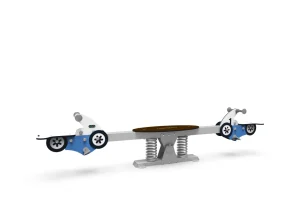
A multi-person seesaw requires children to coordinate their movements, adapt to a partner’s weight, and manage frustration when balance is uneven. This is often exactly what educators and researchers want to observe. The movement should be damped enough to avoid sudden jolts, especially for preschoolers. A spring-assisted seesaw can provide a smoother descent than a rigid pivot, reducing fear and keeping attention on social interaction rather than physical discomfort.
<img src="https://lvdongtoys.com/wp-content/uploads/2026/02/Commercial-teeter-totter_20260202_175304.webp" alt="Commercial teeter totter" style="max-width: 600px; height: auto; display: block; margin: 20px auto;" />
Group spinning wheels and multi-child platforms also support social play. When capacity is clear and the speed is controlled, children practice waiting, inviting peers, and shared excitement. For campus daycare research, documenting how often children initiate social contact on specific equipment can be easier when the equipment zone is visible from a central observation point.
Cognitive and Sensory Learning Through Play Panels and Interactive Equipment
Cognitive development in the playground often happens through cause-and-effect exploration, sequencing, and sensory discrimination. Play panels and interactive equipment can support these processes without turning the outdoor space into an indoor classroom. The value is in the integration: a child manipulates a panel, hears or sees a result, and repeats or modifies the action.
<img src="https://lvdongtoys.com/wp-content/uploads/2026/02/Interactive-Playground-Equipment_20260202_175330.webp" alt="Interactive Playground Equipment" style="max-width: 600px; height: auto; display: block; margin: 20px auto;" />
Sensory panels with tactile surfaces, moving parts, and visual contrasts can be used for studies of attention, fine motor control, and sensory preference. For campus programs that include children with developmental differences, these panels allow observation of how sensory input affects engagement. Manufacturers may offer different audio, visual, and tactile options, but the selection should be driven by the intended developmental outcome, not by electronic complexity alone.
Interactive features that use mechanical engagement rather than screen-based feedback often hold up better outdoors and are easier to maintain in high-use settings. They also keep the play experience physical, which aligns with the broader goal of reducing sedentary time in early childhood environments.
Inclusive and Neurodiversity-Aware Design for Research Settings
Inclusive playground design supports research validity as well as ethical access. When a playground excludes children with mobility, sensory, or communication differences, any study conducted there produces incomplete data. The U.S. Access Board’s accessibility standards and related playground guidance emphasize accessible routes, ground-level play opportunities, and the removal of unnecessary barriers [3]. Campus daycare settings should treat these standards as a baseline, not an aspiration.
Ground-level play panels, accessible spinner entries, and transfer platforms allow a wider range of children to participate. Sensory panels that provide predictable tactile or auditory feedback can support children who need a quiet, low-demand activity before joining more active play. Equipment should not segregate children by ability; instead, it should create overlapping options where children of different needs can engage side by side.
Inclusive campus projects benefit from sensory play panels designed for varied processing needs. <Sensory Play Panels Inclusive Design for Special Needs> covers panel selection for accessible research and therapy environments.
Safety Standards and Research-Grade Documentation
Safety in a campus daycare playground must be documented, not assumed. The U.S. Consumer Product Safety Commission’s Public Playground Safety Handbook provides guidance on age separation, surfacing, and equipment use zones [4]. ASTM F1487-21 establishes performance requirements for public playground equipment in the United States [5]. In Europe and many international markets, EN 1176 defines structural integrity, entrapment requirements, and test methods [6]. A university procurement team should request evidence that the equipment meets the standards applicable to its region.
Compliance claims should be supported by test reports, material certifications, and clear installation requirements. Product documentation for LvDong playground equipment states compliance with EN 1176 and GB/T 34272-2017, but buyers should still verify the exact model, production batch, and installation conditions. A test report is not a decoration; it is a decision-making document that should be reviewed alongside the site plan.
For university procurement teams, documentation quality can determine whether a playground passes review. <Essential Checklist for Playground Equipment Safety Test Reports> covers the test reports and certificates buyers should request before purchase.
Safety also includes design details that affect daily supervision. Clear sight lines, age-appropriate fall heights, and adequate spacing between moving parts reduce the chance of collision. Acoustic noise levels matter more on a campus where nearby classrooms or offices may be sensitive. Selecting equipment with controlled motion and durable, low-maintenance components helps keep the research environment stable over repeated observation periods.
A Practical Note for Campus Procurement Teams
When equipment must support research protocols, specify observation zones, age groups, and measurement needs early. Send your site dimensions, surfacing plans, and the motor or sensory outcomes you intend to study to [email protected]. A clear inquiry should also list the required safety standards and whether you need data-collection-friendly mounting or temporary reconfiguration.
Zoning, Observation, and Data Collection Layouts
A campus daycare playground should be organized so that researchers and teachers can observe without disrupting play. Age separation is one useful principle. Toddlers and preschoolers have different fall-height tolerances, supervision needs, and social patterns. Separate zones for ages 2–5 and 5–12 reduce conflicts and make research observation more consistent [4].
The layout should also account for movement flow. High-energy equipment such as slides and spinners should not empty directly into quiet sensory spaces. Seating for researchers, coded zones for video recording, and unobstructed sight lines from central gathering areas improve data quality. If the campus plans to use temporary or rotating research equipment, modular or low-footprint items may be easier to reconfigure without compromising safety clearances.
Maintenance and Research Continuity
Research continuity depends on predictable maintenance. A broken spring rider or a stiff spinner bearing can change how children use the playground and introduce unmeasured variables into a study. Maintenance records should be kept with the same care as research logs.
Daily checks should confirm that surfaces are clean, moving parts function smoothly, and fasteners remain tight. Monthly and annual inspections should follow the manufacturer’s schedule and local regulatory expectations. Common maintenance points include spring steel assemblies, rotating bearings, chain connections, and play panel surfaces. When replacement parts are required, the lead time and year-over-year availability should be part of the original purchase decision. A playground that performs differently in year two than in year one is a problem for both child care and research.
Procurement Checklist for University Daycare Projects
Before finalizing a campus daycare playground purchase, a procurement team should clarify the following:
- The age range of children who will use the space
- Required safety standards by region, such as EN 1176 or ASTM F1487
- The specific motor, social, and sensory outcomes the equipment should support
- Observation and data collection requirements, including camera positions and sight lines
- Accessibility requirements for children and caregivers with disabilities
- Surfacing plans, fall height data, and equipment use zones
- Documentation needed for institutional review, insurance, and liability review
- Long-term maintenance, spare parts, and inspection support
This list turns a general playground request into a research-compatible specification. It also helps suppliers provide accurate, comparable information instead of generic product suggestions.
Planning a Research-Ready Campus Daycare Playground
A university campus daycare playground works best when the equipment supports daily child care and structured research at the same time. That means choosing movement-rich, socially engaging, and sensory-aware equipment; documenting safety compliance clearly; and planning the layout for observation and inclusion.
If your campus is preparing a childcare or research playground, contact Suzhou LvDong Amusement Equipment Co., Ltd. at [email protected] or WhatsApp +8613915684545. A useful inquiry will include your site plan, age groups, required safety standards, observational goals, and any special accessibility needs. This helps the design team recommend equipment that fits the research environment without adding unnecessary complexity.
FAQ
What safety standards should university campus daycare playground equipment meet?
The applicable standards depend on the country of installation. In the United States, ASTM F1487-21 and the CPSC Public Playground Safety Handbook are common benchmarks. In Europe, EN 1176 applies. University buyers should confirm which standard their insurer, state licensing body, or institutional safety office expects, and request supporting test reports for each installed item.
How much space is needed for a campus daycare research playground?
There is no single answer, but the layout must include the equipment itself plus protective surfacing and use zones around moving parts. A compact playground can still support research if the design uses vertical play, low-footprint spinning equipment, and panel-based activity zones. The key is to leave enough separation between high-motion and quiet areas.
Which equipment types are best for observing gross motor development?
Slides, spring riders, spinning equipment, and climbing transitions provide different gross motor patterns. Slides support sequencing and postural control. Spring riders support balance and core activation. Spinning equipment provides vestibular stimulation. A mixed selection gives researchers more observable movement variety than a single equipment type.
How can campus daycares support inclusive play in research settings?
Inclusive play benefits from ground-level panels, accessible spinners, transfer platforms, and sensory activities that do not separate children by ability. Equipment should allow children with different sensory needs and mobility levels to use adjacent or shared spaces. Documentation of accessible routes and clear ground space is also part of the design review.
What documentation should university procurement teams request from manufacturers?
Buyers should request safety test reports, material certifications, installation instructions, age-range specifications, and maintenance schedules. If the equipment will be used in research, the manufacturer should also provide clear product parameters such as fall height, user capacity, and motion type. These details help researchers describe the play environment accurately.
How often should campus daycare playgrounds be inspected?
A daily visual check should confirm clean surfaces, secure fasteners, and smooth movement. Monthly checks can cover wear on bearings, springs, and connectors. A detailed annual inspection should follow the manufacturer’s schedule and any local regulatory requirements. Research teams should treat inspection logs as part of the study record when equipment status could influence child behavior.
References
[1] World Health Organization. Guidelines on Physical Activity, Sedentary Behaviour and Sleep for Children Under 5 Years of Age. Geneva: WHO; 2019.
[2] National Association for the Education of Young Children. Developmentally Appropriate Practice in Early Childhood Programs Serving Children from Birth Through Age 8. 4th ed. Washington, DC: NAEYC; 2022.
[3] U.S. Access Board. Americans with Disabilities Act Accessibility Standards. Washington, DC; 2010.
[4] U.S. Consumer Product Safety Commission. Public Playground Safety Handbook. Bethesda, MD: CPSC; 2015.
[5] ASTM International. ASTM F1487-21 Standard Consumer Safety Performance Specification for Playground Equipment for Public Use. West Conshohocken, PA: ASTM; 2021.
[6] European Committee for Standardization. EN 1176-1 Playground Equipment and Surfacing—Part 1: General Safety Requirements and Test Methods. Brussels: CEN; 2017.
If you’re interested, check out these related articles:
Safe Quiet Cleanable Playground Equipment for Hospitals
Negotiating Bulk Playground Equipment Orders Expert Strategies
Single vs Double Seat Playground Horse Spring Riders A Comparison