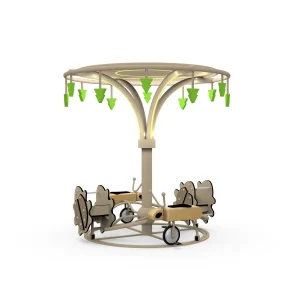
Gated community entry plazas often function as a development’s first physical handshake. The gatehouse, signage, landscaping, and arrival geometry tell a visitor what daily life might feel like before the car door opens. A well-placed play sculpture can turn that arrival zone into a family-focused landmark: distinctive enough for listing photography, tactile enough to invite interaction, and engineered enough to meet public playground expectations.
But moving from decorative art to playable sculpture changes the brief. Fall surfacing, clearance zones, entrapment gaps, maintenance access, and color retention become design criteria rather than afterthoughts. The sections below walk through the planning path for developers, HOA boards, and landscape architects considering a statement play piece in a controlled-access residential setting.
Why Entry Plazas Shape Buyer Perception
An entry plaza is one of the few shared spaces every resident passes daily. For prospective buyers, it also works as a memory anchor. A distinctive sculptural object makes the community easier to describe and harder to confuse with a competing development. In family-oriented projects, visible playable elements signal that children are welcomed rather than merely tolerated. Active outdoor play is also closely aligned with healthy child development, including physical activity and social interaction [1].
The same feature can serve as an informal wayfinding cue: residents may say “turn left at the whale seesaw” or “our unit faces the blue spinner.” That everyday recognition supports a stronger sense of place without adding a separate marketing campaign.
What Makes a Play Sculpture a Statement Piece
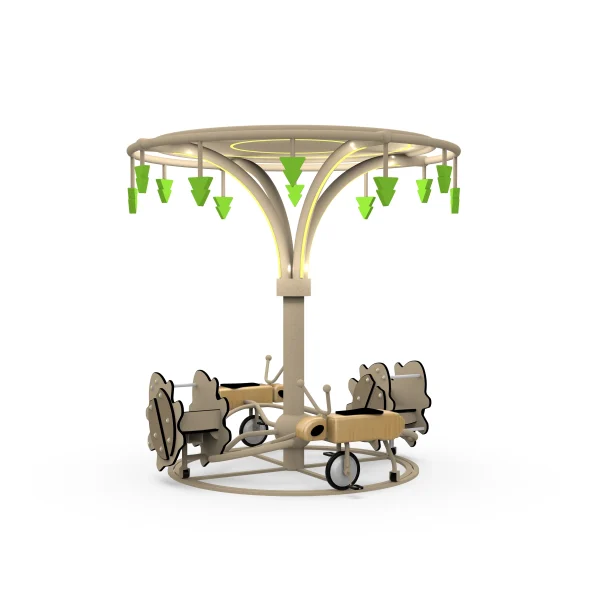
A statement play sculpture is not simply a large object in the middle of a plaza. It earns attention through silhouette, material quality, and the promise of use. Decorative art can be seen; playable sculpture can be touched, climbed, balanced on, or shared. That interactive quality is what makes it feel like part of the community rather than a barrier.
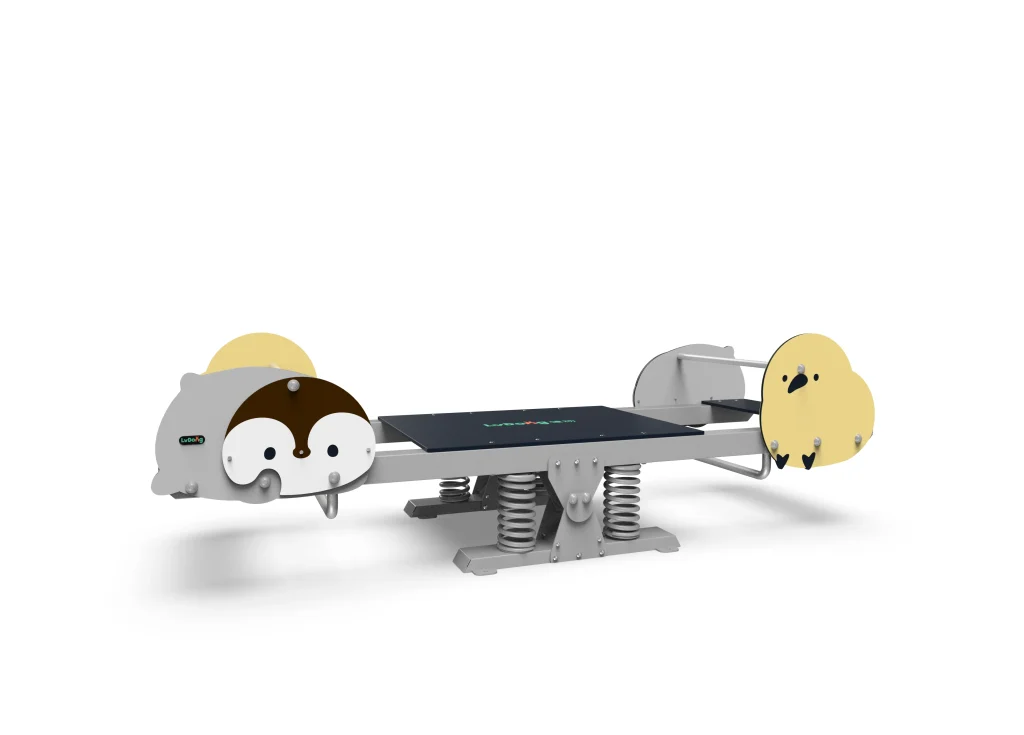
Common entry plaza options include oversized spring riders, sculptural seesaws, multi-child spinners, and compact play structures with a defining visual motif. Lvdong’s multi-player spinning wheel models, for example, range from 120 to 200 cm in diameter and 70 to 220 cm in height, supporting six to ten children depending on configuration. Their maximum falling height is 55 to 77 cm, which helps the design team plan the surrounding impact-attenuating surface. Sculptural seesaws can support two to ten children with a maximum fall height of 60 cm, while spring riders offer a compact single-child option with a fall height of 50 cm.
Custom entry sculptures work best when the theme, scale, and surface geometry are decided alongside the rest of the plaza. <Pre Configured vs Custom Designed Playground Play Sets A Strategic Guide> covers how pre-configured and custom systems compare for footprint and project control.
Safety and Standards for Public-Ready Plazas
Once a sculpture becomes playable, it falls into the public playground equipment category. European projects are generally specified to EN 1176-1 for structural integrity, impact attenuation, entrapment, and protrusion requirements [2]. U.S. projects commonly reference ASTM F1487 for public-use playground performance [3]. The CPSC Public Playground Safety Handbook adds practical guidance on surfacing, use zones, and supervision [4].
Design decisions that make a statement cannot override those standards. The surrounding free space should account for the movement envelope of each play action, the fall height of the highest accessible point, and the trajectory of children leaving the equipment. For a spinner with a fall height above 60 cm, the site will typically need an impact-attenuating surface in the fall zone rather than decorative stone or bare turf [4]. Gaps, fasteners, rails, and pivot points all need probe-test consideration, especially when the piece sits in a high-visibility shared space.
Material and Finish Choices for All-Weather Curb Appeal
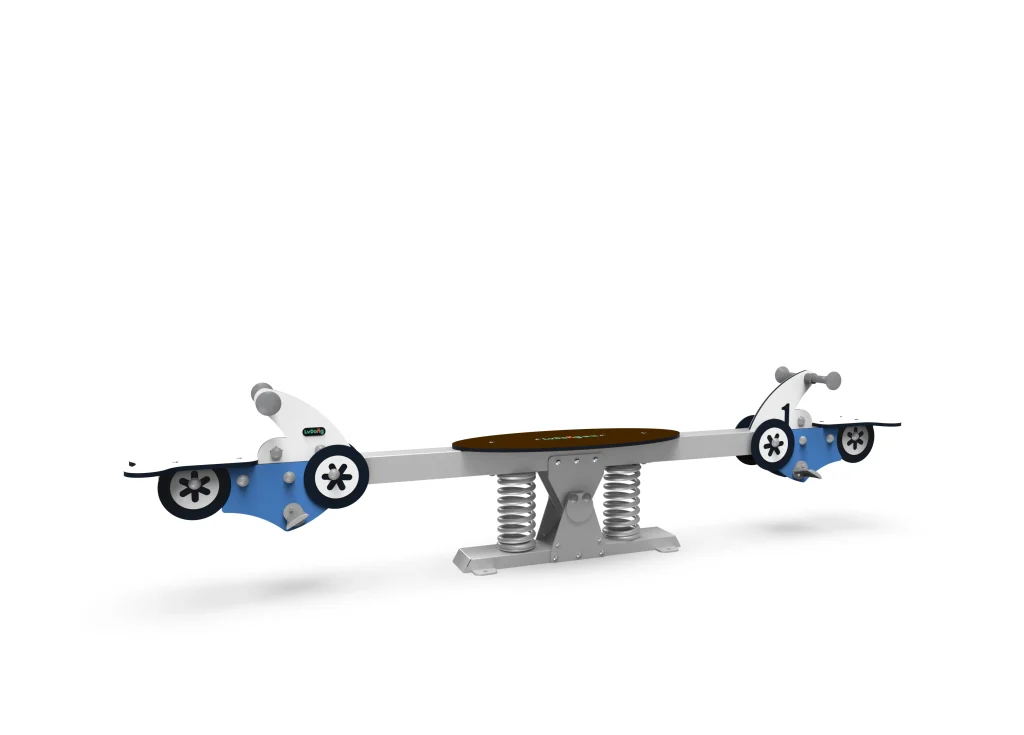
An entry plaza sculpture must hold its color and finish through sun, rain, freeze-thaw cycles, and heavy daily exposure. Galvanized steel frames form a corrosion-resistant base, while powder-coated surfaces carry brand or landscape colors. For humid or coastal locations, stainless steel components may be specified in high-contact areas where salt spray accelerates rust. UV-stable pigments and weather-resistant coatings help prevent the premature fading that turns a sculpture from premium to neglected.
Lvdong’s spring riders use high-strength steel springs and weather-resistant structures designed for outdoor sun and rain, while multi-child spinners are built from wear-resistant materials for high-frequency use. The same material discipline applies whether the piece is placed in a desert community or a coastal resort.
For entry plazas in high-sun climates, color fading can change the statement from premium to neglected within two seasons. <UV Resistance Testing Protecting Outdoor Playground Spring Riders> covers how accelerated UV testing and material choices protect long-term color and finish.
Budgeting and Procurement Without Hidden Costs
Entry plaza projects often look simple at first because the playable object is a single focal point. The budget becomes clearer when the quote separates five areas: the sculpture itself, structural foundation work, impact-attenuating surfacing, drainage and base preparation, and freight with installation. Site access can also add cost when a tall or heavy piece requires a crane or widened delivery route.
Request unit-level dimensions, weight, fall height, and recommended anchoring details before comparing suppliers. That allows an apples-to-apples review of structural steel, finish warranty, spare parts availability, and after-sales support. A low initial unit price is less useful if it omits the foundation template, installation guidance, or replacement components.
For a detailed entry plaza layout, sculpture recommendation, and itemized budget review, email site dimensions and an idea of the planned theme to [email protected]. Lvdong’s design team can check the preferred equipment against the required use zone and falling height before final selections are made.
Budget confusion usually appears in line items like foundation concrete, fall surfacing, drainage, and crane access before the first unit is delivered. <Playground Equipment Quotes Spotting Hidden Costs Explained> covers how to compare quotes line by line and avoid hidden project costs.
Plan Your Entry Plaza Play Statement
A statement play sculpture succeeds when it works as a visual landmark, a family amenity, and a maintainable public feature at the same time. That rarely happens by choosing the largest item in a catalog. It happens through a simple design review: identify the arrival sightline, define the play behavior, check the standards envelope, and then select materials and finishes that will still look intentional after several years.
Suzhou LvDong Amusement Equipment Co., Ltd. supports gated community projects from early concept sketches and 3D visuals through production, installation guidance, and after-sales support. To discuss a custom or pre-configured entry plaza piece, contact the team on WhatsApp at +8613915684545 or by email at [email protected].
FAQ
Is a play sculpture in an entry plaza covered by playground safety standards?
Yes, when it is designed for touching, climbing, balancing, sitting, or spinning. Once equipment invites play, it should be specified to the relevant playground standard in the project market, such as EN 1176 in Europe or ASTM F1487 in the United States [2][3].
What foundation and surfacing does a statement play sculpture need?
The foundation depends on soil conditions, wind loads, equipment mass, and the dynamic forces generated during use. The surrounding surface must be selected for the highest accessible fall height. Areas with fall heights above the surfacing limit generally require impact-attenuating material such as engineered wood fiber, rubber tiles, or poured-in-place rubber.
How can a community manage liability concerns?
The most practical controls are early design review, compliance with applicable standards, installation by trained personnel, documented inspections, and a maintenance schedule. A visually playable piece that does not meet play-equipment requirements is more difficult to manage than one that has been specified as equipment from the start [4].
How long does a custom entry plaza project take?
A custom piece usually moves through sketch approval, 3D visualization, engineering, production, inspection, and freight. Smaller pre-configured units can ship quickly, while fully custom themed pieces often require longer production windows. Confirming the production slot early is especially important before peak construction seasons.
Can the sculpture reflect a specific theme or brand?
Yes. Many gated communities use marine, botanical, animal, or architectural motifs that match the development name or entrance landscape. Powder coating can match brand colors, and panels can include community names or graphical elements. The key is to keep the themed surface durable enough for public exposure.
References
[1] Yogman, M., Garner, A., Hutchinson, J., Hirsh-Pasek, K., & Golinkoff, R. M. (2018). The Power of Play: A Pediatric Role in Enhancing Development in Young Children. Pediatrics, 142(3), e20182058.
[2] EN 1176-1:2017. Playground equipment and surfacing — Part 1: General safety requirements and test methods. European Committee for Standardization.
[3] ASTM F1487-21. Standard Consumer Safety Performance Specification for Playground Equipment for Public Use. ASTM International.
[4] U.S. Consumer Product Safety Commission. Public Playground Safety Handbook. CPSC Publication No. 325.
If you’re interested, check out these related articles:
Playground Equipment Safety Your Essential Self Inspection Checklist
Indoor Playground Design Consultation Your Project Blueprint