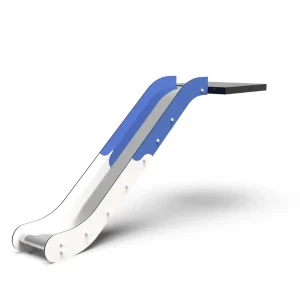
Curved slide banked turns do more than change direction. They manage the sideways force a moving child creates when the slide curves, and the banking angle is the main control for that force. When the angle is too flat, the child drifts into the outer wall or tips toward the exit edge. We treat this as a safety calculation, not a styling choice. This article explains how inclination angles reduce side ejection, what design checks matter before production, and how to confirm a curved slide will behave after installation.
Why a Flat Curved Slide Turn Causes Side Ejection
Most sliding failures at a curve are not caused by the child losing grip. They come from the slide changing direction while the child keeps moving in a straight line. The faster the entry speed and the tighter the radius, the harder the child is pushed toward the outer side of the turn. On an unbanked or lightly banked turn, that force loads the outer side wall and the child’s upper body, which can tip a smaller rider toward the edge.
Curved slide banked turns reduce this by tilting the slide bed toward the inside of the curve. The tilt turns some of the outward force into a reaction against the slide surface, so the child stays closer to the intended path instead of riding against the outer wall. We see the difference in production checks: turns with a shallow bank show heavier scuffing and side wall contact, while properly banked profiles carry the rider more evenly through the curve.
Banking is not the only variable. Entry speed, turn radius, side wall height, and rider position all work together. A steep bank on a wide radius can feel tippy, while a low bank on a tight radius can push a child outward before the side wall can contain the movement. That is why we treat each curved slide route as a set of interacting dimensions rather than a fixed rule.
How Inclination Angles Work in a Curved Slide Banked Turn
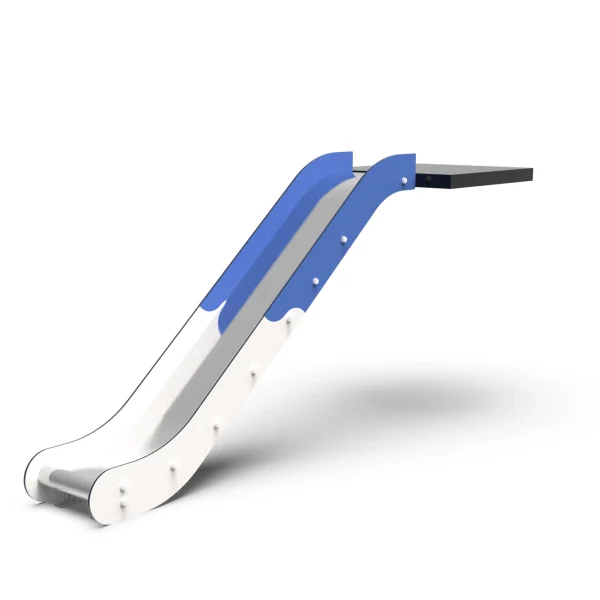
The angle we call banking in a slide is the cross slope of the slide bed through the turn. When a child enters a curve, two things happen: the slide bed rotates under the child, and the child’s momentum continues along the previous path. The banking angle converts some of the resulting sideways motion into a normal force against the bed, which improves rider stability without relying only on the outer wall.
From a design perspective, the useful banking range for curved slide turns is usually modest. Very high angles create their own problem because a stopped or slow child may sit awkwardly or slide sideways toward the inside. The practical target is the minimum angle that keeps the expected rider within the slide path at the highest foreseeable entry speed. We determine that by reviewing the slide height, the preceding straight section, and the worst case rider position.
| Design factor | What we check | Why it matters |
|---|---|---|
| Turn radius | Minimum centerline radius against the slide length | Tighter radius increases outward force |
| Banking angle | Cross slope at the turn entry, midpoint, and exit | Balances lateral force with seated stability |
| Side wall height | Clearance above the slide bed at the outer edge | Contains a rider who enters faster than planned |
| Exit transition | Straight runout length after the turn | Lets the rider leave the curve without a sharp redirect |
There is no single banking angle that works for every curved slide. The banking profile must be checked against the same EN 1176 and GB/T 34272-2017 safety framework we use for the rest of the playground unit. We also compare the dry surface assumption with the wet condition because an outdoor slide on a rainy day can carry more speed than the design calculation used.
Before a curved slide route is released to production, the banking profile should be checked in three dimensions rather than drawn as a flat centerline. <Custom Playground Slide Design From Vision to 3D Reality> covers how custom slide geometry moves from concept to a reviewable 3D model, and why that step catches turn issues before tooling begins.
Design Checks That Validate Curved Slide Banked Turns
Before we approve a curved slide banked turn, we run a short set of checks. These checks separate a turn that works on paper from one that works under repeated use by a wide age group.
- Check the rider path from the preceding straight into the turn. The transition should bank gradually instead of changing angle at one weld line.
- Check the banking angle against the expected entry speed. A faster approach needs either a larger radius, more banking, or a taller outer wall.
- Check the outer side wall height at the midpoint of the turn. It must be high enough to contain the child if the approach speed is higher than designed.
- Check the exit path. A curved slide that straightens too abruptly can throw the rider toward the outside after the turn, which transfers the ejection risk into the runout.
If your project uses a curved slide on a compact site with a short approach, it is worth confirming the banked turn profile before finalizing the layout. Send your slide height, target age group, and available runout to [email protected], and we can review the load case with the production team. This review is most useful before the site is fixed, because adjusting the platform height or rotating the slide route is less costly than changing the turn after fabrication.
Site and Layout Factors That Change Curved Slide Safety
Site layout affects side ejection as much as the slide itself. A curved slide that enters the turn after a long straight section will carry more speed than one that turns directly off the platform. On a compact community park, the available runout may be short, so we often reduce the entry speed or increase the bank rather than rely on the side wall alone.
Outdoor installation adds weather. A wet slide bed reduces friction, which can make riders enter the turn faster than the dry condition used in the original calculation. We specify the turn profile with a wet surface assumption for outdoor projects, and we ask buyers to confirm whether the slide will be shaded or fully exposed. The answer changes the surface material and the banking margin.
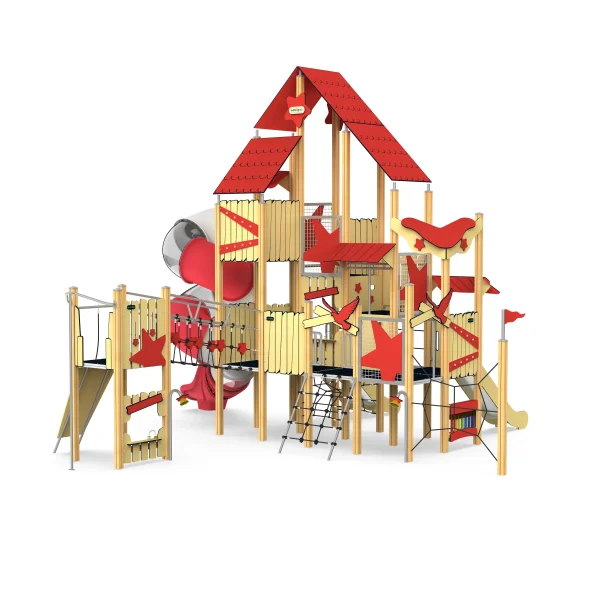
Tunnel slide curves introduce another condition. The overhead enclosure changes how a child positions the body, and the closed tube traps heat and moisture if it is not vented. The same banking principles apply, but the structural ring spacing and vent openings need to be designed with the turn in mind.
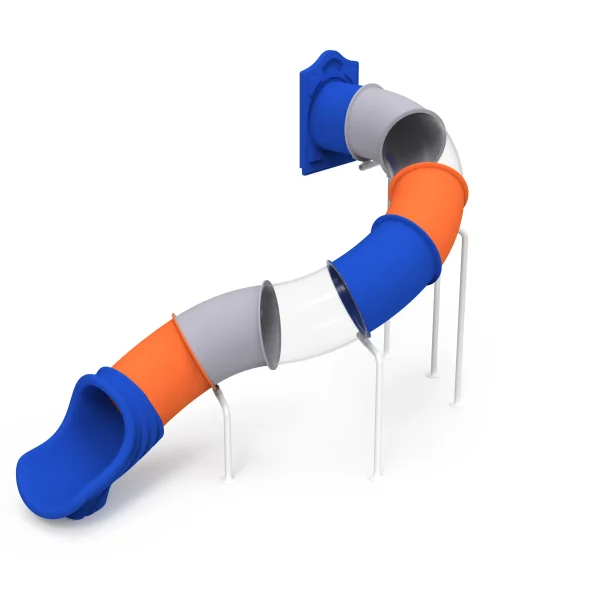
Curved tunnel slides add the same banked turn physics inside a closed tube, but the support and ventilation details change how the turn behaves under load. <Advanced Tunnel Slide Support Structure and Ventilation Design> covers why a curved tunnel section needs stiffer ring support and airflow openings without weakening the fall protection envelope.
Confirming Your Curved Slide Before Production
A curved slide that looks right in a catalog can still be wrong for your approach speed, age group, and exit space. That gap is where side ejection risk hides. Our Suzhou LvDong team reviews curved slide banked turns as a complete loading case, including platform height, transition length, turn profile, and runout. Send your site dimensions, target age range, and slide route to [email protected] or WhatsApp +8613915684545, and we will confirm the banking and outer wall requirement before you commit to a layout.
Curved Slide Banked Turn Questions Buyers Ask
Do curved slide banked turns create a greater safety risk than straight slides?
Curved slide banked turns are safe when the turn geometry matches the expected speed and age group. A straight slide cannot redirect a child, but a properly banked curve does not need to be dangerous. The risk comes from treating the turn as a styling feature instead of a load condition. We check the radius, banking angle, side wall height, and exit runout together. When those four align, the child stays within the slide path without pressing hard against the outer wall.
Can a taller outer wall replace the need for a banking angle?
Many buyers assume a taller outer wall alone will stop side ejection. It can reduce the impact, but it does not cancel the outward force. If the banking is too flat, a fast child hits the wall at an angle and may still climb or tip, especially in a tunnel slide or when the child enters the turn lying back. The better design combines a moderate wall height with enough banking to reduce the lateral load before the wall is needed. That makes the wall a secondary guard, not the primary control.
What banking angle should buyers specify for a toddler slide?
It depends on the rider path. A toddler slide with a low entry height and a gentle radius can often work with a modest inclination because the entry speed is low. A higher slide or a longer straight approach needs either a larger turn radius, more banking, or a reduced speed entering the turn. We ask buyers to share the platform height and the straight length before settling on an angle, because those two numbers determine how much sideways force the turn must manage.
When should a curved slide design be reviewed before site purchase?
In the site reviews we handle, the most common curved slide issue is not the bank itself but the transition into the turn. If the entry curve begins before the child has settled, the body enters at an angle and fights the banking rather than following it. We look at the straight section before the bend, the width change, and the exit runout as one path. If your project includes a curved slide in a compact footprint, share your site dimensions and target age range with [email protected] so we can confirm the turn profile before ordering.
If you’re interested, check out these related articles:
School Playground Equipment Zoning for Grade Based Development
Why ISO Certification Elevates Commercial Playground Equipment Manufacturers
OEM Branding Services Elevating Outdoor Playset Manufacturing
Playground Equipment Paint Refresh Optimal Surface Prep Recoating
Free 3D Design for Community Park Playground Equipment Solutions