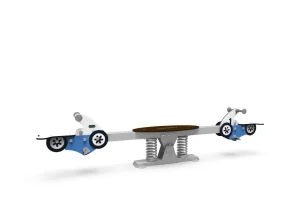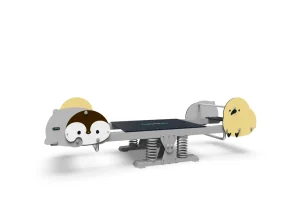
Train station play corners fail when they are planned as miniature playgrounds instead of short-cycle waiting spaces. A child moving through a 30-minute delay needs immediate play in the first minute, then an easy exit before the train arrives. Our design work for station operators keeps returning to the same three requirements: equipment must start quickly, clean easily, and tolerate repeated short use without staff intervention. This article covers equipment selection, space planning, and maintenance rules for platforms and concourses where every component faces hundreds of small users each week.
Short-Cycle Design Choices for Train Station Play Corners
Most station corners are planned around theming rather than cycle time. A decorative train-shaped playhouse looks right for the setting, but if it takes a child 40 seconds to climb inside and another minute to exit through a slide, most children never complete the play loop. In that situation the equipment becomes a photo backdrop, not an activity zone.
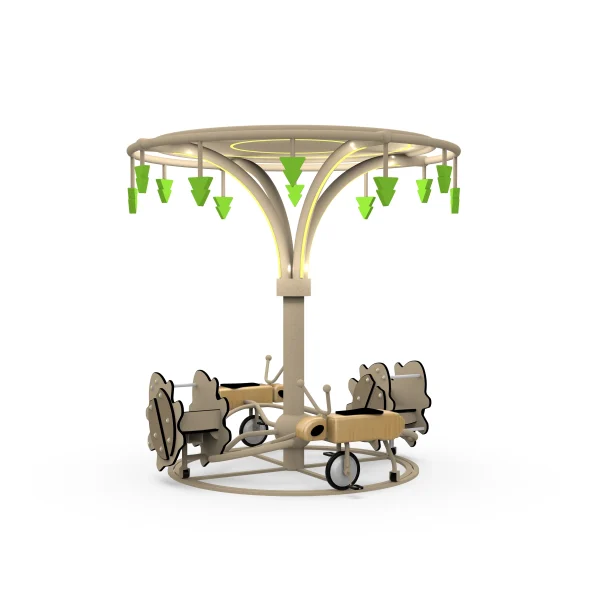
When I review a station floor plan, I look first at how long a child needs to reach the first physical play action. If the answer is more than 20 or 30 seconds, the corner will underdeliver no matter how well it is built. For a 30-minute delay, the play cycle should be measured in 3 to 8 minute segments, with several children entering and leaving at different times. Spring riders, low-profile spinners, and wall-mounted panels meet that rhythm better than large multi-level structures.
Short cycle time also changes how we think about seating. Parents need sight lines that work while they hold luggage and watch departure boards. Equipment placed against a wall or in a shallow alcove gives them a place to stand without blocking circulation.
Equipment Types for a 30-Minute Waiting Window
The right mix depends on passenger age range, available floor area, and whether the space is staffed. In most station concourses, we keep the equipment low to the ground and avoid parts that can be removed or thrown. Three categories perform consistently.
| Equipment type | Play start time | Typical footprint | Maintenance demand | Best station location |
| Spring rider | Immediate | 60 to 99 cm length | Low | Alcove or corner |
| Single-player spinner | Immediate | 60 to 95 cm width | Low | Mid-concourse island |
| Multi-player spinning wheel | Immediate | 120 to 200 cm diameter | Moderate | Large waiting hall |
| Wall-mounted play panel | Immediate | Wall depth only | Low | Corridor wall |
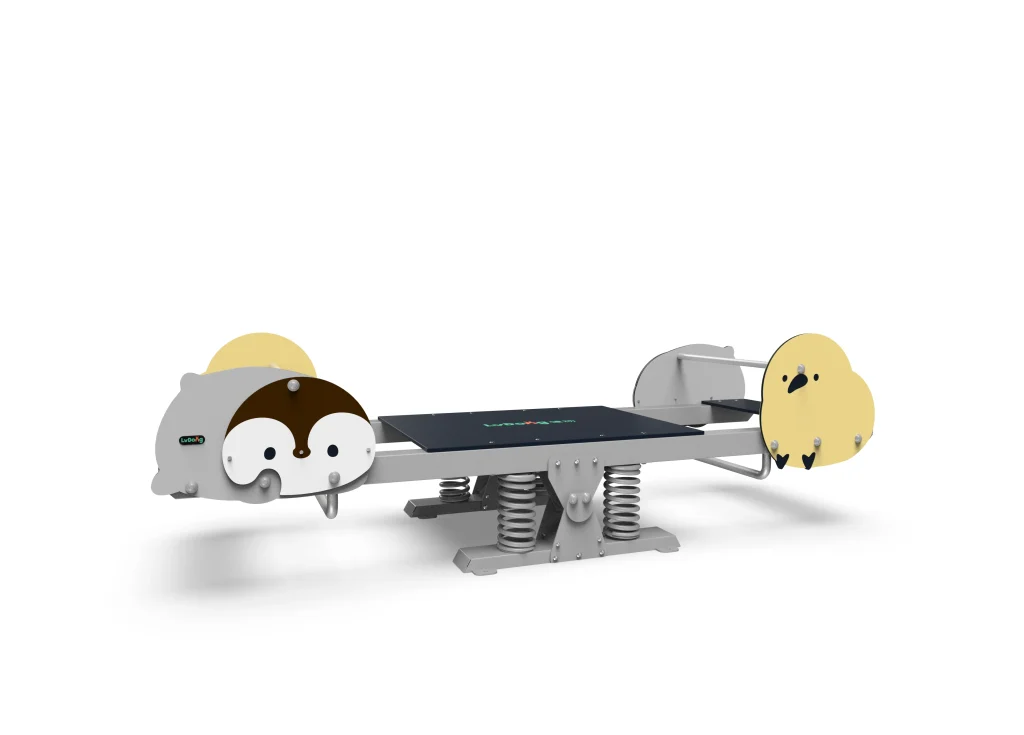
| Multi-person seesaw | Immediate | 300 to 320 cm length | Moderate | Family waiting area |
Spring riders are the easiest fit for narrow platforms because their footprint stays under one metre in length and they give movement without staff supervision. Wall-mounted panels create play value in circulation areas where floor space cannot be sacrificed. Multi-person seesaws and larger spinners only belong in wide halls where a fall zone will not block passenger flow.
Station concourses and airport family zones share the same peak-load pattern: many short play cycles with almost no recovery time. <High Traffic Durability Tips for Airport Playground Equipment> covers material selection and user-flow decisions that keep equipment stable when use is concentrated into short boarding windows.
Space and Clearance in Crowded Platform Areas
The biggest physical constraint in a train station play corner is not the equipment footprint. It is the fall zone and movement clearance around it. A station platform has two traffic streams: passengers walking to the train, and waiting children moving between a parent and the play unit. If those streams overlap, the play corner becomes a bottleneck even when the equipment itself is small.
Wall-mounted panels are useful because they do not consume floor clearance. Floor equipment should be placed against columns, inside shallow recesses, or in corners where the fall zone does not cross the main walking route. For a spring rider, the space requirement is roughly the unit length plus a 1.5 m fall zone in each free direction. A spinner needs the same fall clearance all around its diameter, which is why a 120 cm spinner does not simply need 120 cm of floor area.
Line of sight matters more in a station than in a park. Staff may not be dedicated to the play corner, so CCTV coverage and clear views from seating and departure boards should shape orientation. Equipment should not create a hiding space behind a tall panel.
If your station has narrow platforms, curved concourses, or boarding gates close to the play zone, confirm the fall zone and mounting method before you finalize the layout. Send your floor plan and expected passenger flow to [email protected] and we will check the clearances against your selected equipment.
Materials and Cleaning That Reduce Station Downtime
Train station air carries brake dust, cleaning residue, and wide temperature swings. Equipment with open bearings, unpainted mild steel, or unprotected plywood will degrade faster here than in a park. We specify galvanized or stainless frames, UV-stabilized plastics, and sealed bearings for station projects. Surfaces need to tolerate daily wiping with mild detergent or disinfectant without becoming chalky or sticky.
Station environments layer temperature swings, cleaning chemicals, and constant handling onto every surface. <Weatherproof Play Panels Material Durability Comparison> compares substrate and coating options for panels so operators do not discover delamination or fading after the first quarter of heavy use.
Vibration from passing trains affects floor-mounted equipment. Bolts and bearings can loosen faster if the unit is anchored directly to a slab that carries rail vibration. We review the connection points and specify locking fasteners or isolation pads in those locations. This is not a reason to avoid floor equipment, but it changes the fastening schedule and the first-month re-torque routine.
On the documentation side, station operators should ask for EN 1176 compliance certificates, installation drawings, and test reports before delivery. Multi-player spinning equipment in our catalogue is designed to EN 1176 and GB/T 34272-2017, and the same requirement should apply to any panel, rider, or seesaw considered for public use.
We often see station operators accept a certificate without checking which tests were actually completed for their equipment type. <Essential Checklist for Playground Equipment Safety Test Reports> explains which documents should accompany the order and what to verify before the corner opens to the public.
Specifying a Station Play Corner Without Overbuilding
A station play corner does not need a large budget or a themed structure to work. The failed projects are usually the ones that overbuilt the look and underplanned the play cycle. The better path is to start with two or three low-footprint units, place them where sight lines are clear, and add complexity only after passenger behavior confirms the space is being used.
Once the equipment type and placement are clear, the remaining decisions are specific enough to confirm quickly: frame material, anchoring method, panel substrate, and certification package. For station operators working through these requirements, send your floor area, passenger flow estimate, and any station design standards to [email protected] or WhatsApp +8613915684545. We will return a shortlist and layout recommendation matched to your delay windows.
Common Questions About Station Play Corners
How much space does a station play corner actually need?
A workable corner can fit in 4 to 6 square metres when you use wall-mounted panels and one or two low-footprint floor units. The governing dimension is the fall zone around each floor item, not the footprint alone. A spring rider may occupy less than one square metre, but the cleared space around it typically extends about 1.5 m in each direction. If you can place that zone against a wall or inside a recess, the corner stops competing with passenger circulation.
Are spinners and seesaws too noisy for a waiting area?
Many operators assume all spinners and seesaws are too noisy for a waiting room, but the noise usually comes from loose fasteners, exposed metal stops, or dry bearings, not from the play movement itself. A single-player spinner with sealed bearings and a controlled rotation mechanism runs quietly enough for a concourse. The same applies to a spring rider with a properly tensioned steel spring. Ask for noise-related details before assuming a motion item will create complaints, and compare them with expected station background levels.
What happens when a part breaks during peak service?
It depends on whether the station has on-site maintenance staff. If trained staff can inspect fasteners and moving parts weekly, we recommend keeping a small spare-parts kit for bearings, spring covers, and panel hardware, and scheduling a re-torque after the first month of operation. If the station relies on external contractors, choose equipment with fewer exposed moving parts and request a maintenance schedule before purchase. The more complicated the mechanism, the more likely a minor failure turns into a long shutdown.
Can the play corner stay open while trains are boarding?
In station layouts we have reviewed, the real hazard is not the play equipment itself but the exit path during boarding announcements. Children abandon a rider quickly when a train arrives, and if the fall zone crosses the main walking route, the two traffic streams collide. That is why we prefer equipment placed in a recess, against a wall, or in a corner where the exit direction leads back to seating, not toward the platform edge. Share your station drawings and we will confirm which units fit without narrowing circulation routes.
If you’re interested, check out these related articles:
Key Contract Clauses for Commercial Playground Equipment Purchase
12 Critical Post Installation Acceptance Tests for Playgrounds
To discuss a station play corner and its available space, contact the LvDong team with your project requirements.