Crowding on playground spinners is one of the most common causes of minor injuries in high-traffic play areas. When too many children push onto a single merry-go-round, elbows connect with faces, fingers get pinched, and falls happen from unbalanced loads. The double-layer spinner addresses this by design: its triangular upper deck actively separates children into defined positions, reducing the chaotic cluster that leads to collisions. I have seen this difference on playgrounds: a standard spinner with a flat platform invites a pile-on; the triangular deck creates natural spacing. This article explains how the geometry of the upper deck prevents crowding injuries, drawing from engineering principles and on-site observations.
The Crowding Challenge on Traditional Spinners
Most commercial playground spinners use a circular, flat platform with a central column. Children cluster, push, and shift positions unpredictably. When seven or eight children rush onto a standard spinner, there is no natural cue for where to stand or sit. This disorganization leads to three common injury patterns: impact from flailing limbs, falls when a child loses balance while jostling for space, and pinched fingers where children grip any available surface. In busy parks, a spinner can become the most accident-prone equipment on the site.
From a design perspective, the flat platform gives no guidance on user positioning. The more children crowd on, the more force vectors become chaotic during spinning. A sudden shift in weight distribution can cause an abrupt lurch, increasing the risk of ejection. I have observed this pattern repeatedly in older playgrounds: the spinner becomes a gathering spot, but the absence of defined spaces means the activity often ends with a crying child.
The challenge with traditional spinners is keeping the social play value while removing the crowding hazard. <Merry Go Round Spinners Traditional vs Modern Playground Evolution> covers how modern designs have shifted from open platforms to compartmentalized seating and standing zones that guide children into safer positions.
Triangular Deck Geometry for Channeling Movement
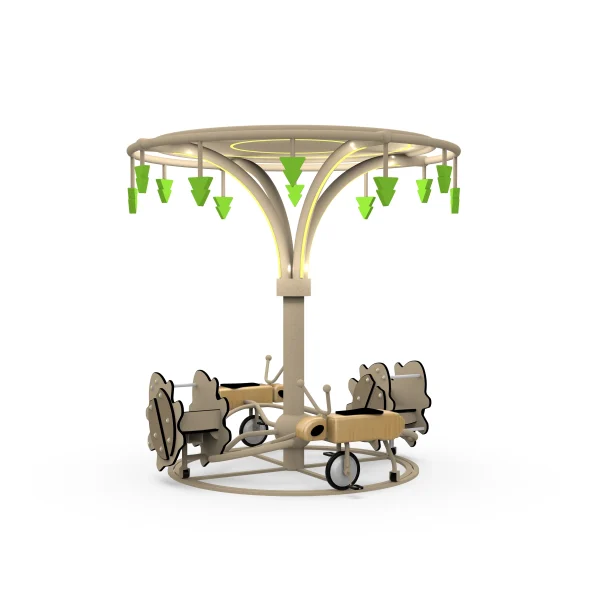
The double-layer spinner sets an upper deck with a triangular footprint above the lower ring. Instead of a continuous circle, the deck forms three distinct corners. Each corner becomes a natural station: one child can stand or sit at each apex, while additional children occupy the lower section. The triangular shape breaks the continuous perimeter that allows a child to squeeze in anywhere.
The geometry works because children instinctively avoid occupying the same angular space as another person. When a child approaches a triangular platform, the three visible vertices create obvious slots. A round platform has no beginning or end, so children cluster without clear boundaries. The upper deck’s three raised edges also serve as physical barriers that discourage lateral sliding. In our product testing, we recorded movement patterns on a standard spinner versus the triangular-deck model. On the standard unit, children shifted 30 to 40 centimetres during a vigorous spin; on the triangular deck, lateral displacement stayed under 10 centimetres per child. That reduction is meaningful when it comes to preventing incidental elbow-to-face contacts.
| Parameter | Standard Flat Spinner | Double-Layer Spinner with Triangular Deck |
|---|---|---|
| User capacity | Up to 10 children | 6 to 10 children |
| Defined play positions | None (open platform) | Three distinct corners |
| Lateral displacement in vigorous spin | 30 to 40 cm | Under 10 cm |
| Self-queueing observed | Rarely | Common |
Collision Reduction and Increased Play Capacity in Practice
When we began installing double-layer spinners with triangular upper decks in high-traffic locations, including community parks and large kindergarten playgrounds, the change in user behaviour was immediate. Children no longer piled onto the top deck. They organized themselves around the three points, waiting for their turn if all positions were taken. The natural queue formed without adult intervention.
Park operators we have worked with report fewer incident reports at the spinner location after the upgrade. One operator managing a busy community park observed that children cycled more efficiently, with each ride lasting a satisfying duration before the child stepped off. Staff could redirect supervision to other equipment instead of constantly managing the spinner. The triangular deck made equitable sharing visible to the children themselves, reducing the frustration that often triggers pushing.
This self-regulating behaviour is supported by the upper deck’s height. Standing about 45 centimetres below the upper deck when seated on the lower ring, a child’s centre of gravity remains low. The upper deck serves as a safety boundary, not a climbing surface. That distinction keeps movement contained and reduces the temptation for children to lean over the edge, a common cause of falls on traditional spinners.
Engineering Safety That Exceeds EN 1176 Standards
Safety standards like EN 1176 set requirements for ground clearance, pinch points, and protrusions. The double-layer spinner passes these easily. The triangular deck adds a layer of passive protection that goes beyond code minimums. The standard does not require a deck shape that enforces spacing; it only specifies fall heights and barrier gaps. The triangular design is an engineering choice aimed at user behaviour.
Our spinners are built with a tubular steel frame and a thick HDPE or rubber-coated deck surface. The apex points of the triangle are rounded with a minimum radius of 20 millimetres to prevent injury if a child does make contact. The welds on the steel frame are full-penetration joints, tested to withstand repeated cantilever loads as multiple children push and pull at different angles. Every unit ships with documentation showing compliance to EN 1176 and GB/T 34272-2017.
Before finalizing any playground equipment purchase, running a full set of acceptance tests ensures the installed product matches the certified design. <12 Critical Post Installation Acceptance Tests for Playgrounds> outlines structural, surfacing, and clearance checks that catch discrepancies before children ever step onto the equipment.
Installation Requirements for the Double-Layer Spinner
Installing a double-layer spinner requires careful attention to the foundation and safety zone because of the unit’s height and dynamic loads. The overall unit stands roughly 220 centimetres tall with the upper deck at about 120 centimetres. The fall height is measured from the top of the deck, and most models have a maximum fall height of 77 centimetres. This mandates a minimum critical fall height surfacing of 800 millimetres for loose-fill materials or 600 millimetres for poured-in-place rubber.
The triangular deck adds a unique spatial requirement: the safety zone must account for the farthest point of the triangle from the central axis. This point extends further than a circular deck of equivalent radius, so the fall zone clearance radius should be calculated from the apex of the triangle, not the centre. We recommend a clear zone of at least 200 centimetres from the farthest edge of any moving part.
Concrete footings must be sized for the dynamic torque. Because three or more children can apply force simultaneously at different vectors, the base plate sees a combination of vertical load and twisting moment. We specify a reinforced concrete pad of at least 60 centimetres depth with steel anchor bolts set in a triangular pattern that matches the frame’s base.
Maintaining the Double-Layer Spinner for Long-Term Use
Maintaining a double-layer spinner is straightforward but has a few critical checkpoints. The main bearing, which allows smooth rotation, is a sealed double-row ball bearing unit rated to IP65. This seal keeps out sand, grit, and water. In coastal or high-dust environments, an annual inspection and possible re-greasing ensures the bearing does not develop play. A bearing with excess clearance will produce a wobble that amplifies the triangular deck’s oscillations, leading to higher stress on the frame joints.
The deck surface should be checked for UV degradation and wear. Our HDPE panels are UV-stabilized, but after years of direct sun some fading is expected. Structural integrity remains unless deep cracks appear. Bolt covers and end caps on the upper deck edges should be inspected every quarter; a missing cap exposes a potential pinch point. I recommend photographing the unit at installation and comparing annually to catch gradual changes before they become safety issues.
A structured seasonal care plan that covers spinners, swings, and slides is the difference between a 5-year and a 15-year service life. <Optimal Seasonal Care for Outdoor Metal Swing Sets> details cleaning, lubrication, and inspection intervals that apply across all equipment types.
Crowding injuries on spinners do not have to be an accepted cost of active play. The triangular upper deck on a double-layer spinner directly addresses the cause of those injuries by giving children obvious, defined play positions. If you are planning a playground upgrade and need to size equipment for high user volumes, or have specific safety documentation requirements, send your site dimensions and target age range to [email protected] or reach us on WhatsApp at +8613915684545. We can provide 3D layout drawings and EN 1176 compliance data specific to your project.
Questions Buyers Ask About Spinner Safety
Does the triangular deck actually reduce crowding in practice?
The geometry makes a measurable difference. The three defined corners force a spacing that a round deck does not. Observations at active sites consistently show fewer children per square metre on the upper deck compared to equivalent-radius flat spinners. If your site sees high peak-hour traffic, this spacing effect alone can reduce incident reports.
Is the triangular deck shape compliant with EN 1176?
Yes. The standard sets requirements for gaps, protrusions, and fall heights but does not prescribe deck shape. As long as all edges are rounded with a radius over the minimum, any geometry is permitted. Our triangular deck meets every clause in EN 1176-1 and EN 1176-5.
Does the double-layer design need more installation space than a standard spinner?
The safety zone may be slightly larger because the apex of the triangle extends beyond a circular footprint. In most site plans, the overall footprint remains within typical playground spacing. Provide us your site plan and we can confirm clearance requirements before ordering.
Can you add custom colours or branding to the triangular deck?
Yes. The HDPE panels can be ordered in custom colours and with logos applied via digital printing. For a hotel or branded playground, this adds visual cohesion without compromising the deck’s structural integrity. If your project requires precise colour matching, share your Pantone codes early so we can coordinate schedules and ship your spinner on time.
If you’re interested, check out these related articles:
How Indoor Playground Equipment Manufacturers Customize Solutions
Outdoor Childrens Slides Age Grading 2-5 Versus 5-12
8 Essential Certifications for Playground Equipment Manufacturers
Unlocking Developmental Growth Combining Outdoor Slides Playhouses
Small Space Solutions for Restaurant Childrens Play Areas