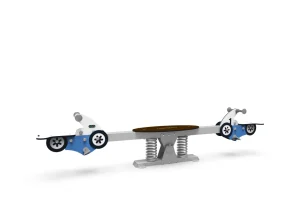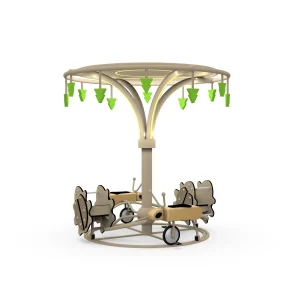
Island nation importers face a cost structure that mainland buyers rarely see. Every cubic meter of container space carries a premium because the journey often includes feeder vessels, transshipment dwell time, and smaller port handling windows. When the cargo is commercial playground equipment — steel slide towers, spring riders, multi-person seesaws, and tube slides — the dimensional weight problem compounds quickly. A 40-foot high-cube container costs roughly the same whether it leaves Shanghai at 70% or 95% utilization, and that difference is frequently the margin between a viable public park project and a deferred one.
This article works through the loading optimization levers that matter most for island destinations: container selection, flat-pack design, cubic meter sequencing, consolidation, packaging trade-offs, and Incoterm selection. The goal is not to compress equipment unsafely. It is to give importers a repeatable method for buying more playground value per shipment without increasing product risk or weakening the standards that protect children.
Why Island Freight Economics Punish Poor Loading
A standard 40-foot high-cube container offers approximately 76 cubic meters of internal volume with inner dimensions of roughly 12.03 m × 2.35 m × 2.69 m [1]. A 20-foot general-purpose container offers roughly 33 cubic meters [1]. Fixed port charges, documentation fees, and ocean base rates do not scale down with unused space. That means an importer in Fiji, Mauritius, or the Maldives who ships a half-filled container of swings and spinners pays close to the same as one shipping a full load.
Island routes add transshipment risk and handling stages. Each additional lift at a hub port increases the chance of package damage and schedule delay. Poorly loaded cargo shifts during feeder-vessel transfers, and with playground equipment that means boxed steel frames abrading HDPE slide sections. Tight, planned, and anchored loading reduces both damage claims and the indirect cost of reordering parts.
Selecting the Right Container Before You Load
Importers in island nations often default to the smallest container that fits the order, assuming smaller means cheaper. For dimensional cargo like playground equipment, the reverse is frequently true. A 40HQ’s per-cubic-meter ocean cost is typically lower than a 20GP’s, and its taller internal height lets tall slide towers ship with fewer knockdown operations.
Three practical checks belong in every loading plan:
- Gross weight limit: a 40HQ carries a payload near 26,500 kg after tare when considering road and crane limits at destination [1]. Playground equipment mixes dense steel components with low-density HDPE slides, so the constraint is usually cube rather than weight — but island ports with small reach stackers favor loads that stay below local lift capacity.
- Destination lifting: some island ports lack container gantry cranes and rely on mobile equipment with lower maximum lift. Keeping the load within local equipment limits avoids a container stuck on the quay.
- Verified Gross Mass: SOLAS requires the packed container’s VGM to be declared before the vessel loads [2]. Accurate loading data supports this declaration without last-minute weighing penalties.
Flat-Pack and Modular Design: The Core Cost Lever
Fully assembled playground assemblies are freight-inefficient by design. A pre-assembled carousel or a welded slide platform consumes air where only steel posts and empty volume exist. Flat-pack, bolt-together modular construction changes the economics fundamentally.
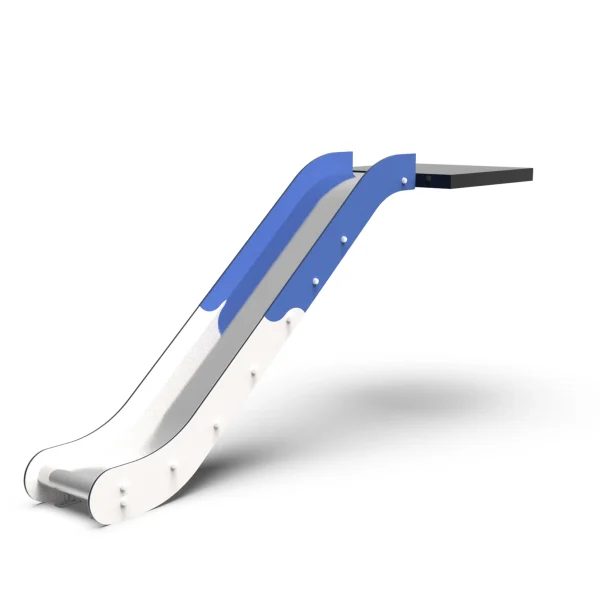
Commercial equipment designed for international shipping uses knock-down construction: slide body sections nest inside one another, spring riders separate into base plate, spring, and body, see-saw frames disassemble into bolt-indexed components. This is not a compromise in safety — it is an engineering choice. EN 1176-compliant modular equipment can be bolted to the same structural tolerances as welded equipment when the fastener schedule and torque specifications are followed [3]. For island buyers, flat-pack also matters at the destination: components move through narrow quay gates, load onto small trucks, and require fewer installers to maneuver.
The practical rule is to request a knock-down bill of material before ordering. Every numbered steel tube, brace, panel, and fastener should appear in the warehouse packing list. Missing a single slide coupler is a minor freight line item but a major installation standstill on an island where the next shipment arrives in eight weeks.
Cubic Meter Planning and Consolidation for Small Orders
Cubic meter optimization rewards a disciplined order sequence rather than improvised packing. The process moves from dense anchors to light fill:
- Steel base plates, frame posts, bearing assemblies, and spring rider bodies go first, distributed along the container floor to balance the center of gravity.
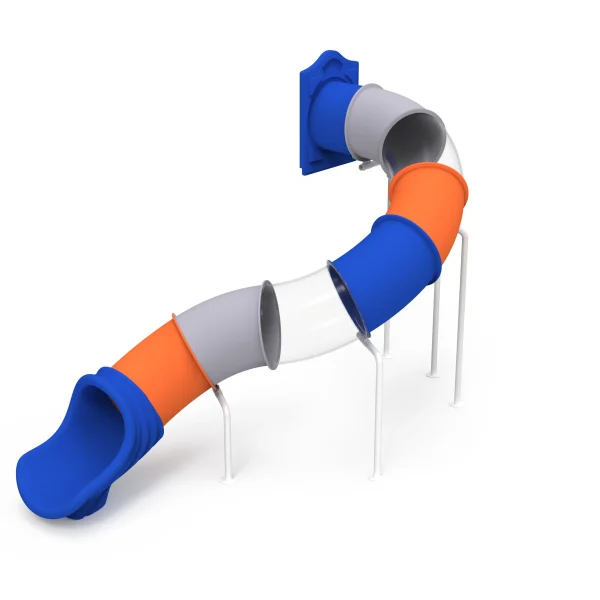
- Slide segments and tunnel sections nest next, with the largest diameter shell outside and progressively smaller shells inside. LLDPE slide sections tolerate limited flex but should never be compressed under steel frames.
- Panel and deck components fill the middle bands using vertical upright stacking where the crating is rated for it.
- Small hardware cartons, spare parts kits, and fastener boxes fill residual voids; these should be strapped, not left loose.
- The final 20 to 30 cm at the door receives dunnage and airbags to prevent cargo movement during rough feeder passages.
A well-executed sequence commonly brings a mixed playground order from the low 80s to over 92% cube utilization. On a 76-cubic-meter 40HQ, that incremental fill is equivalent to adding roughly 9 cubic meters of sellable equipment without adding freight cost — enough to hold a full multi-person seesaw and several compact spring riders.
Most island playground orders are smaller than mainland municipal tenders. A Caribbean kindergarten may need one multi-player spinner, two spring riders, and a panel set — far below a full container. Paying for a dedicated 20GP at low utilization is often the worst-cost outcome. Three consolidation paths fit small volumes:
- LCL (less than container load): suitable for very small orders, but handling is highest and ocean damage risk rises with each co-loaded container. If choosing LCL, insist on steel-framed crating and full shrink wrap.
- Group consolidation by region: several island buyers or one distributor combine orders into a single FCL. Unit cost drops sharply, but the combined load requires a clear marking plan so destination deconsolidation does not mix buyer components.
- Supplier mixed-model FCL: using multiple equipment categories from one manufacturer — slides, spinners, panels, spring riders — to fill a container rather than splitting orders across suppliers that each ship partial loads.

For buyers who cannot fill a container, an incremental purchase of spare parts and consumable items is frequently wiser than paying LCL rates. Bearings, fastener kits, extra surfacing samples, and post-installation touch-up paint are dense, small, high-value fills that absorb leftover cube while protecting the future maintenance calendar.
When load planning reveals gaps in the equipment list, importers often overlook the service side. <Optimizing Playground Equipment Spare Parts Lead Time and Stock> covers the spare-parts logic that keeps installation crews moving.
Packaging Choices That Survive Ocean Transfer
The packaging hierarchy for island ocean freight is protective first, space-efficient second. Weak packaging exposes the load to salt air, humidity, and multiple lifts, and it silently erodes the buyer’s investment before the playground opens.
- Steel components: galvanized or powder-coated surfaces should be wrapped individually or separated by volatile corrosion inhibitor paper at contact points. Bare strapping against powder coat creates rub marks visible at the site level.
- HDPE and LLDPE components: these resist moisture but scratch under shifted contact. Foam edge guards and cardboard separators at nesting contacts prevent swirl marks. Bubble wrap alone compresses under load; for HDPE slides, foam or heavy kraft interleaving is more stable.
- Hardware and fasteners: moisture-sealed cartons with desiccant sachets. Island humidity causes fasteners to rust inside containers even when the equipment itself remains fine.
- Framed crates: export-grade plywood or steel framed crates with forklift pockets protect complex assemblies and enable efficient stacking. Crates are the strongest defense against multi-lift damage but add volume — the loading plan should account for crate dimensions in the cube calculation.
The goal is a container that arrives with zero cargo shifts, because any shift at sea becomes a scratch, dent, or bent connection by discharge.
Incoterms and Port Selection for Islands
Commercial terms determine where loading risk and freight cost move between supplier and buyer. For island destinations, the comparison determines how much control the buyer has over the loading described in this article.
- FOB Shanghai: the buyer controls main carriage and consolidator selection. This offers the most control over consolidation and destination handling, but requires the buyer to manage transshipment and final-leg coordination. Making detailed loading and lashing instructions part of the purchase contract is essential under this term.
- CIF: the seller arranges freight and insurance to the named port. Convenient for new importers, but it limits visibility into consolidation choices. The buyer still pays destination charges after discharge, and in transshipment-heavy island routes those charges can be opaque.
- DAP or DDP: the seller carries responsibility deeper into the destination, useful when island inland transport and customs processes are unfamiliar to the buyer. Unit cost is higher and should be evaluated against local clearing fees.
For most island governments and institutional buyers, FOB with a named forwarder and explicit loading requirements offers the best balance: the manufacturer controls production and packing quality, while the buyer controls the freight consolidation levers that dominate total landed cost.
If you are planning an island project and want a loading plan matched to a specific equipment list, contact Suzhou LvDong‘s export team at [email protected] with the destination port and order scope. The planning conversation is where the real freight saving is won — before the container is booked, not after.
Pre-Shipment Verification and a Repeatable Loading Protocol

The final hours before a container is sealed are the cheapest quality control available to a distant buyer. A pre-shipment check tied to the loading plan should verify:
- Knock-down completeness: every packing-list line physically present, with no substituted bolts or mismatched spring strength.
- Surface protection: coated surfaces separated, HDPE shells cushioned, fasteners sealed.
- Load anchors: lashing points, airbags, and dunnage secured so nothing can travel more than a few centimeters.
- Documentation: packing list, commercial invoice, VGM verification, certificates of conformance, and installation manual printed and inside a sealed document pouch.
For public projects, the same discipline applies to safety documentation. Certificates requested during import clearance and project acceptance should be checked before shipping, not after arrival. A buyer’s site team cannot fix paperwork in the receiving port.
Pre-shipment verification is where documentary problems are caught before they become island project delays. <Essential Checklist for Playground Equipment Safety Test Reports> covers the certification records buyers should request.
Container loading optimization is not a one-off negotiation. Importers who buy regularly should turn the load plan into a standing protocol: a packing schematic agreed before each production run, a cube utilization target of 90% or better, a damage-free discharge target, and a post-arrival inspection record that feeds the next order’s plan.
The strongest protocols connect the loading plan to the total purchase. When the buyer treats the container as a precise economic unit, pricing conversations shift from a unit quote to a landed-cost quote. That perspective separates island buyers who routinely overpay on freight from those who treat ocean shipping as a controllable design input.
Procurement clarity changes the whole loading discussion. <Buying Playground Spinners Pricing Discounts and Supplier Insights> covers how equipment pricing and container-fill strategy fit together.
Plan the Load, Not Just the Order
Island nation playground imports carry a permanent tension: playground equipment is bulky by nature, while island shipping costs are disproportionately sensitive to every cubic meter. The lever that resolves this tension is container loading optimization. It begins with flat-pack modular design, proceeds through disciplined cube sequencing and consolidation decisions, and ends with pre-shipment checks that protect both the equipment and the project schedule.
An import plan that treats container loading as an afterthought hands the economic advantage to the shipping line. A plan that treats loading as a design parameter returns it to the playground — where the budget belongs, and where the children actually benefit.
Your Next Step: Request a Loading Optimization Plan
For municipal, resort, school, and hospitality buyers importing playground equipment to island destinations, the fastest way to reduce sea freight cost is to order with a loading plan already drafted. Send your draft equipment list, destination port, and any consolidation constraints to [email protected], or reach our export team on WhatsApp at +86 139 1568 4545. We will respond with a knock-down packing schematic, cube estimate, and the loading sequence that supports your FOB or CIF decision.
FAQ
How much can container loading optimization actually reduce sea freight costs?
A jump from 80% to 92% cube utilization on a 40HQ adds roughly 9 cubic meters of capacity without new freight charges. The landed-cost saving depends on the equipment mix, but the unit freight cost falls roughly in proportion to the gained cube for the same fixed ocean rate.
Is flat-pack playground equipment less safe than welded assembled equipment?
Within the applicable standard, no. EN 1176-compliant modular equipment must meet the same structural and entrapment requirements as welded equipment when assembled according to the manufacturer’s fastener schedule and torque specification [3]. The safety risk is not flat-pack itself but improper assembly, which is why documented installation and pre-shipment fastener checks matter.
Which container size is best for island playground orders?
A 40HQ generally offers the lowest cost per cubic meter, but the right choice follows the actual order cube rather than habit. Small orders may fit a 20GP under certain port and crane constraints, while very small orders may be better off as part of a consolidation. Container selection should be made against the loading plan, not before it.
What packaging material is most critical for ocean shipments to islands?
For steel components, corrosion-inhibiting separation — volatile corrosion inhibitor paper or individual wrapping at contact points — matters most, because salt air and humidity accumulate over long transit. For HDPE and LLDPE slide components, rigid corner protection and nesting separators prevent surface damage during transshipment lifts.
What does FOB mean for container loading control?
Under FOB, the buyer arranges and controls the main carriage and forwarder, so loading instructions can be made part of the export plan. CIF gives the seller the carriage arrangement, which is convenient but limits the buyer’s visibility into consolidation choices. For island importers who want to direct loading, FOB with explicit packing and lashing requirements is usually the better fit.
What should buyers request from their supplier before the container closes?
A knock-down packing list, a pre-shipment cube calculation, the VGM verification, and a physical inspection against the packing list. For certified public projects, the same moment should confirm that EN 1176 or destination-standard certificates, installation manuals, and spare part lists are inside the container documents so nothing is missing at discharge.
References
[1] ISO 668:2020, Series 1 freight containers — Classification, dimensions and ratings. International Organization for Standardization.
[2] International Maritime Organization, SOLAS Chapter VI Regulation 2 — Verified gross mass of a container carrying cargo.
[3] EN 1176-1:2017, Playground equipment and surfacing — Part 1: General safety requirements and test methods. European Committee for Standardization.
If you’re interested, check out these related articles:
Buying Playground Spinners Pricing Discounts and Supplier Insights
Space Saving Cantilever Swing Set Design for Urban Play Environments
Hotel Kids Club Playground Equipment Configuration Guide
Selecting Commercial Playground Manufacturers A Step by Step Guide