Marina and harbor play areas sit at the intersection of two aggressive environments: salt-laden marine air and intermittent diesel exhaust from vessels, service vehicles, and generators. Standard playground equipment that performs well in an inland park can develop surface corrosion, seized bearings, and weakened springs within months at a waterfront site. The design problem is not whether children can play there — it is whether the equipment can remain safe, smooth, and visually clean through years of chloride exposure and acid-forming soot. For operators and specifiers, the solution starts with material selection and ends with an inspection rhythm that treats coastal exposure as a continuous maintenance condition.
Why Waterfront Sites Change the Equipment Conversation
Playground safety standards do not treat every site the same. EN 1176-1 requires materials to be selected so that the equipment remains safe during its expected service life under the conditions of the site [1]. ASTM F1487-21 similarly expects manufacturers and operators to account for environmental deterioration [2]. A marina or harbor is a severe environment under both frameworks: moisture is nearly constant, chlorides are present in the air, and diesel exhaust adds sulfur oxides, nitrogen oxides, and carbon soot.
When diesel exhaust meets marine humidity, the resulting surface film can become mildly acidic. Soot particles then act like sponges, holding that acidic moisture and chloride against metal surfaces. This is why equipment near idling areas, fuel docks, or generator enclosures often fails faster than equipment just a few meters away. Coastal play equipment therefore needs more than a standard powder-coated frame; it needs a corrosion strategy that starts at the material level and continues through fasteners, bearings, and maintenance.
Corrosion Drivers at Marinas and Harbors
Salt mist is the most obvious threat. Chloride ions break down passive oxide layers on stainless steel and attack zinc coatings on carbon steel. On many grades of stainless, chlorides cause pitting and crevice corrosion, especially under washers, bolt heads, and plastic hand grips where moisture cannot dry. Galvanic corrosion is also common when stainless steel and zinc-plated carbon steel are bolted together without isolation.
Diesel exhaust compounds the problem. Sulfur oxides and nitrogen oxides can convert into sulfate and nitrate deposits, particularly on shaded or sheltered surfaces. Soot deposits are hygroscopic, meaning they attract and retain water. In a marine atmosphere classified as C5-M or the hybrid C5-I coastal-industrial environment under ISO 12944-2, unprotected carbon steel corrodes quickly and coating life is significantly shortened [4]. Salt spray testing according to ISO 9227 is useful for comparing coating systems, but it is an accelerated laboratory test and does not directly predict service life [3].
Material Selection for Coastal Play Equipment
The right material varies by component. A one-material approach rarely works because slides, swing chains, springs, and panel housings face different stresses and exposure patterns.
| Component | Preferred Material | Why It Works in Marina Air | Key Inspection Focus |
|---|---|---|---|
| Slide bed | 316 stainless steel or UV-stabilized LLDPE | 316 resists chloride pitting; LLDPE does not corrode | Crevice points under clamps; UV dulling of LLDPE |
| Support posts | Hot-dip galvanized carbon steel | Thick sacrificial coating suited to C5 environments [4] | Coating scratches, flange edges, post base |
| Fasteners | 316 stainless steel or A4 grade | Avoids zinc-plated fastener failure | Crevice corrosion under heads |
| Swing chains | Stainless steel chain or heavy galvanized chain | Reduces rust staining and wear-driven coating loss | Link wear, salt buildup in joins |
| Spring rider spring | 55SiCr spring steel with anti-corrosion coating | Preserves spring force while resisting surface rust | Coating cracks near weld points |
| Activity panel housing | Marine-grade aluminum or sealed fiber-reinforced plastic | Avoids steel corrosion and protects electronics | Seal integrity, drain holes |
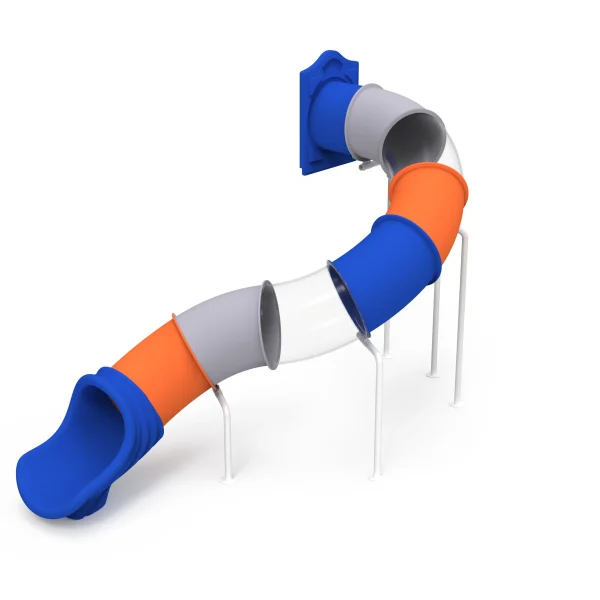
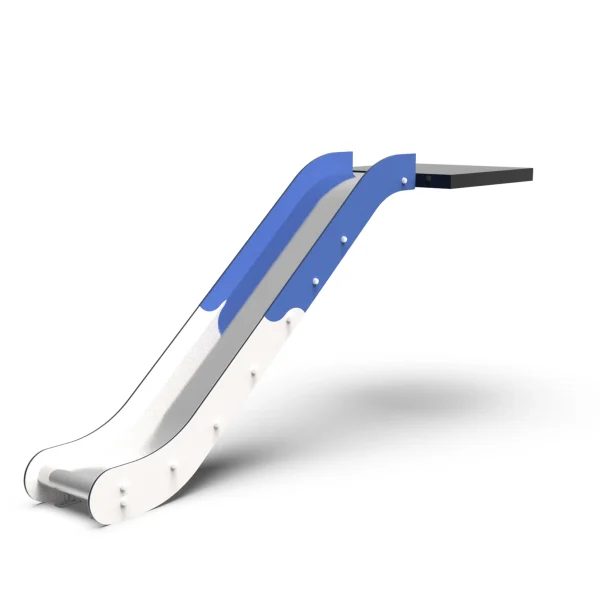
For slide beds, Playground Slide Manufacturer OEM options commonly compare LLDPE and stainless steel. LLDPE is naturally resistant to salt corrosion, but it must include a proper UV stabilization package to avoid chalking. Stainless steel offers a hard, smooth surface, but 304 is not automatically marine-grade; 316 is more resistant to chloride pitting, especially in shaded or poorly washed areas.
Marina environments punish mixed-material interfaces, so slide beds need either marine-grade stainless or dense UV-stabilized LLDPE rather than standard powder-coated steel. <Playground Slide Materials LLDPE vs 304 Steel Performance> covers the trade-offs between 304 stainless and LLDPE for salt-exposed play surfaces.
Fasteners, Coatings, and the Details That Fail First
In coastal inspections, the first failures are rarely the main beams. They are fasteners, bracket edges, chain links, and spring mounts. Zinc-plated bolts can lose their coating in months and begin rusting, staining surrounding plastic and creating sharp-edged threads. Marine play equipment should use 316 stainless steel or A4-grade fasteners, and dissimilar metal pairs should be separated with nylon washers or sealant to prevent galvanic action.
Hot-dip galvanizing remains one of the most reliable protective systems for carbon steel structures. The coating specification in ISO 1461 defines the minimum thickness and continuity requirements for fabricated steel articles [5]. Thicker galvanized coatings perform better in high-chloride environments, but all cut or drilled edges must be treated after fabrication. Closed tube ends should be capped or welded shut so salt-laden water cannot pool inside.
Swing chains and connection hardware deserve special attention. Playground Swing Manufacturer OEM components made from stainless steel or heavily galvanized chain reduce rust staining on children’s hands and prevent the abrasive wear that accelerates coating loss.
Swing chains and connection hardware are common failure points in marine air because thin zinc coatings wear quickly. <Swing Set Components Advanced Material Selection for Durability> covers chain and bearing material choices for long service life in humid and coastal climates.
For spring riders, select spring steel with a documented anti-corrosion coating. <(Playground Spring Rider Manufacturer OEM)[https://lvdongtoys.com/product-category/playground-spring-rider/]> Let precise link: I’ll fix in final? We can’t. We’ll use proper markdown. Need not rush. In final I’ll ensure markdown correct.
Let’s continue.
Design Features That Reduce Diesel Fume Deposition
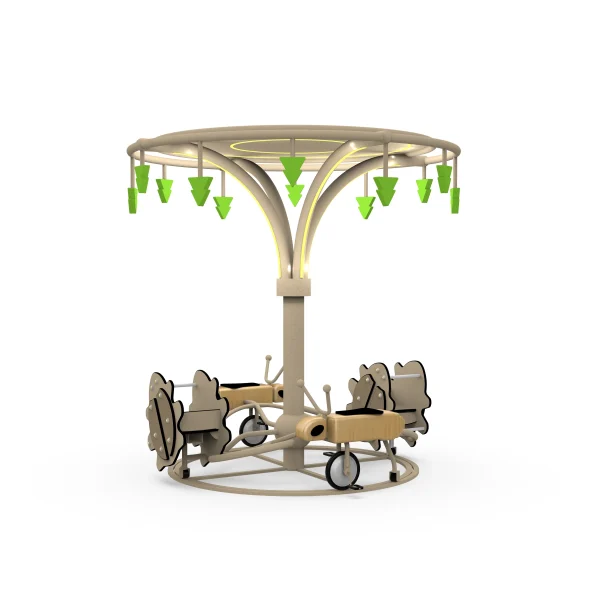
Good coastal playground design keeps diesel soot from accumulating where it causes harm. Avoid horizontal ledges and deep pockets where soot can build up. Use sloped or rounded surfaces that rinse more easily in rain or manual washing. Bearings should be sealed and, where possible, protected by covers so diesel soot cannot mix with grease to form an abrasive paste.
Place equipment away from idling zones, fuel docks, and generator exhausts. If that is impossible, specify non-porous surfaces and a more frequent washdown cycle. Interactive panels should have sealed enclosures and downward-facing cable entries so exhaust residue does not migrate into electronics. For waterfront installations, Interactive Playground Equipment Manufacturer OEM systems should be evaluated with salt-room or salt-spray testing on the enclosure, not only on the display surface.
Installation and Foundation Practices for Marine Soils
Marine soil conditions are often soft, saline, or seasonally saturated. Foundations should be designed for the site’s soil bearing capacity and drainage pattern, not simply copied from an inland installation. Use concrete anchors with stainless steel or hot-dip galvanized hardware, and avoid direct contact between pressure-treated wood and steel components unless a protective barrier is specified.
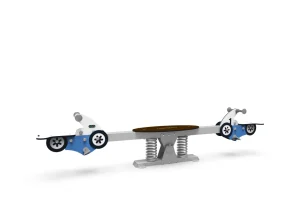
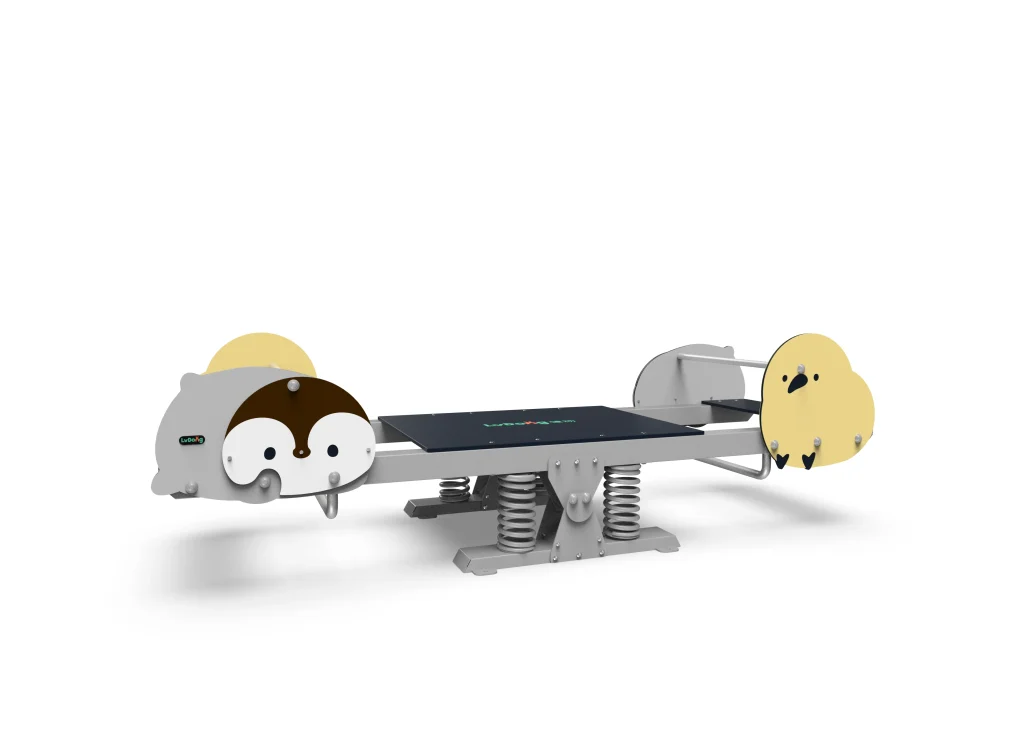
Raise equipment bases slightly above the finished grade where possible, and install drainage channels so saline water does not pond under play structures. For spring riders and seesaws, anchor points should be inspected for crevice corrosion at the interface between concrete and coated steel. Correct installation prevents many of the early failures that get incorrectly blamed on material quality.
Coastal Inspection and Maintenance Calendar
Coastal play equipment needs shorter inspection intervals than inland equipment because salt deposits hide early coating failures. A practical rhythm includes:
- Weekly: rinse surfaces with clean water; wipe down chains, springs, and bearings where salt film is visible.
- Monthly: inspect fasteners, post bases, and coating edges; remove soot build-up with mild detergent; check drainage paths.
- Quarterly: test moving parts for smooth operation; inspect sealed bearings and spring coatings; document any rust points.
- Annually: perform a full structural audit, recoat or touch up damaged areas, and review anchor integrity.
Do not wait for visible rust before acting. Coastal corrosion works from the edge inward, and a small coating crack can become a structural loss faster than expected.
Coastal sites need shorter inspection intervals than inland parks because salt deposits hide early coating failures. <Annual Maintenance Calendar for Outdoor Play Equipment A Guide> covers monthly and quarterly tasks that prevent small corrosion points from becoming structural issues.
Procurement Checklist for Marina Play Areas
When evaluating suppliers for a marina or harbor playground, request the following:
- Material test reports for stainless steel, aluminum, and plastic components exposed to salt spray.
- Fastener specification: confirm 316 stainless steel or A4 grade, not zinc-plated carbon steel.
- Coating system documentation, including galvanizing thickness per ISO 1461 [5] or equivalent powder coating qualification.
- Bearing and hinge sealing details, including resistance to salt-laden dust and diesel soot.
- Foundation and anchoring details suitable for the site’s soil and flood elevation.
- A coastal maintenance manual with washdown and inspection intervals.
- Spare parts lead time for fasteners, bearings, chains, and spring assemblies.
If your project requires a technical review of marine specification choices, Lvdong’s engineering team can evaluate site photos, local exposure class, and equipment configurations before you finalize an order.
Specify marine-resistant play equipment with confidence. Send site photos, corrosion concerns, and the number of play zones to [email protected] or WhatsApp +8613915684545. Lvdong’s engineering team will recommend material combinations, anchoring details, and an inspection plan matched to EN 1176 [1] and your local marine exposure class.
Frequently Asked Questions
What makes marina playground equipment different from standard park equipment?
Marina equipment must resist chloride-induced pitting, galvanic corrosion, and acidic diesel soot deposits, not just rain and UV. This affects material choice, fastener grade, bearing sealing, and the frequency of cleaning and inspection. A standard inland coating system may fail quickly in a C5-M or C5-I environment [4].
Is 304 stainless steel enough for harbor salt mist?
304 stainless can perform acceptably in mild coastal conditions when cleaned regularly, but it is vulnerable to chloride pitting and crevice corrosion in sheltered or shaded areas where salt deposits remain wet. For critical components such as slide beds, anchors, and fasteners, 316 stainless steel or A4-grade hardware provides a higher safety margin.
How often should coastal play equipment be washed and inspected?
A practical marine maintenance program includes weekly fresh-water rinses, monthly soot and salt removal, quarterly moving-part checks, and an annual structural audit. Intervals should be shortened if equipment is downwind of idling vessels or exposed to direct sea spray.
Are plastic slides safe from salt corrosion?
Yes, UV-stabilized LLDPE slide beds do not rust and resist chloride attack well. However, their fasteners, brackets, and support structures can still corrode, so plastic does not remove the need for stainless steel hardware and regular inspection.
Can interactive panels survive diesel fumes and salt air?
Sealed interactive panels can survive if enclosures are marine-grade, cable entries are sealed, and drainage is designed. Look for enclosure corrosion testing and protect the panels with routine soot removal. Avoid open seams and upward-facing connectors that allow salt-laden moisture to pool.
References
[1] EN 1176-1:2017. Playground equipment and surfacing — Part 1: General safety requirements and test methods. European Committee for Standardization.
[2] ASTM F1487-21. Standard Consumer Safety Performance Specification for Playground Equipment for Public Use. ASTM International.
[3] ISO 9227:2022. Corrosion tests in artificial atmospheres — Salt spray tests. International Organization for Standardization.
[4] ISO 12944-2:2017. Paints and varnishes — Corrosion protection of steel structures by protective paint systems — Part 2: Classification of environments. International Organization for Standardization.
[5] ISO 1461:2022. Hot dip galvanized coatings on fabricated iron and steel articles — Specifications and test methods. International Organization for Standardization.
If you’re interested, check out these related articles:
20 Essential Questions Choosing a Playground Equipment Supplier
8 Essential Certifications for Playground Equipment Manufacturers
Negotiating Bulk Playground Equipment Orders Expert Strategies
Merry Go Round Spinners Traditional vs Modern Playground Evolution
Top 10 Animal Spring Rider Designs for Modern Playgrounds