Spinning playground equipment has shifted from novelty to necessity in modern play space design. The rotation creates sensory input that children actively seek out, and when the engineering holds up, these pieces become the most consistently used elements on any playground. Getting the selection right in 2025 means balancing safety certification requirements, material durability under real-world conditions, and the actual developmental benefits that justify the investment.
Safety Standards That Actually Matter for Spinning Equipment
Spinning playground equipment operates under specific mechanical stresses that static structures never face. The rotational forces, repeated loading cycles, and the unpredictable ways children use these pieces demand compliance with standards built for exactly these conditions.
ASTM F1487 governs playground equipment across North America, covering everything from design tolerances to installation specifications. EN 1176 serves the same function in Europe, with particular attention to free space requirements around rotating elements. Both standards address critical fall height calculations, entrapment hazards at pinch points, and structural integrity under repeated use cycles.
Products like multi-player spinning wheels and single-player spinning equipment should carry dual certification under EN 1176 and GB/T 34272-2017, the Chinese National Standard for unpowered amusement equipment. This dual compliance indicates testing against multiple regulatory frameworks rather than just meeting minimum local requirements.
The surfacing beneath spinning equipment requires careful matching to fall height specifications. A single-player spinning unit with a 34 cm maximum falling height needs different surfacing consideration than a larger multi-user spinner where children might exit at higher speeds. Risk assessment procedures should map each spinning element to its specific surfacing requirements rather than applying blanket specifications across an entire playground.
Ongoing inspection schedules catch problems before they become safety incidents. Bearing wear, structural fatigue at weld points, and degradation of rotational components all progress predictably with use. Documented maintenance protocols extend equipment life while maintaining the safety margins the original certifications established.
| Standard | Region | Focus Areas | Key Requirements |
|---|---|---|---|
| ASTM F1487 | North America | Design, Manufacturing, Installation, Maintenance | Critical fall height, entrapment, protrusions, structural integrity |
| EN 1176 | Europe | General safety requirements and test methods | Free space, materials, structural integrity, installation |
| GB/T 34272-2017 | China | Safety for unpowered amusement equipment | Design, materials, manufacturing, installation, inspection |
ADA Requirements and Inclusive Spinning Equipment Design
ADA compliance for playground equipment extends beyond wheelchair accessibility to encompass the full range of physical and sensory abilities children bring to play spaces. Spinning playground equipment presents both challenges and opportunities for inclusive design.
Accessible entry points matter for children who transfer from mobility devices. Some multi-user spinning structures incorporate stable platforms with options for both standing and seated positions, allowing children with different physical capabilities to participate in the same play experience. Transfer systems that meet ADA specifications enable children to move from wheelchairs onto spinning equipment independently or with minimal assistance.
Sensory considerations factor into inclusive spinning equipment as well. The vestibular input from rotation benefits many children, including those with sensory processing differences who actively seek this type of stimulation. Design choices that allow speed control or provide visual reference points during rotation make spinning equipment accessible to children who might otherwise find the experience overwhelming.
Material Selection and Design Innovation in Spinning Equipment
The mechanical demands on spinning playground equipment exceed those on static structures. Bearings handle thousands of rotation cycles daily. Structural connections absorb the dynamic loads of children jumping on and off moving platforms. Material choices that perform adequately in static applications may fail prematurely under these conditions.
High-density polyethylene panels resist UV degradation and maintain color stability through years of sun exposure. Powder-coated steel frames provide structural strength while the coating system protects against corrosion in humid or coastal environments. Stainless steel components at critical wear points, particularly bearing housings and connection hardware, justify their higher cost through extended service life.
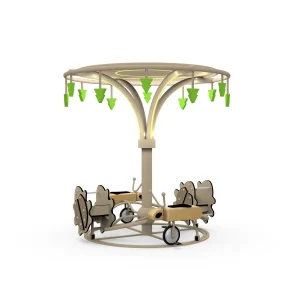
Multi-player spinning equipment benefits from design approaches that encourage group interaction. Space cage configurations, windmill-inspired structures, and pod-style enclosures create shared experiences where children must coordinate their movements. These designs transform simple rotation into collaborative play that builds social skills alongside physical coordination.
Single-player spinning equipment serves different developmental purposes. Minimalist rotating seats and spring-mounted spinners allow children to control their own experience, building body awareness and balance through self-directed play. The simpler mechanical systems in these units typically translate to lower maintenance requirements and longer service intervals.
| Material Type | Durability | Maintenance | Environmental Impact |
|---|---|---|---|
| High-Density Polyethylene (HDPE) | Excellent | Low | Recyclable |
| Powder-Coated Steel | Excellent | Moderate | Recyclable |
| Stainless Steel | Superior | Low | Recyclable |
| Roto-Molded Plastic | Good | Low | Recyclable |
Matching Spinning Equipment to Age Groups and Play Value Goals
Age-appropriate design in spinning playground equipment involves more than size scaling. The developmental benefits shift across age ranges, and equipment selection should align with specific play value objectives.
Multi-player spinning wheels designed for ages 2+ through 6+ accommodate 6-10 children simultaneously. The social dynamics of shared spinning create opportunities for negotiation, turn-taking, and collaborative movement that younger children particularly benefit from. The larger user capacity also means higher throughput during peak playground hours, a practical consideration for commercial installations.
Single-player spinning equipment targeting ages 2 and above focuses on individual skill development. Balance refinement, coordination, and proprioceptive awareness all improve through self-directed spinning experiences. These units require less supervision than multi-user equipment and allow children to progress at their own pace.
Maximum falling height specifications directly influence age appropriateness determinations. Equipment with higher fall heights requires more advanced motor skills to use safely, naturally limiting the appropriate user age range regardless of posted signage.
For playground projects where space constraints limit equipment options, strategic design approaches can maximize play value within available footprints. If you are looking for ways to maximize play value in limited spaces, consider reading our guide on 《Maximizing Space Strategic Designs for Mall Indoor Playgrounds》.
Total Cost Analysis for Commercial Spinning Equipment
Purchase price represents only the initial component of spinning playground equipment investment. Installation labor, ongoing maintenance, eventual replacement, and the opportunity costs of equipment downtime all factor into accurate cost projections.
Installation complexity varies significantly across spinning equipment designs. Some units require only 1-2 installers and approximately 2 person-hours for complete assembly. Others demand specialized equipment, concrete footings with extended cure times, or manufacturer-supervised installation. These differences can shift total installation costs by factors of three or more.
Maintenance requirements correlate strongly with mechanical complexity. Bearing systems need periodic lubrication and eventual replacement. Moving parts require inspection schedules that static equipment does not. The maintenance burden of spinning playground equipment should be factored into staffing plans and annual operating budgets.
Return on investment for commercial playground installations depends on how effectively equipment drives facility usage. Spinning equipment consistently ranks among the most popular playground elements, drawing repeat visits and extending average stay times. These usage patterns translate to measurable business outcomes for facilities that depend on visitor traffic.
Financing structures for commercial playground equipment range from outright purchase to lease arrangements with maintenance bundled into monthly payments. The optimal approach depends on capital availability, tax considerations, and organizational preferences around asset ownership versus operational expense treatment.
Manufacturer Selection and Long-Term Partnership Value
The manufacturer relationship extends well beyond the initial equipment purchase. Design consultation, installation support, warranty service, and parts availability all depend on the capabilities and commitment of the manufacturing partner.
Manufacturers with integrated operations spanning R&D, design, production, installation, and after-sales support can address issues more efficiently than those who outsource portions of their value chain. When a problem arises, having a single point of accountability simplifies resolution.
Quality control documentation provides insight into manufacturing consistency. Certifications, testing records, and inspection protocols all indicate the rigor applied during production. Manufacturers who readily share this documentation typically have confidence in their processes.
Project portfolios reveal practical experience with installations similar to your planned project. A manufacturer with extensive experience in municipal parks brings different insights than one focused primarily on residential installations. Commercial playground projects benefit from partners who understand the usage patterns, regulatory requirements, and durability demands of high-traffic public spaces.
Warranty terms deserve careful comparison across manufacturers. Coverage duration, what components are included, and the process for making claims all vary. Strong warranty policies backed by responsive service teams provide meaningful protection for significant equipment investments.
Frequently Asked Questions
What safety factors should drive spinning playground equipment selection?
Compliance with ASTM F1487 and EN 1176 establishes the baseline for spinning playground equipment safety. Beyond certification, the specific installation matters significantly. Surfacing must match the critical fall height of each spinning unit. Clearance zones around rotating equipment need to account for children entering and exiting during operation. Regular inspection schedules catch bearing wear and structural fatigue before they create hazards. The safest installations combine certified equipment with proper surfacing, adequate spacing, and documented maintenance protocols.
How does spinning equipment support child development differently than static playground elements?
Spinning playground equipment provides vestibular stimulation that static structures cannot replicate. The rotation activates the inner ear’s balance mechanisms, building spatial awareness and coordination through repeated exposure. Multi-player spinning equipment adds social development dimensions as children negotiate speed, direction, and turn-taking. Single Player Playground Spinner equipment allows children to control their own sensory input, building body awareness and self-regulation skills. These developmental benefits complement rather than replace what children gain from climbing, sliding, and other static play elements.
What material specifications indicate durable spinning playground equipment?
Bearing quality determines how long spinning playground equipment maintains smooth operation. Sealed bearings with appropriate load ratings for the expected user capacity outlast open bearings exposed to dirt and moisture. Frame materials should match environmental conditions. Stainless steel resists coastal salt air better than powder-coated carbon steel. HDPE panels maintain color and structural integrity through UV exposure that would degrade lower-grade plastics. Weld quality at structural connections affects long-term durability under the dynamic loads spinning equipment experiences.
Can spinning equipment designs be customized for specific playground themes or space constraints?
Custom spinning playground equipment solutions accommodate specific project requirements when standard configurations do not fit. Manufacturers with in-house design capabilities can modify dimensions, colors, and themed elements to integrate spinning equipment into broader playground concepts. Space-constrained installations may benefit from compact single-user spinners or vertically-oriented designs that deliver rotation experiences within smaller footprints. The customization process typically involves design consultation, engineering review, and prototype approval before production.
Moving Forward with Your Spinning Equipment Project
Selecting spinning playground equipment for commercial installations requires balancing safety requirements, material durability, developmental benefits, and total cost considerations. The decisions made during planning directly influence how well the equipment serves children and how long it continues performing.
Suzhou LvDong Amusement Equipment Co., Ltd. brings over a decade of experience in unpowered amusement equipment to these discussions. Our project portfolio spans municipal parks, residential communities, cultural tourism destinations, and educational facilities. We welcome conversations about specific project requirements and how our spinning equipment solutions might address them. Contact us at [email protected] or WHATSAPP:+8613915684545.