Thoughtful playground swing set planning shapes public spaces where children engage safely over years of use. The process reaches beyond equipment catalogs into site hydrology, regulatory frameworks, material behavior under UV exposure, and maintenance cycles that determine whether a swing set lasts eight years or twenty. After working through dozens of municipal and school district installations, I have watched projects succeed or fail based on decisions made months before any equipment arrived on site. What follows covers the ground that project managers and community developers need to navigate before committing budgets.
Where a Swing Set Should Go and Why Drainage Matters First
Site selection determines half the project’s outcome before anyone discusses equipment. A location that floods after moderate rain will undermine surfacing adhesion, accelerate steel corrosion at anchor points, and create liability exposure within two seasons. I evaluate natural drainage patterns first, then sun exposure—full southern exposure in northern latitudes bakes rubber surfacing and fades plastic components faster than partial shade from existing trees. Proximity to parking, restrooms, and pedestrian flow affects supervision lines and accessibility compliance.
Foot traffic patterns deserve more attention than they typically receive. A swing set positioned directly in the path between a parking lot and a pavilion will see children running through active swing arcs. Repositioning the equipment thirty feet to the side costs nothing during planning and prevents predictable incidents. Accessibility for users with mobility devices requires not just ADA-compliant surfacing but also approach grades and transfer platform positioning that allow independent access rather than token compliance.
When placing a swing set, the required safety surfacing and use zones extend well beyond the equipment footprint—typically six feet in front and back of swing seats at minimum, more for longer chains. Existing trees provide natural shade that reduces surface temperatures and extends material life, but root systems can heave surfacing and foundations over time. Local zoning and permitting requirements vary enough between jurisdictions that I confirm them before finalizing any site plan. These factors collectively dictate whether a proposed location is feasible and how equipment orientation and material selection must adapt.
What ASTM F1487 and EN 1176 Actually Require
Safety standards exist because playground injuries follow predictable patterns that proper design prevents. ASTM F1487 governs public playground equipment in North America, specifying fall heights, entrapment hazards, protrusion limits, and use zone dimensions. EN 1176 serves the same function across Europe with different measurement protocols and test methods. Both frameworks address the same core risks: falls to surfaces, entrapment of heads and limbs, impact with equipment, and structural failure under load.
For playground swing sets specifically, ASTM F1487 establishes critical fall height based on pivot point elevation and requires impact-attenuating surfacing throughout the use zone. The standard specifies minimum clearances between swing seats and between seats and support structures. EN 1176 adds requirements for chain link dimensions to prevent finger entrapment and specifies dynamic load testing protocols. ADA accessibility requirements layer on top, mandating that a portion of elevated play components connect via accessible routes and that ground-level activities accommodate children using mobility devices.
The surfacing decision affects both safety compliance and long-term maintenance burden:
| Surfacing Material | Critical Fall Height (Typical) | Maintenance Frequency | Initial Cost | Durability |
|---|---|---|---|---|
| Engineered Wood Fiber | Up to 12 feet | High | Low | Medium |
| Rubber Tiles | Up to 10 feet | Low | High | High |
| Poured-in-Place Rubber | Up to 12 feet | Low | Very High | Very High |
| Sand/Pea Gravel | Up to 5 feet | High | Very Low | Low |
Engineered wood fiber meets fall height requirements economically but requires regular raking, top-up additions, and replacement of displaced material. Poured-in-place rubber costs three to four times more upfront but eliminates displacement issues and reduces ongoing labor. The right choice depends on maintenance staffing, budget cycles, and how intensively the site will be used.
How Material Selection Determines Whether Equipment Lasts
The materials in a swing set frame, seats, and hardware determine its resistance to the specific environmental conditions at each site. Galvanized steel frames resist corrosion in humid climates far better than powder-coated steel, though both outperform painted finishes. UV-stabilized plastics maintain color and structural integrity under sun exposure that would degrade standard polymers within three seasons. Coastal installations face salt spray that attacks fasteners and chain links—stainless steel hardware adds cost but prevents the premature failure I have seen on galvanized components within five years of coastal installation.
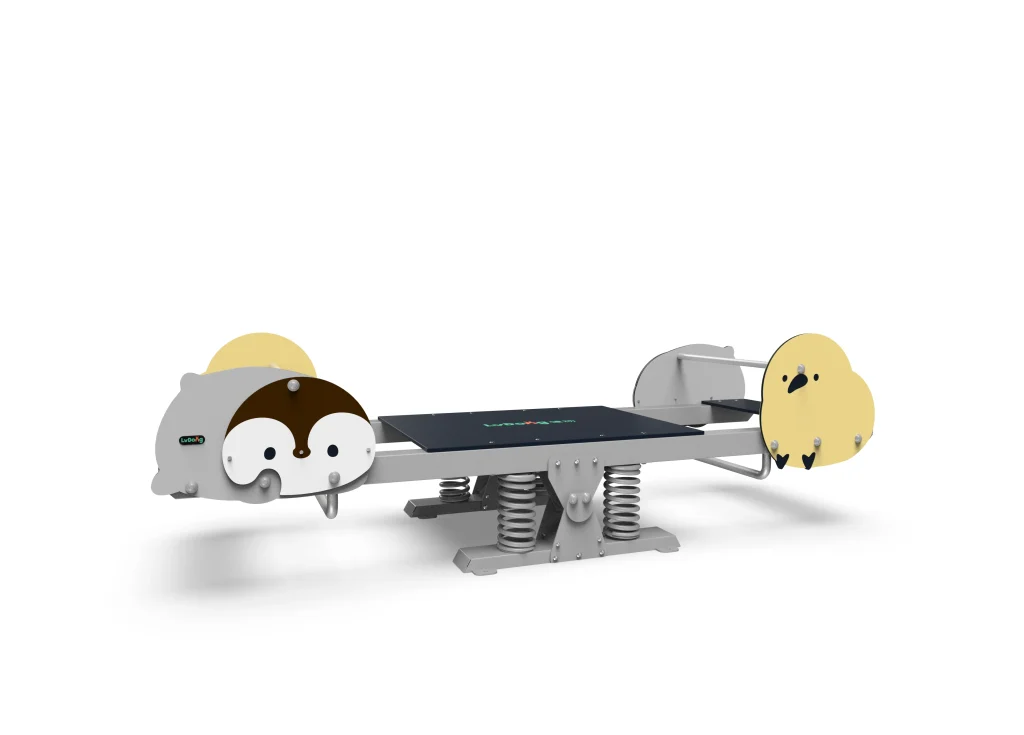
Age-appropriate seat selection affects both safety and play value. Bucket seats and full-bucket seats support children under five who lack the core strength and grip to stay secure in belt seats. Belt seats serve older children who can hold chains and center their weight during swinging. Mixing seat types on a single bay allows siblings of different ages to swing together, which increases the equipment’s utility for families. Suzhou LvDong Amusement Equipment Co.,Ltd manufactures equipment using these material standards, including multi-person options like their outdoor playground seesaw designed for ages three and up, accommodating two to ten children depending on configuration. Their spring playground equipment maintains a maximum fall height of 50 cm, appropriate for toddlers developing balance skills.
Why Installation Failures Create the Worst Liability Exposure
Improper installation causes equipment failures that no amount of quality manufacturing can prevent. A swing set frame anchored with insufficient concrete depth will shift under dynamic loads as children swing at maximum arc. Bolts torqued below specification work loose over months. Hardware installed without thread-locking compound backs out from vibration. These failures happen gradually, then suddenly, and they create liability exposure that falls on the site owner regardless of manufacturer quality.
Ground conditions vary enough that installation protocols must adapt. Sandy soils require deeper footings than clay. Frost heave in northern climates demands footings below the frost line. Rocky substrates may require core drilling rather than standard excavation. Professional installers understand these variables and carry the equipment to address them. They also maintain documentation that demonstrates compliance with manufacturer specifications and safety standards—documentation that matters if an incident ever reaches litigation.
Playground swing sets require layered inspection schedules to catch problems before they cause injuries. Daily or weekly visual checks identify obvious hazards like broken seats, exposed hardware, or displaced surfacing. Monthly or quarterly operational inspections examine wear patterns, chain elongation, and fastener tightness. Annual comprehensive inspections by certified professionals assess structural integrity, surfacing impact attenuation, and compliance with current standards. Suzhou LvDong Amusement Equipment Co.,Ltd includes professional installation services that establish the baseline condition for these ongoing inspection cycles.
What Maintenance Costs Over a Twenty-Year Equipment Life
A commercial playground swing set represents a capital investment that maintenance either protects or wastes. The equipment itself may carry a ten-year warranty on structural components, but warranties cover manufacturing defects rather than wear from use or environmental exposure. Actual longevity depends on maintenance execution: cleaning that removes debris before it traps moisture, lubrication that prevents chain wear, hardware checks that catch loosening before it progresses, and component replacement that addresses wear before failure.
Budget planning for playground swing sets should include annual maintenance costs at roughly 5-10% of initial equipment cost, plus surfacing maintenance that varies by material choice. A $15,000 swing set installation with poured-in-place rubber surfacing might require $750-1,500 annually in maintenance labor and supplies, plus periodic surfacing repairs. The same equipment with engineered wood fiber surfacing might require $2,000-3,000 annually due to material replenishment and raking labor. These ongoing costs compound over a fifteen to twenty-year equipment life into totals that rival or exceed the initial purchase.
Suzhou LvDong Amusement Equipment Co.,Ltd structures warranty and after-sales support to address both manufacturing issues and maintenance guidance. Their documentation includes maintenance schedules specific to each equipment type and the materials used in its construction. If your project requires equipment that will serve a community for decades, these support structures matter as much as the initial product specifications.
Frequently Asked Questions
How long can I expect a commercial swing set to last in a public park?
Commercial swing sets built from galvanized steel frames and UV-resistant plastics typically last fifteen to twenty years with consistent maintenance. The actual lifespan depends heavily on usage intensity, environmental exposure, and whether maintenance schedules are followed. Equipment in high-traffic urban parks with daily use wears faster than identical equipment in lower-traffic suburban settings. Coastal and high-UV environments accelerate material degradation regardless of usage levels.
What are the key differences between residential and commercial swing sets?
Commercial swing sets meet stricter safety standards, use heavier-gauge materials, and require professional installation methods that residential equipment does not. ASTM F1487 compliance for public playgrounds specifies testing protocols, material requirements, and design constraints that residential equipment sold under ASTM F1148 does not face. Commercial frames typically use 3.5-inch or larger diameter posts with wall thicknesses that residential equipment cannot match. The price difference reflects these material and compliance requirements.
Is it possible to customize swing set designs for specific themes or spaces?
Manufacturers including Suzhou LvDong Amusement Equipment Co.,Ltd offer customization for themed environments, unusual site constraints, and specific accessibility requirements. Customization can include color schemes matching school or park branding, modified dimensions for constrained spaces, and integrated accessible components beyond standard ADA minimums. Custom work typically extends lead times and increases costs, but allows playground swing sets to serve specific community needs rather than forcing sites to adapt to standard configurations. To discuss requirements for your next project, contact us at [email protected] or +8613915684545.
If you’re interested, check out these related articles:
International Playground Equipment Procurement A Step by Step Guide
School Playground Equipment Zoning for Grade Based Development