Interactive play equipment shapes how children engage with playgrounds, and the choice between motion sensor technology and mechanical engagement defines both upfront cost and years of operation. Park planners face a split decision: high-tech interactivity that flashes and tracks, or proven mechanical systems that spin and challenge without batteries. From a manufacturing perspective, the smarter choice depends less on the technology itself and more on the playground’s real-world conditions—maintenance access, climate, vandalism risk, and daily visitor volume. For most public venues, mechanical solutions outlast and underspend their electronic counterparts, though theme parks and branded visitor centers can justify sensor-based systems when the experience, not just durability, drives the value.
How Motion Sensor Interactivity Works on the Playground
Motion sensor play equipment uses capacitive touch, infrared beams, camera tracking, or pressure-sensitive mats to detect a child’s movement and trigger lights, sounds, or visual effects. A child waving a hand near a panel can launch a light chase across a wall. A jump on a floor mat can score points on a connected display. The sensor hardware sits inside weatherproof enclosures, typically rated IP65 or higher, and the control unit runs a simple embedded program that cycles through preloaded games.
These systems need power, which means either a permanent grid connection, a dedicated solar panel with battery storage, or a manual charging routine. In sunny climates, solar works well, but dust on panels and battery degradation still demand quarterly checks. The software itself rarely fails; what breaks are the connectors, the exposed USB ports, and the wiring that children find and tug. Operators who plan for weekly inspection of cable glands and enclosure seals get the full lifespan. Those who install and forget usually face dead units within two years.
Mechanical Engagement Mechanisms That Drive Repeat Play
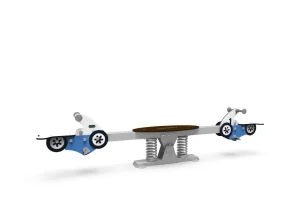
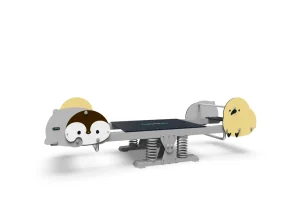
Mechanical interactive equipment relies on direct physical effort. A child pushes a lever that activates a gear train that spins a drum of beads. Two children pedal a set of bicycle cranks connected to a water pump or a musical chime. A spring rider rocks and triggers a mechanical counterweight that clicks a striker against a resonant plate. No microcontroller runs the show; the child’s own motion creates the response.
The appeal is immediate and physical. A turn of a handle produces a visible, satisfying result. There is no boot-up delay, no software freeze, and no “out of order” sign because a battery died. The mechanisms are exposed or encased in clear polycarbonate, so older children can watch the linkage work, which adds a layer of curiosity-driven play. Our design team has found that the repeat-play rate on well-tuned mechanical games—where the feedback feels crisp and immediate—matches or exceeds that of touchscreens, especially among children ages 3 to 7 who are still developing screen literacy.
Durability and Maintenance: What Park Operators Learn After Year One
A manufacturer’s catalogue often includes both motion sensor panels and mechanical spinners side by side. <Interactive Playground Equipment Manufacturer OEM> shows how these two categories coexist in a single product line, reflecting the practical reality that selection hinges on the site, not a one-size-fits-all preference.
After the first year of weather, the differences in maintenance demand become stark. Sensor panels suffer from moisture ingress at cable entry points, especially when temperature swings expand and contract the conduit seal. In coastal locations, salt mist accelerates corrosion on exposed connectors. Vandalism targets screens and sensors directly: a rock can shatter a capacitive panel, and a bent cable plug can kill an entire zone. Mechanical equipment has its own failures—spring fatigue, bearing wear, bent levers—but those failures are gradual and predictable. A worn bearing will rumble for weeks before seizing, giving maintenance staff time to schedule a repair.
Durability in heavy-traffic settings separates robust equipment from fragile installations. <High Traffic Durability Tips for Airport Playground Equipment> covers how surface materials and bearing specifications handle thousands of daily interactions, a stress test that directly exposes the gap between sensor-driven panels and all-mechanical systems.
We routinely test enclosure designs under continuous water spray in our quality lab. The most common failure we see is not the sensor itself but the gland nut loosening after thermal cycling, a small detail that field crews often miss. If your maintenance team does not include someone comfortable with a multimeter and silicone sealant, the cost of outsourcing even minor electronic faults will eat into annual budgets quickly. For that reason, many municipal parks departments we work with now specify mechanical-only interactive zones, and they report a 60% drop in call-out repairs compared to their previous mixed installations.
Cost Comparison: Upfront Price vs. Lifetime Budget
| Feature | Sensor-Based Interactive | Mechanical Engagement |
|---|---|---|
| Power requirement | Grid or solar with battery | None |
| Typical upfront cost per station | $3,000–8,000 | $400–1,500 |
| Annual maintenance (parts & labor) | $300–800 | $50–150 |
| Expected component lifespan | 5–8 years | 15+ years |
| Vandalism resilience | Low (screens, cables) | High (bent metal repairable) |
The initial purchase price is only the first number. For a community park with five interactive stations, the sensor route can easily add $15,000–40,000 in upfront cost, plus another $1,500–4,000 annually in maintenance, compared to a few thousand dollars for an equivalent mechanical set. Over a ten-year cycle, the difference compounds. We have quoted installations where running underground conduit for power to a single sensor panel cost more than the entire spring rider set beside it.
That said, sensor-based systems can generate higher perceived value in paid-entry venues. A hotel kids club or ticketed science center can justify the cost because the novelty of interactive lights attracts parents willing to pay a premium. Operators in that segment often treat the electronics as a consumable marketing expense, refreshing the hardware every five years as part of a wider renovation cycle. For free-access public playgrounds, that math rarely holds. One of our municipal clients calculated that replacing all their sensor panels after seven years nearly matched the cost of a complete mechanical playground rebuild, including surfacing.
Matching Interactive Type to Venue Profile
A seafront park in a tropical climate, with daily salt spray and minimal supervision, is a clear candidate for mechanical equipment. Stainless steel bearings, galvanized frames, and sealed mechanical links survive conditions that would degrade sensor enclosures within a single monsoon season. An indoor shopping mall play zone, with controlled temperature, no rain, and cleaning staff nearby, can support sensor panels without the same risk.
The decision also touches on accessibility. Mechanical spinners with low transfer platforms and ground-level rockers can serve children with physical disabilities without requiring fine motor control. Some sensor games demand precise hand placement or fast reactions, which can exclude children with certain developmental conditions. At the same time, well-designed touch panels with large targets and audio cues can engage children on the autism spectrum in ways that purely physical equipment cannot. The right match is specific: a sensory room in a therapy center benefits from programmable sensor walls, while an inclusive public playground often does better with adaptive mechanical units.
Stakeholder priorities tip the scale. Maintenance budgets, staff technical skills, expected visitation, and local climate all matter more than the technology headline. When we work with buyers who manage multiple sites, we often map out a matrix: mechanical for district parks and housing estates, a small sensor zone for a flagship city-center playground where presence and prestige matter. That split approach keeps overall cost per visit low while still offering a technology showcase where it drives visibility.
Planning Your Interactive Playground Investment
Choosing between motion sensors and mechanical engagement is ultimately a decision about who will keep the equipment running and for how long. At Suzhou LvDong, we manufacture both types and see orders shift depending on those real-world factors. We recommend mechanical systems for any site where unsupervised access, extreme weather, or limited maintenance budgets are the norm. For premium indoor or supervised outdoor venues where novelty drives attendance, sensor-based play panels can pay off if paired with a five-year service plan and trained onsite staff.
To discuss your specific site requirements or request a comparative cost breakdown that includes installation, maintenance projections, and realistic lifespan data, reach out at [email protected] or via WhatsApp at +8613915684545. We can share performance data from similar installations to help you weigh the long-term numbers.
What Practitioners Ask About Interactive Equipment
How long do sensor-based interactive panels actually last outdoors?
In practice, you should budget for electronics replacement within five to seven years, and in coastal or high-humidity locations, failures can appear as early as year three. The panel housing itself may look intact, but moisture creeping past the seal degrades the circuit board contacts gradually. Our field reports show that enclosures with sacrificial desiccant packs and quarterly seal inspections can push operational life to the eight-year mark. Without those practices, the median time to first sensor failure drops below four years in tropical climates. The display components, if any, tend to outlast the sensor logic, but clouding of the protective lens under UV exposure is another aging vector.
Do mechanical spinners really engage children as much as digital games?
A common misreading is that children need screens to stay engaged. In our observations across installed sites, a well-designed mechanical game, such as a pair of bicycle cranks that drive a vertical marble lift, creates longer sustained play than many touchscreen panels. The physical cause-and-effect loop is immediate, and children repeat the action to master it. Digital games run on preprogrammed cycles; after a child has seen every animation three times, the novelty fades unless content is refreshed regularly. Mechanical interactions do not rely on surprise. They rely on mastery, and that keeps children coming back. The age group also matters: toddlers and preschoolers gravitate toward physical levers and spinning elements more than screen-based prompts.
How does vandalism differ between the two types?
The gap is significant. A sensor panel with a glass or polycarbonate face can be shattered with a single impact, and a severed cable harness can render the entire unit inoperable until a technician replaces the wiring loom. Mechanical equipment suffers damage too, but the results are usually partial: a bent handle still works, a dented panel does not stop the game. Repairs on mechanical units often require only standard tools and a replacement part from shelf stock. Electronic repairs frequently involve ordering proprietary circuit boards with supplier lead times. For unsupervised sites with known vandalism risk, the economic case for mechanical dominates.
Can I mix sensor and mechanical interactive equipment in one playground?
It depends on your budget, site layout, and target age group. Many of our clients blend a single sensor station into an otherwise mechanical playground, positioning it near a seating area where parents can supervise. This gives the venue a visual focal point for marketing while keeping the bulk of the equipment maintenance-friendly. The split also reduces the risk that a power outage or hardware fault shuts down all interactive features at once. We typically suggest placing sensor units close to a power source and ensuring that the surrounding area is well lit, as electronic panels in dim corners attract more probing hands and accidental damage.
Which type faces fewer hurdles during safety certification?
In the certification documentation we prepare for EN 1176, mechanical equipment usually requires a simpler set of test reports because the hazards are mechanical and well understood. Entrapment gaps, crush points, and fall heights are measured with physical probes. Sensor equipment adds an electrical safety layer, often referencing IEC standards for low-voltage outdoor installations, plus electromagnetic compatibility testing if the unit emits radio frequencies. The paperwork does not block certification, but it extends the timeline and sometimes requires retesting after firmware updates that change a device’s behavior. If your project includes both types, sharing a preliminary layout helps us flag any certification gaps before production. Send your concept drawing to [email protected], and we will review the compliance pathway.
If you’re interested, check out these related articles:
Evaluate Playground Equipment Samples Before Buying A Guide
Mastering Metal Slide Heat Prevention Strategies for Playgrounds
Playground Slide Materials LLDPE vs 304 Steel Performance
Sensory Play Panels Inclusive Design for Special Needs
Annual Maintenance Calendar for Outdoor Play Equipment A Guide
Compare the current equipment catalogue when preparing a mechanical-versus-sensor brief, then discuss your project requirements with the LvDong team.