Why a Warehouse Spinner Test Beats a Visual Once-Over
A spinner sample arriving at your warehouse carries more than the product itself: it carries the factory’s weld discipline, coating process, bearing selection, and final assembly care. Freight vibration, handling, and heat can expose weaknesses that a showroom photo cannot. The most reliable way to protect a larger order is a structured sample evaluation protocol that moves from paperwork to rotation and then to sign-off.
For public-use spinners placed in schools, parks, and community projects, the baseline safety reference is EN 1176-1:2018 [1]. That standard frames the inspection around user safety, structural integrity, and predictable movement. A warehouse protocol based on those same priorities lets you catch problems before installation teams and children do.
1. Start With the Paper Trail Before Cutting the Wrap
Unpacking too quickly is the most common mistake in spinner evaluation. Begin with the documents that should travel with the sample. Match the packing list to the purchase specification, then confirm the product name, model, finish, and accessories. If the sample is a multi-player unit, check that the deck, seats, hand grips, and any installation templates are present.
Look for three documents in particular: the dimensional drawing, the conformity declaration, and the spare-parts or maintenance note set. The drawing should include the overall diameter, height, fall height, and critical footprints. If the factory conformity documents reference a national standard, compare the listed model and material grades against the drawing and the physical parts.
| Checkpoint | What to look for |
|---|---|
| Shipping frame | No cracked pallet supports, no bent mounting plates |
| Weld areas | No pits, cracks, undercut, or sharp spatter |
| Fasteners | Correct type, no missing bolts, no stripped threads |
| Platform or deck | No warping, no gaps that widen under hand pressure |
| Seats and grips | No torn edges, loose handles, or exposed metal ends |
| Markings | Model, lot, and safety labels match the drawing |
2. Inspect the Frame, Welds, and Surface Finish by Section
Walk around the entire spinner before anyone climbs on it. Good welds should be continuous, uniform, and free of pits, cracks, or deep undercut. Check the underside of the deck and the gusset areas, not only the visible top ring. Use a flashlight and, if possible, run a clean cloth along the weld lines to feel for sharp edges. A sample that is smooth to the hand but rough under the cloth may have fine spatter that becomes a corrosion point.
Check the finish next. Powder-coated or galvanized surfaces should show no blisters, chips, or uneven color across high-wear zones. Look for scratches that penetrate to bare metal. At bolt holes and welded joints, confirm that the coating is not already flaking. This is a strong early signal of how the unit will age outdoors.
3. Confirm the Dimensions and Clearance Values
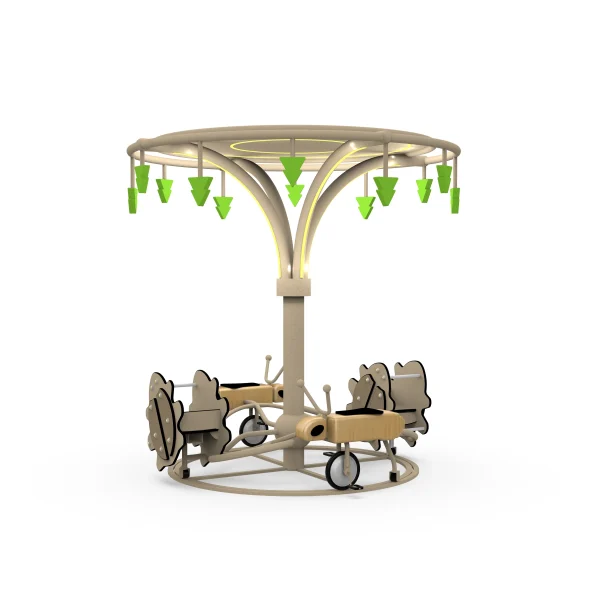
A spinner that looks correct can still fail because the delivered model is a smaller or taller variant. Measure the overall diameter, platform height, and maximum falling height before moving to functional checks. For LvDong multi-player spinner models, the product range is approximately 120–200 cm in diameter and 70–220 cm in height, depending on model. The sample should fall within the drawing tolerances, not merely close to the sales catalogue image.
Pay attention to the free space around moving parts. The spinner’s user space should be measured from the farthest rotating edge. If you plan to place the sample on a finished playground, compare this measured sweep against the fall-zone and clearance plan. A compact warehouse floor can hide the fact that the real swing radius needs more room than the pallet suggests.
4. Rotate, Listen, and Feel for Bearing Quality
The heart of any spinner is the bearing. Begin with the unit unloaded, then rotate it slowly and listen. A smooth unit should move without grinding, ticking, or a dry metallic scrape. It may have a slight initial resistance, but the movement should not feel gritty. Speed the rotation gradually, but keep hands away from pinch points and do not stand inside the rotating sweep.
Rock the structure gently from the top rail to check for unexpected play at the base or the bearing flange. A small measured bearing clearance is normal, but loose movement that shifts the deck side to side is not. The evaluation should include rotation with an even load or simulated load before sign-off.
[A spinner that rotates smoothly can still hide design-generation risks, so the sample protocol should compare the received model against modern structural expectations.] <Merry Go Round Spinners Traditional vs Modern Playground Evolution> covers how traditional and modern spinner designs differ in risk profile and what owners should inspect.
5. Run the Safety Clearance, Entrapment, and Pinch-Point Checks
After the movement test, switch from performance to safety geometry. Check openings, gaps, and moving joints for entrapment or crush risks. ASTM F1487-21 [2] includes requirements for head and neck entrapment, protrusions, and pinch/crush/shear points on public playground equipment. Look for holes or slots in accessible zones where a child’s body part could be trapped.
The U.S. Consumer Product Safety Commission’s Public Playground Safety Handbook [3] adds practical clearance guidance around moving equipment. Walk around the spinner and measure outward from the furthest rotating edge. Confirm that adjacent walls, fences, pallets, or other equipment would not fall inside that movement arc. If the warehouse is too tight to allow a full rotation, mark the sweep line and inspect what would be in the path.
One inspection team found a spinner with a well-finished top rail but an internal weld line that was only visible by touch near the seat gusset. The unit passed a basic visual once-over, but the cloth test caught the defect before the sample was accepted.
Need a Second Opinion on a Finding?
If a dimension, weld, or movement finding is unclear during the sample check, take photos from three angles and note whether the issue appears in an unloaded or loaded state. You can send those images and a short description to a supplier engineer for a documented opinion before deciding to accept or reject the sample.
For technical support with LvDong spinner samples, contact Suzhou LvDong Amusement Equipment Co., Ltd. by email at [email protected] or WhatsApp +8613915684545. Include the sample order number and the drawing reference if available.
6. Validate Materials, Coatings, and Corrosion Resistance
A spinner that will live outdoors in rain, sun, and salt air needs more than a good first impression. Check the material call-outs on the drawing against the visible and tactile finish. Stainless steel should be non-magnetic or limited magnetic in the stated grade; galvanized steel should show no deep scratching through the zinc layer. Powder-coated parts should be free of pinholes and next to bolt heads the coating should not already be breaking away.
Use a coin or a plastic scraper on an inconspicuous area to check coating adhesion, but avoid damaging the sample. For UV-sensitive colored surfaces, ask whether the finish includes a stabilizing topcoat. A sample with a uniform finish is more likely to keep its color after repeated exposure, especially in high-UV markets.
Where the purchaser requires Chinese national standard alignment, ask the supplier to mark the GB/T 34272-2017 [4] conformity on the inspection file rather than treating it as a separate marketing note.
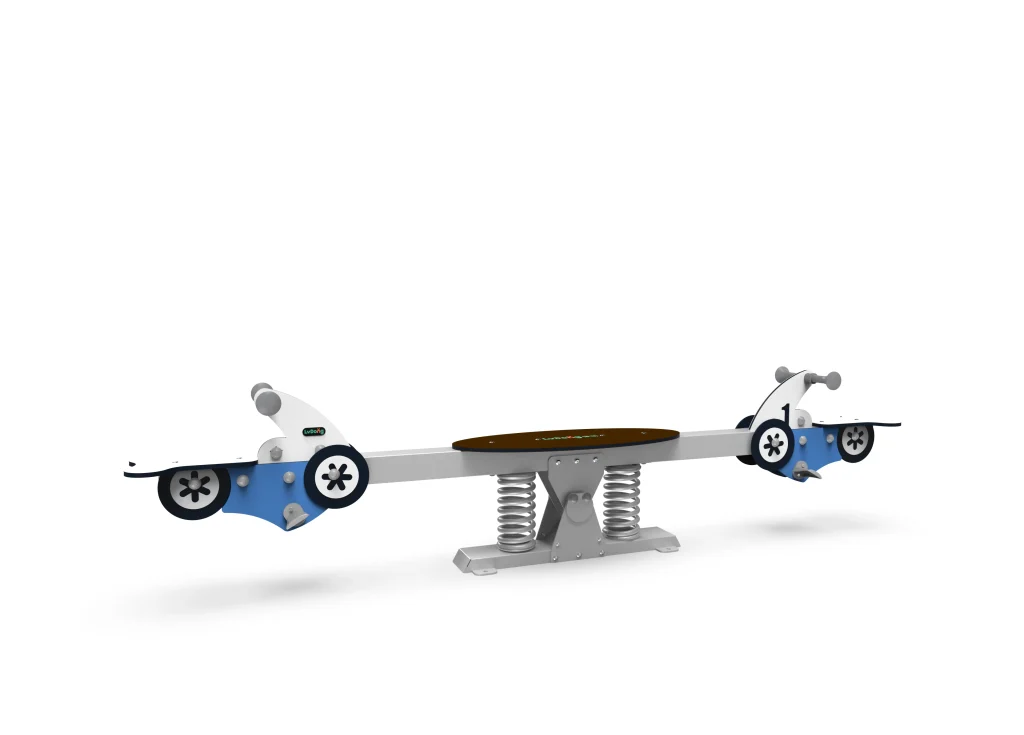
7. Apply a Controlled Load and Stability Check
A spinner that runs smoothly when empty is not yet validated for a group of children. For a multi-player spinner, simulate an evenly distributed load across the deck or seats using sandbags, boxes, or evaluators. If live loading is not possible in the warehouse, at least have two or three adult evaluators step carefully into the intended play positions and slowly rotate the unit.
The key observation is whether the platform remains stable and level under load. Watch for deflection near the deck-to-post connection, tilting of the seat tubes, or grinding from the bearing when weight shifts. The unit should return to a predictable rest position without sticking or over-rotating.
[Before the sample arrives, supplier-side controls matter just as much as the receiving inspection itself.] <Factory Visit Checklist Outdoor Playground Equipment Quality> covers the in-factory checks that make warehouse sample acceptance more predictable.
8. Close With a Sample Sign-Off Report
Do not accept a spinner sample with a verbal “looks good.” Finalize a simple report with the sample number, test date, evaluator name, and each result. Keep photos attached and note any deviation from the drawing. If the sample passes, write the acceptance criteria for the full order: same model, same material grades, same bearing type, same coating system, and same conformity documents.
If the sample fails, do not assume the next unit will be different because a sales representative says so. Record the failure, ask for a root-cause response, and require photographic evidence of correction before scheduling a replacement or moving ahead. This is the point where the sample protocol protects the entire container.
[Passing the sample is only one gate in a larger buying process.] <International Playground Equipment Procurement A Step by Step Guide> covers the procurement steps that turn an approved sample into a protected full order.
Get a Spinner Sample Protocol Review
A written sample protocol can save a project from replacing bearings, repainting decks, or explaining a failed unit to a client. If you are preparing a spinner purchase, use the checks above as your receiving baseline and keep the drawing close by during the inspection.
For buyer-specific questions on spinner sample acceptance, contact Suzhou LvDong Amusement Equipment Co., Ltd.:
WhatsApp: +8613915684545
Email: [email protected]
Please include your sample order number, the model name, and clear photos of any finding so the engineering team can respond with targeted advice.
Frequently Asked Questions
What is the first test to perform when a spinner arrives?
Begin with the paperwork and visual identity check, not the rotating test. Confirm the model, drawing number, and conformity references before physical testing.
How long should a spinner sample evaluation take?
A thorough receiving check usually takes one to two hours for a single unit after the sample is fully accessible. More time is needed when the spinner is loaded or when the site requires measured fall-zone data.
Do I need third-party testing for a spinner sample?
Third-party testing is strongest when the sample must meet a specific market requirement such as EN 1176 or ASTM F1487. In many cases, a structured internal protocol plus supplier conformity documents is a good first screen; third-party validation can be added before final acceptance.
What should I do if the sample fails one check?
Record the issue with photos, pull the sample from further use, and ask the supplier for a documented root-cause response and a corrective action plan. A replacement should not automatically clear the failure until the root cause is addressed.
Can I evaluate a spinner without formal testing equipment?
Yes, many initial checks are visual, tactile, and dimensional with a tape measure and a flashlight. However, formal probe testing for entrapment, load deflection, or coating adhesion requires the correct instruments and should be performed by a qualified inspector when the specification requires it.
References
[1] CEN, EN 1176-1:2018, Playground equipment and surfacing — Part 1: General safety requirements and test methods, European Committee for Standardization.
[2] ASTM International, ASTM F1487-21, Standard Consumer Safety Performance Specification for Playground Equipment for Public Use, ASTM International, West Conshohocken, PA, 2021.
[3] U.S. Consumer Product Safety Commission, Public Playground Safety Handbook, Publication No. 325, U.S. CPSC.
[4] Standardization Administration of China, GB/T 34272-2017, Safety requirements for playground equipment and facilities.
If you’re interested, check out these related articles:
Playground Equipment Quotes Spotting Hidden Costs Explained
Key Contract Clauses for Commercial Playground Equipment Purchase
Effectively Compare Playground Equipment Suppliers Services
To discuss spinner sampling requirements, contact the LvDong team with your project requirements.