Family pool areas inside casino resorts sit at the intersection of two very different regulatory worlds. One world cares about play value, fall heights, and accessible routes. The other world cares about restricted access, minor separation, and clear operational boundaries. That makes poolside play equipment selection more deliberate than a standard hotel or community park installation.
The good news is that gaming authorities generally do not certify playground equipment. They regulate the access, segregation, and supervision around it. That means the equipment you choose must first satisfy pool safety, public playground, and accessibility requirements, and then fit into a site plan that keeps the pool deck clearly separated from any gaming zone.
Gaming Authority Rules Do Not Regulate Slide Steel — They Regulate Access and Separation
The first planning task is to define where the family pool play area sits in relation to licensed gaming space. Most gaming regulators require physical or operational separation of minors from restricted gaming areas [1]. The pool deck and family amenities are typically classified as non-gaming zones, but only if the route, signage, and staff observation points support that classification.
A casino-resort family pool should therefore be designed as a destination zone that does not require families to pass through, pause beside, or double back into gaming-adjacent circulation paths. This is not a playground standard question. It is a licensing and security layout question, and it should be settled with the property’s compliance team before the first equipment drawing is generated.
Minors, Gaming Floors, and Non-Gaming Amenities
Casino jurisdictions differ in how strictly they treat adjacent non-gaming family areas. Nevada regulators establish operational controls for minors in and around restricted gaming areas [1]. Other jurisdictions may impose licence conditions for resort hotel towers, pool decks, and entertainment venues even when those venues contain no gaming devices.
For the buyer, the practical point is simple: do not assume that a family pool is automatically outside the gaming authority’s review. Confirm the property’s non-gaming designation, then document how the play equipment zone supports that designation through controlled entry, clear sight lines, and no dead-end circulation.
Jurisdictional Differences That Change Equipment Placement
Some regulators may require that the family pool play area be enclosed or fenced separately from adult pool areas. Others may accept a low barrier combined with signage and staff monitoring. The equipment itself rarely changes, but the site clearance, fall zone fencing, and gate layout often do.
Because of this, equipment with a compact footprint and low fall height is easier to fit into restricted layouts. Ground-level play panels, seated spring riders, and single-post spinners often create fewer compliance conflicts than tall multi-deck structures with elevated platforms.
What a Casino Resort Family Pool Equipment Package Must Include
A compliant package balances three priorities: pool-safe materials, playground-standard impact protection, and accessible play value. The equipment should not introduce new entry hazards, blind corners, or climbable elements that direct children toward the water without supervision.
Low-Profile Play Close to the Water
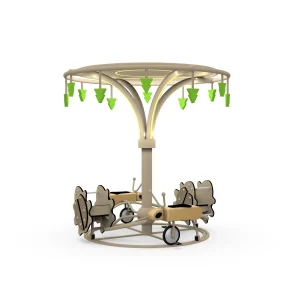
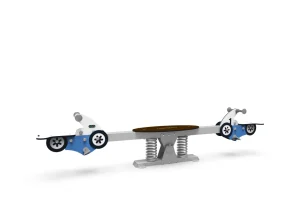
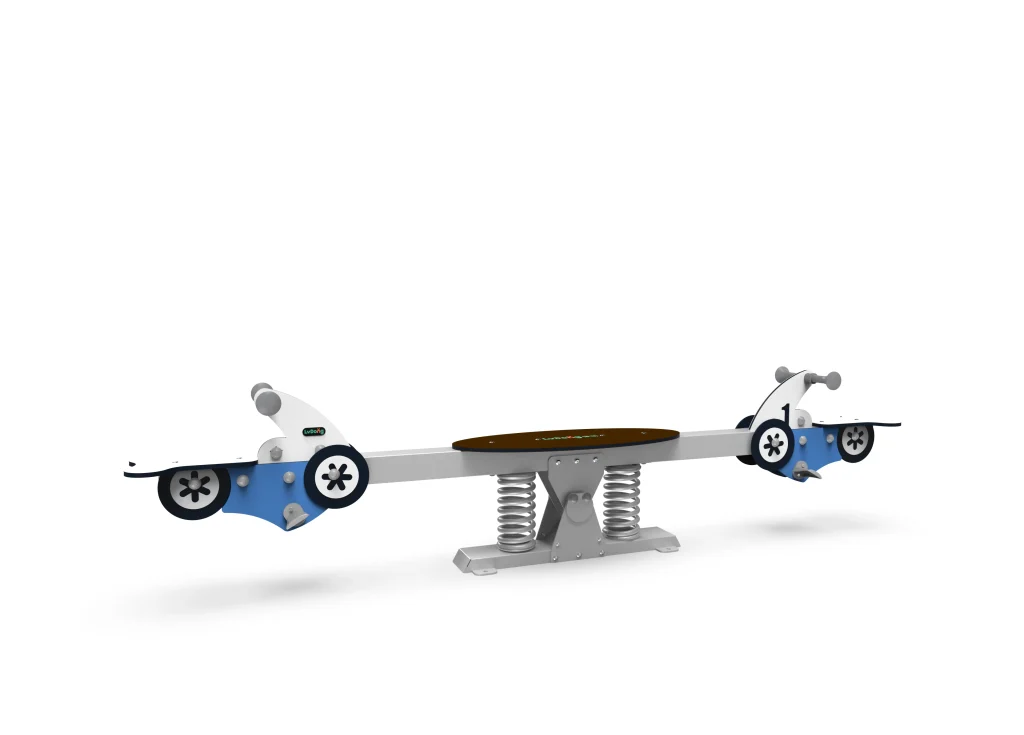
For the area immediately adjacent to the pool deck, low-profile equipment usually performs best. Seated spring riders, ground-level interactive play panels, and compact playground spinners provide motion and activity without creating elevated fall height at the pool edge.
This also supports supervision. A low play zone lets lifeguards and parents scan the deck with fewer visual obstructions, which is a practical requirement in busy resort pools.
Shade, Signage, and Supervision Sight Lines
In casino-resort settings, the play area should be visible from multiple staff positions. Tall themed structures can be attractive, but they may block the line of sight between the family pool, the shallow-water entry, and the gate. Where possible, use open-frame equipment, low spinners, and play panels arranged along the perimeter rather than in the centre of the deck.
Signage should clearly identify the family pool zone, age range, supervision requirements, and the route back to the hotel tower or non-gaming amenity area. This signage supports both pool safety and gaming-authority access control.
Material Selection for Chlorine, Salt, and High-Traffic Pool Decks
Pool environments accelerate corrosion, UV degradation, and coating wear. Equipment that works well in a dry playground may fail early beside a chlorinated pool or a coastal casino resort.
Corrosion Resistance in a Chlorine Environment
Frames, fasteners, and moving parts should use galvanized steel, stainless steel, or equivalent corrosion-resistant treatment where they will be exposed to pool chemicals and frequent hose-down cleaning. Bolted connections and bearing housings need the highest attention because trapped moisture and chlorinated water create hidden corrosion points.
For coastal casino resorts, salt spray adds a second layer of corrosion stress. Stainless steel components and sealed bearings should be specified for spring riders, spinners, and seesaws placed outdoors near the waterline.
Wet-Surface Slip Resistance and Impact Attenuation
Pool decks are wet, and wet feet change the play surface. The equipment platform, step surfaces, and transition points should use slip-resistant textures or coatings. Below and around the equipment, the surface should meet impact attenuation requirements for public playground use under EN 1176 and ASTM F1487 [3][4].
Open drainage is also important. Equipment should not trap standing water, and the fall zone should slope away from the pool shell to prevent chlorinated runoff from pooling under the structure.
Traffic Flow and Capacity on the Family Pool Deck
A casino-resort family pool handles fluctuating traffic: quiet weekday mornings, busy conference weekends, and peak holiday periods. Equipment should be selected for rapid turnover and clear movement between water, play, seating, and shade.
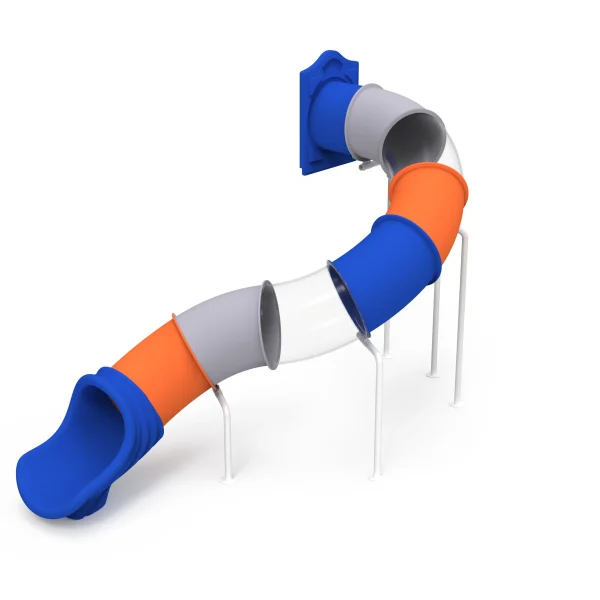
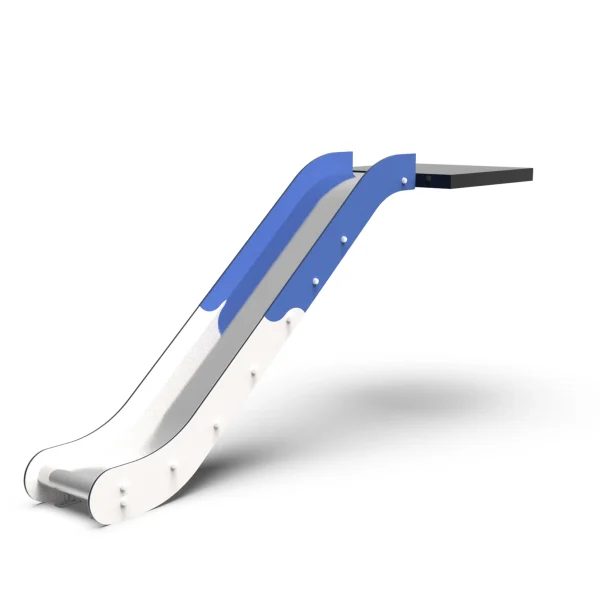
For slide-heavy layouts, queueing and exit clearance become the main bottleneck. A slide landing zone that overlaps a walkway or a spring rider cluster creates unpredictable movement and reduces supervision quality.
On a high-turnout family pool deck, flow conflicts around slides, entries, and wet walkways create bottlenecks that are hard to fix after installation. <Double Slide Playground Design for Optimal Traffic Flow Strategies> covers how paired slide layouts reduce crowding and keep supervision lines clear.
Designing for Peak Resort Occupancy
Rather than adding more equipment, many regulated properties benefit from fewer, higher-durability pieces arranged in a long, open plan. This preserves clear travel routes, reduces collision points, and makes maintenance access simpler. Low-capacity, low-maintenance items such as play panels and seated spring riders can absorb short bursts of activity without requiring a queue.
Vetting a Manufacturer for Gaming-Regulated Resort Projects
Compliance extends beyond the equipment itself. The manufacturer should be able to provide standards documentation, material traceability, and design drawings that fit the property’s security and pool-safety review process.
Compliance starts before the order is placed. <Evaluate Commercial Playground Manufacturers 8 Critical Selection Factors> covers the selection factors most relevant to regulated resort procurement.
Documentation Required for Regulated Purchases
Before approving equipment, the property team typically needs:
- EN 1176 or ASTM F1487 compliance documentation
- Material specifications for corrosion-resistant coatings and fasteners
- Fall height and use-zone drawings
- Installation details for anchoring and drainage
- Maintenance and inspection schedules
These documents should be assembled into a compliance file that remains available after opening, because pool inspectors, accessibility reviewers, and gaming-authority walkthroughs may request them at different times.
Factory Audit and Third-Party Verification
For a casino-resort project, a factory visit or third-party inspection is often justified before shipment. The audit should confirm welding quality, coating thickness, bearing sealing, and the accuracy of the drawings submitted for approval.
A supplier visit confirms the difference between a polished catalogue and a production line that supports a demanding resort project. <Factory Visit Checklist Playground Equipment Supplier Evaluation> covers the checks that matter before shipment.
Plan Your Regulated Family Pool Play Zone
If you are specifying equipment for a casino-resort family pool, the safest path is to work from the site plan and the property’s non-gaming access rules outward. Confirm the regulatory classification, map the sight lines, choose corrosion-resistant low-profile equipment, and assemble the compliance documentation before installation begins.
For project-specific support, send your pool deck layout, local authority requirements, and target equipment list to [email protected] or WhatsApp +8613915684545. Include the jurisdiction and the property’s gaming-zone boundary so the equipment package can be matched to the correct clearance, surfacing, and access constraints.
FAQ
Does a casino resort family pool require separate approval from the gaming authority?
In many jurisdictions, the family pool is treated as a non-gaming amenity, but the access route and separation from licensed gaming areas must be clearly documented. Confirm the classification with the property compliance team before finalizing the layout.
What playground safety standards apply to poolside equipment?
Poolside play equipment should meet the same public playground safety standards as any commercial installation, including EN 1176 or ASTM F1487 for impact attenuation, entrapment, and protrusion requirements [3][4]. The pool deck must also meet applicable swimming pool and health codes, such as those reflected in the Model Aquatic Health Code [5].
Can the equipment be installed inside the pool enclosure?
Yes, provided the equipment does not create a climbing path over the enclosure, block emergency access, or trap water. Low-profile equipment with a compact use zone is generally easier to place inside a restricted pool enclosure.
How do we keep the play area compliant with ADA while maintaining water access?
Provide an accessible route from the family pool entrance to the play area, and where play equipment is provided, accessible ground-level components should be included [2]. Transfer spaces and clear deck zones should not overlap with slide exits or active play areas.
What should be included in the compliance file before opening?
Keep a compiled file with standards documentation, material specifications, fall height and use-zone drawings, installation records, access route drawings, and maintenance schedules. This supports inspection readiness for pool safety, accessibility, and property licensing reviews.
References
[1] Nevada Gaming Control Board. Regulation 5 — Operation of Gaming Establishments. https://gaming.nv.gov/
[2] U.S. Access Board. Americans with Disabilities Act Accessibility Guidelines. https://www.access-board.gov/
[3] ASTM International. ASTM F1487-21, Standard Consumer Safety Performance Specification for Playground Equipment for Public Use.
[4] European Committee for Standardization. EN 1176-1:2017, Playground equipment and surfacing — Part 1: General safety requirements and test methods.
[5] Centers for Disease Control and Prevention. Model Aquatic Health Code. https://www.cdc.gov/mahc/
If you’re interested, check out these related articles:
Multi Function Playhouse with Slide and Swing Commercial Solutions
Safe Quiet Cleanable Playground Equipment for Hospitals
To discuss your resort family play-area brief, contact the LvDong team with your project requirements.