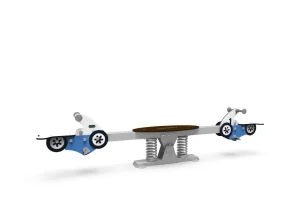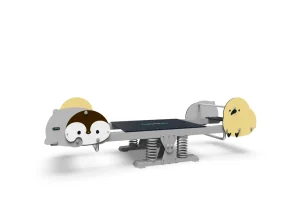
Airport family zones work best when the play area is treated as a service module rather than a permanent build. Quick-install playground equipment for airport family zones lets terminal teams add, move, or store children’s play capacity without core drilling through concourse slabs or waiting on long construction windows. Over years of supplying unpowered children’s equipment for public venues, I have learned that airport projects reward a different specification logic: shorter install time, documented fall heights, and restraint systems that suit high-traffic rotations. The following sections cover the equipment forms, surfacing choices, and installation checks that matter most.
Airport Play Zones Need Quick-Install Equipment, Not Permanent Builds
Terminal environments change faster than municipal parks. Security checkpoints move, airline zones shift, retail areas expand or contract, and construction hoardings force temporary reconfiguration. A fixed play structure with deep foundations can become an obstacle in that cycle. Quick-install playground equipment for airport family zones takes a different approach: units are anchored to existing floor slabs with surface-mounted plates or weighted bases, installed by one or two technicians during off-peak hours, and removed or repositioned when passenger flow changes. The key is not simply buying smaller equipment. It is choosing pieces with low fall heights, durable anti-slip surfaces, and modular anchors that do not require cutting through waterproofing or buried services.
In our work supplying unpowered children’s equipment for public venues, I have seen how airport projects differ from standard park installations. A park can tolerate a longer installation window and a heavier foundation. An airport cannot. The equipment has to arrive ready to assemble, with pre-drilled base plates and clear spacing requirements, so the terminal team does not need to close a large area for days. That practical constraint shapes every specification that follows.
Flooring and Fall Height Decide Whether a Temporary Layout Works
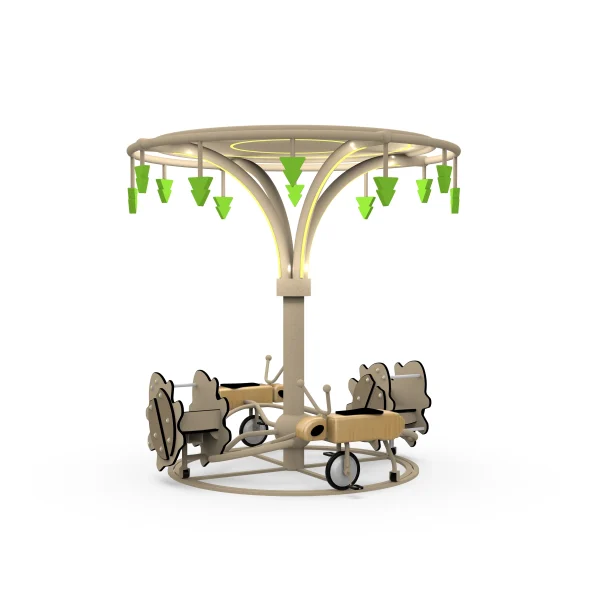
Hard stone and polished tile floors are common in terminals. They are easy to clean but they are not impact-attenuating surfaces for play. Airport project teams often underestimate this point because the installation is temporary. The fall height of the equipment still governs the surfacing requirement. Lower fall heights reduce the area that needs protective surfacing, which reduces cost and keeps the zone flexible. Spring rider units in our current range have a maximum fall height of 50 cm, while multi-player spinners fall between 55 cm and 77 cm depending on the model. That is a meaningful difference when the surrounding floor is tile: a 50 cm fall height can be managed with a compact interlocking rubber tile perimeter, while a taller unit may require a larger surfacing zone.
If the airport wants a small slide or elevated playhouse, the fall height rises further and the surfacing footprint expands. I would not place a tall slide into a rotating airport layout unless the terminal already has a fixed play room with proper flooring. For most temporary family zones, spring riders, low-profile spinners, and wall-mounted play panels are a safer starting point. They keep the critical fall height below the point where the flooring solution dominates the budget.
High-Cycle Equipment Choices Fit Airport Family Areas
Airport play zones see short, intense use. Children pass through between flights, often with tired parents and heavy hand luggage. The equipment has to engage quickly, clean easily, and hold up under frequent use without small loose parts. The table below matches equipment types to typical airport roles:
| Equipment type | Best role in an airport family zone | Installation note | Why it fits a rotating layout |
|---|---|---|---|
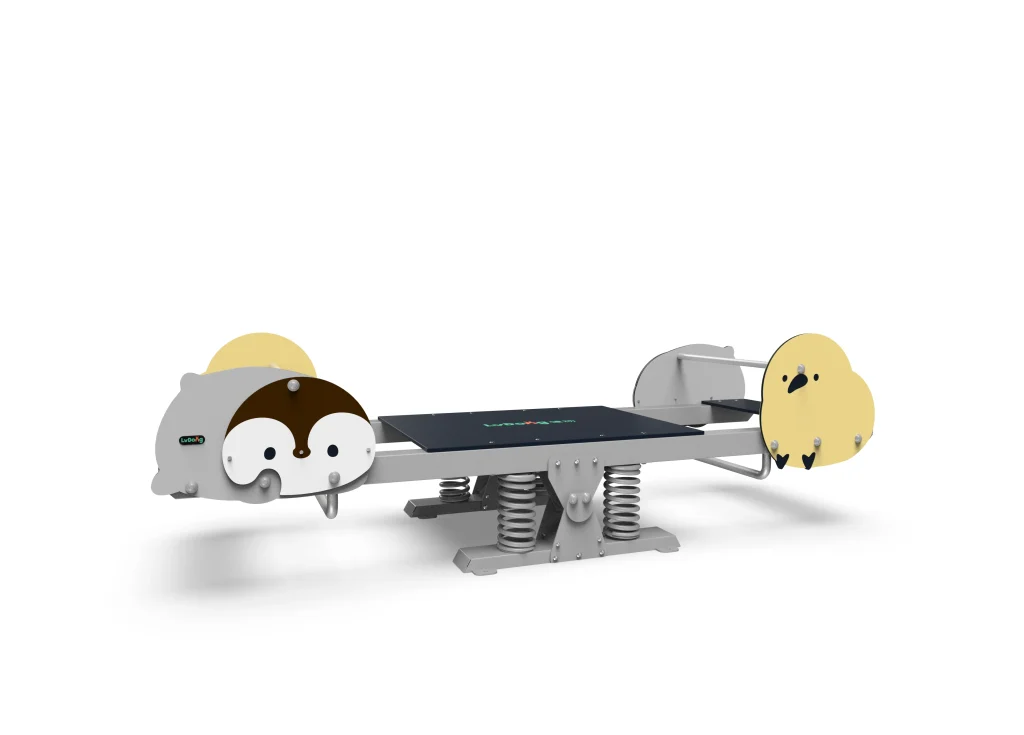
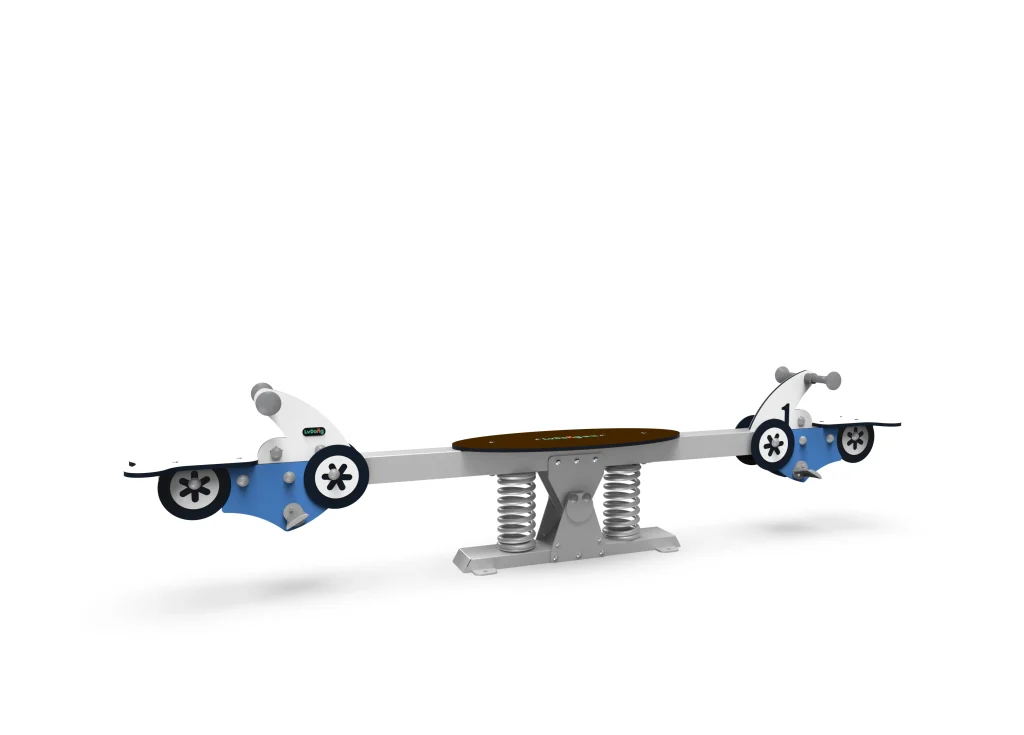
| Spring rider | Toddler movement and short waiting play | 1 installer, about 0.5 person-hours | Low fall height, compact footprint, simple relocation |
| Multi-player spinning wheel | Mixed-age social play, absorbs passenger surges | 1–2 installers, about 2 person-hours | Round footprint, 6–10 child capacity, durable rotation |
| Activity panel | Wall or frame mounted sensory play | Panel fixing depends on adjacent structure | Small zone, no heavy base, theme can change with panel swap |
| Small slide or playhouse | Longer play cycle and visual landmark | Requires fall surfacing and crane or pallet movement | High appeal but only suitable where floor zone and fall height allow |
Spring riders and activity panels are usually the easiest first phase. They require less floor preparation and can be stored in a back-of-house area when not in use. Spinners add social play but need a clear safety perimeter and a surfacing ring. A small slide or themed playhouse makes the zone more visible from across the concourse, yet it commits the airport to a larger fall zone. In practice, we often recommend a combination: two or three spring riders, one multi-player spinner, and a row of activity panels. That mix keeps the zone compact and gives a clear visual signal without turning the area into a construction project.
Rotating Layouts Depend on Modular Anchoring and Two-Person Installation
Airport operators sometimes need to move a play zone from one gate area to another during terminal works or seasonal schedule changes. Quick-install equipment handles this when the anchor method is deliberately chosen. For most concourse slabs, we specify surface-mounted base plates with mechanical anchors. Removal leaves only discrete bolt holes that can be filled, rather than large core holes for cast-in foundations. Where drilling is not permitted, weighted frames or ballasted spinners can be used, but they still need to be checked against the floor load limit and wind or overturning loads.
If your terminal program involves moving play zones across airside and landside boundaries, it is worth confirming the floor load limit, anchor approval, and egress path with the airport engineer before finalizing the equipment list. Send your available floor zone dimensions and relocation plan to [email protected] and we can check the anchoring approach against the proposed units.
The labor hours matter more in an airport than in a park. The product data above shows why: a spring rider can be installed by one person in about half an hour. A spinner takes one to two installers and roughly two person-hours. That means a compact four-unit family zone can be assembled during a single overnight window, tested, and handed over before the morning passenger peak. The same low labor requirement makes future moves realistic rather than theoretical.
Safety Documentation and Receiving Checks for Quick-Install Airport Equipment
Before an airport accepts a temporary play zone, there is a documentation window that cannot be skipped. For every unit, the buyer should receive the EN 1176 certificate or corresponding test report for the product family, the critical fall height declaration, the installation manual with anchor specifications, and the recommended inspection schedule. Spinners and moving units should also have load test or continuous rotation test evidence where applicable. This is not about collecting paper for its own sake. A terminal is a high-traffic public space, and the facility team needs a clear record of what was installed and how it should be maintained.
Airport teams often need the full documentation set compressed into one folder before a rotating play area can open. <Essential Checklist for Playground Equipment Safety Test Reports> covers the test reports and inspection records to request for each item, including what to match against EN 1176 before public opening.
For equipment that will be moved several times, spare parts become part of the operational plan. A relocation can turn into a delay if a spring cover, connector, or surface pad is missing. We recommend keeping a small kit for the units in rotation, with wear components matched to the model list. The kit should travel with the equipment, not sit in a central maintenance store, because airport moves often happen during tight overnight windows when there is no time to search for parts.
Temporary zones are often de-installed, stored, and re-installed across a multi-year terminal program. <Optimizing Playground Equipment Spare Parts Lead Time and Stock> covers how to hold critical connectors, spring covers, and wear parts so a short rotation does not stall on missing hardware.
Airport teams do not have spare weeks to manage a playground procurement. The most useful move is to treat the play zone as a defined package: equipment list, fall heights, surfacing zone, anchor method, installation hours, and certification files. If you are planning a temporary or rotating airport family zone, send the floor area, target opening date, and preferred equipment types to [email protected] or WhatsApp +8613915684545. We can return a short-form proposal with layout options, fall height data, and installation sequence for your terminal.
Airport Project Teams Ask These Questions Before Ordering
How quickly can an airport family zone be installed?
Most compact zones with spring riders and activity panels can be installed in one overnight shift if the anchor points and surfacing are approved in advance. The install work itself is short: one rider costs about half a person-hour, while a spinner takes roughly two person-hours with one or two installers. The determining variable is airport access and security clearances, not assembly time. Schedule the work with the terminal operations team early so the equipment can be delivered to the loading bay and moved to the zone without conflicting with passenger peaks.
Does temporary play equipment still need fall surfacing?
Yes. The word temporary refers to the layout, not the impact performance. Hard terminal flooring such as tile or polished stone is not an acceptable landing surface under a play unit. The required surfacing area follows the equipment’s critical fall height. Spring riders at 50 cm need a modest interlocking rubber tile perimeter. Spinners between 55 cm and 77 cm and any slide platform need a larger, properly rated surface. Choose the equipment first, then size the surfacing.
Can the equipment be moved without damaging the terminal floor?
It depends on the anchor system. Surface-mounted base plates leave discrete bolt holes that can be filled during de-installation. Weighted or ballasted frames avoid drilling completely but must be checked against floor load limits and overturning calculations. If the airport requires zero visible damage after removal, specify a non-penetrating installation and confirm the maximum equipment height and user load with the manufacturer. This decision should be made before the order, not after delivery.
What documentation should airport project teams request before installation?
Start with the EN 1176 certificate or test report for each product line, the critical fall height declaration, the installation manual with torque and anchor details, and the maintenance schedule. For moving equipment such as spinners, request the load test or rotation test record where applicable. A tidy documentation package matters because terminal facilities teams must hand files to safety and compliance reviewers. If your project needs the full package before opening, share the equipment list and delivery timeline with [email protected] and we will confirm the available certificates and test reports.
If you’re interested, check out these related articles:
DIY vs Supplier Playground Equipment Installation Guide
Evaluate Commercial Playground Manufacturers 8 Critical Selection Factors
Child Development Benefits Playground Spinning Toy Impact
Advanced Tunnel Slide Support Structure and Ventilation Design