Tunnel slide emergency exits are not an optional accessory once a closed tube runs long enough for a worried child to lose sight of the opening. A properly placed midpoint escape hatch changes a frightening confinement moment into a manageable exit, and it changes how parents and inspectors judge a playground structure. I look for this early in any tunnel slide specification because the cost of adding a hatch after fabrication is far higher than designing the tube around it from the start. The right hatch position, latch, lighting, and air path work together, and if any one of them is weak, the emergency egress system becomes harder to defend.
What Makes Tunnel Slide Emergency Exits Different From Standard Slide Egress?
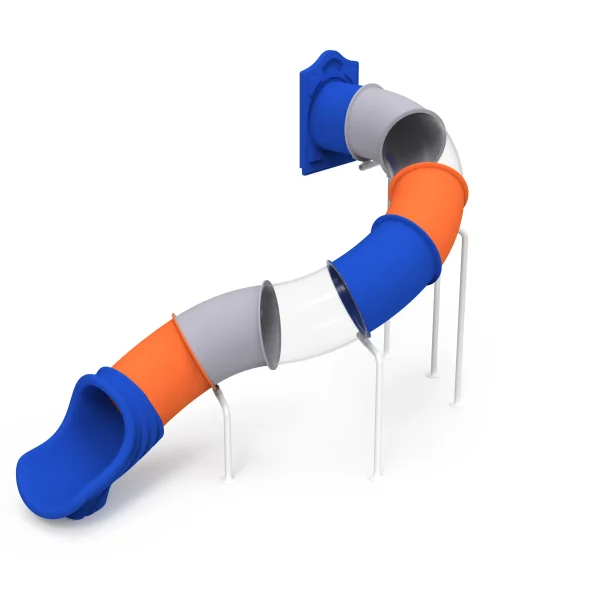
A standard tube slide already has an exit: the runout at the bottom. For short, straight enclosed sections that an adult can see through, that single exit usually matches the actual risk. The issue appears when a tube is long, curved, or turned enough that a child inside no longer has a visible opening in either direction. Tunnel slide emergency exits become a formal need at that point because the bottom runout is no longer a practical escape route for a frightened or stuck child.
We design these as separate service openings placed along the enclosed run, not as larger decorative windows. Their job is not ventilation or visibility; it is to let a supervising adult reach the child quickly and to give the child a clear direction if they are still able to move. A hatch that looks like a window but cannot be opened from outside is not an emergency exit. That distinction matters during inspection and maintenance because some catalog descriptions blur the two.
Which Children Are Most at Risk Inside Enclosed Tube Slides?
Claustrophobic children are the obvious group, but the deeper risk sits with younger users who lose orientation. At age three, a child may stop at the darkest point of a curved tube, refuse to move in either direction, and not answer a parent’s call reliably. A child with sensory processing differences can become distressed by the echo, heat, or lack of visible exit before the tube is even half finished. In our layout reviews for kindergarten projects, I look at the deepest enclosed section as the first egress candidate, because that is where a child who hesitates is hardest to see and slowest to reach.
Older children can also freeze after a collision or a knee bump inside the tube. The common assumption that children will always slide toward the exit is not reliable once fear or pain takes over. A midpoint hatch gives supervisors a reach point that the bottom runout cannot offer. The design target is not simply compliance; it is making sure the adult can act before panic escalates.
How Should a Midpoint Escape Hatch Be Positioned and Locked?
Positioning a hatch at the exact center of the slide path is not always right. For a straight tube, the midpoint often matches the worst visibility point. For a curved or multiturn slide, the worst spot is usually just after a bend, where the child disappears from both the top entrance and the bottom exit. I call this the visual dead zone, and it is where a hatch earns its place.
| Slide condition | Where to check | Egress decision |
|---|---|---|
| Short enclosed tube under 3 m | Entire run visible from either end | No midpoint hatch required if an adult can see the full path |
| Straight enclosed tube 3 to 6 m | Midway point and darkest section | One hatch at the midpath or immediately after the longest dark section |
| Curved tube with one bend | Area just past the interior curve | One hatch after the bend, at the visual dead zone |
| Multiturn tube over 6 m | Each opaque section between bends | One hatch per segment or at the deepest visual break |
| Tube with viewing panels | Still follow path length | Hatch or adult reach still required if the child cannot be reached quickly |
The hatch opening should be large enough for an adult to reach both shoulders of a child without twisting. That usually means a clear opening wider than the child’s body profile, not a small inspection port. The door should open outward or lift off, never inward where a child’s body can block it. A flush exterior latch keeps the hatch from being opened by another child on the outside, but it must be simple for an adult to release with one hand.
What counts as a true midpoint on a curved tunnel slide?
The true midpoint is the point of longest combined distance from the two nearest openings: the top entry and the bottom runout. On a straight tube, that is near the center. On a curved tube, measure along the slide path, not across the site plan.
Can a child open the hatch from inside without adult help?
In most designs, no. The release is deliberately set to an adult hand strength, while the interior surface stays smooth with no finger holds that could pinch. The purpose is adult access, not independent child exit. If a child can open it easily, it becomes a fall opening, not a controlled emergency hatch.
Does a midpoint hatch weaken the tube structure?
A properly framed hatch does not loosen the shell because the opening sits inside a reinforced ring or flanged frame. The risk appears when someone cuts a hatch after fabrication without adding that reinforcement. For stainless steel tube sections, we add a welded perimeter ring. For rotationally molded plastic, the shell needs a molded or bolted frame with the load redirected around the opening.
If your tunnel slide has more than one bend or an enclosed run over 4 meters, the hatch count and reach access need confirmation before the equipment list is final. Send your layout to [email protected] and we will check it against the same egress criteria we use in our tube slide design reviews.
Why Do Tunnel Slide Ventilation and Visibility Matter Before Egress?
A child rarely panics because of the hatch itself; panic comes from heat, darkness, and not knowing how much tube remains. Ventilation and visibility are the first line, and the hatch is the second. If air moves through the tube and a polycarbonate panel shows the next section, many children regain enough calm to finish the slide without using the hatch.
Enclosed tube sections create a separate set of thermal and airflow problems that egress design cannot solve alone. <Advanced Tunnel Slide Support Structure and Ventilation Design> covers support ring spacing, vent placement, and how passive airflow reduces the warm, stale feeling that can make a child panic before reaching an exit.
That sequence is important because an emergency exit only works when the child is mobile enough to use it or the adult can reach them quickly. Ventilation buys time. A viewing section gives the child information. The hatch offers the physical intervention. In our tunnel slide specifications, these three elements are reviewed as one system, not as separate options.
What Should Buyers Verify Before Ordering a Tunnel Slide?
Start by verifying that the hatch is part of the original fabrication drawing and not a site modification. A tube slide with a hatch cut later can carry stress concentrations and water ingress problems that the warranty will not cover. The next item is the hatch frame material and latching detail: the opening must close flush enough that hair, clothing, and fingers cannot catch, and the latch must not protrude into the slide path. Ask for the test reports tied to the tunnel slide emergency exit hardware: EN 1176 compliance, GB/T 34272-2017 where the unit is exported from China, structural load calculations, and any third party inspection documents for the completed unit. A manufacturer that resists sharing these details before order is unlikely to document them after delivery.
A midpoint escape hatch is only as credible as the fabrication and testing behind it. <8 Essential Certifications for Playground Equipment Manufacturers> explains which certifications signal that a supplier’s welding, material, and quality processes are solid enough for safety-critical openings in a slide shell.
Then check the site reach path. A hatch at the midpoint only works if an adult can climb to that point or the slide is low enough for reach from the ground. Ask your supplier to mark the hatch location on the elevation drawing and confirm the standing surface below it. If the hatch opens over a platform edge or requires a ladder, the emergency path is incomplete.
When a tunnel slide is long enough to need a midpoint escape hatch, child fear is not a design edge case; it is a predictable event. The right solution combines a reinforced opening, adult reach, ventilation, and a clear inspection record. If you are specifying a tunnel slide for a kindergarten, park, or therapy space, send your slide length, tube diameter, and site elevation to [email protected] or WhatsApp +8613915684545. We will confirm the hatch placement and structural reinforcement before you order, so the fabricated tube arrives ready for its actual users, not for a catalog photo.
What Else Should Buyers Ask About Tunnel Slide Emergency Exits?
Are tunnel slide emergency exits required by EN 1176?
EN 1176 does not name a fixed number of midpoint hatches. It sets opening, entrapment, and structural requirements that, on a long enclosed tube, make a supervised egress route the practical way to meet them. Many buyers expect a single line in the standard. The actual standard leaves part of the risk assessment to the designer and site owner, so the hatch specification is a design judgment rather than an optional extra. That is why we ask for the full slide path drawing before we quote a tunnel slide.
Does a midpoint hatch change interior heat or airflow?
It can, and the effect depends on how the frame is sealed. A flush hatch with a closed cell gasket adds little to air leakage, but a poorly fitted frame can break the air path and create a warmer still section inside. The more important point is that a hatch should not be the main airflow solution. Vent slots or covered vents are simpler and safer for continuous air movement. We position the hatch for adult access first. If the opening accidentally works as a vent, that is a secondary effect, not the design reason.
Can an escape hatch be added to an existing tunnel slide?
It depends on the shell material and the current reinforcement layout. A stainless steel tube can usually be retrofitted if the original support rings are still sound and a fabricator adds a welded perimeter frame before cutting. A rotationally molded plastic tube is harder to retrofit because cutting removes structural continuity, and a bolted add-on frame may not match the original load path. Before buying a used tube or renovating an older slide, ask the manufacturer whether the shell was designed for a field modification.
What should maintenance staff check on the hatch each month?
In the maintenance checklists we prepare for park clients, we put the hatch latch first, then the surrounding frame. The latch must close from the outside with one hand and must not leave a gap wider than a small finger. The frame edges need a visual check for cracks, loose rivets, or signs of water staining. A quick pull test on the door and a check of the standing surface below the hatch are enough for a monthly round. If your hatch is difficult to close or shows cracking around the frame, share a photo and the slide model to [email protected] and we will advise whether it needs reinforcement or replacement.
If you’re interested, check out these related articles:
Playground Slide Materials LLDPE vs 304 Steel Performance
Space Saving Cantilever Swing Set Design for Urban Play Environments