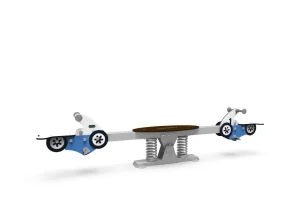
Selecting the right playground seesaw requires more than picking a fun piece of equipment. The process involves weighing different types against safety distances, material durability, and the specific needs of your site. Getting these factors right means children have engaging experiences while the equipment holds up to years of daily use.
What Separates the Main Playground Seesaw Categories
Playground seesaws fall into two broad categories, each suited to different age groups and play objectives.
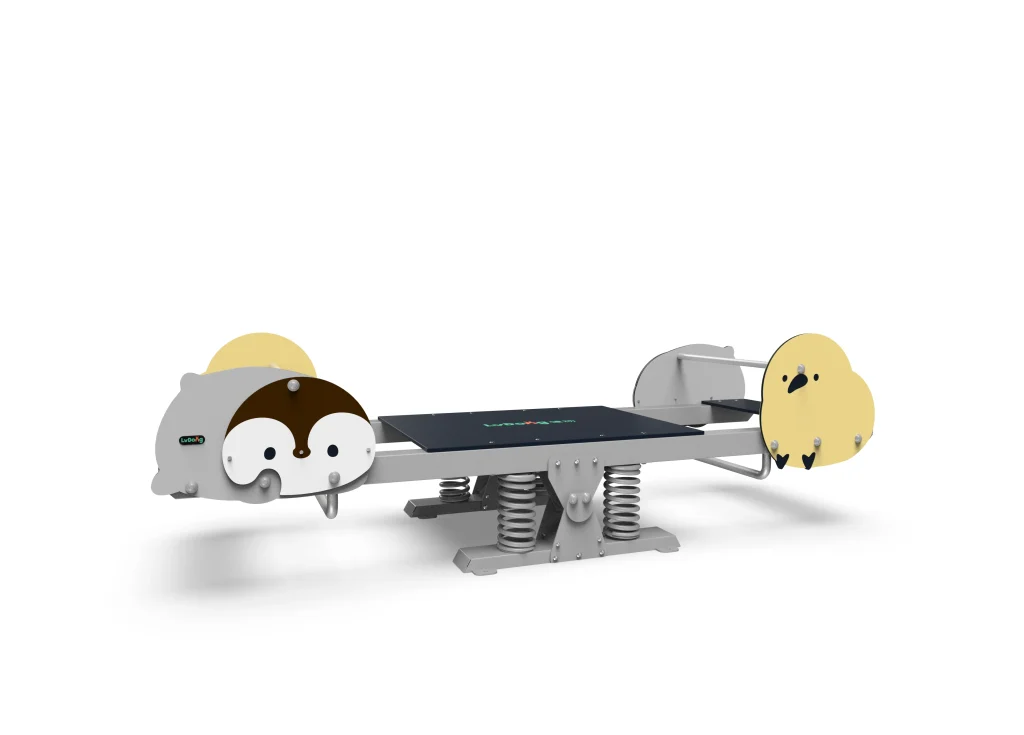
Traditional seesaws — the classic teeter-totter design — create reciprocal motion between two or more users. The movement depends on coordination between riders, which makes these units effective for developing balance and social timing. Multi-person models can accommodate anywhere from two to ten children, turning a simple up-and-down motion into a group activity. A spring-assisted base on these larger units smooths out the motion and reduces jarring at the endpoints.
Spring riders work differently. A single child sits on a molded seat mounted to a heavy-gauge steel spring, and the rocking motion comes entirely from their own body movement. The fall height stays low, the footprint stays compact, and the play experience focuses on individual balance rather than group coordination. These units show up frequently in kindergartens and early education centers where space is limited and the user population skews younger.
| Seesaw Type | Motion Source | User Capacity | Typical Fall Height | Primary Age Range |
|---|---|---|---|---|
| Traditional multi-person seesaw | Reciprocal weight transfer between riders | 2–10 | Moderate (varies by design) | 3–12 years |
| Spring rider | Single user’s body movement against spring | 1 | Low | 2–6 years |
The choice between these categories depends on who will use the equipment and how much space you have. A community park serving a wide age range benefits from multi-person seesaws that encourage group play. A daycare with limited outdoor square footage may get more value from several spring riders distributed across the space.
How Safety Distances and Surfacing Affect Seesaw Placement
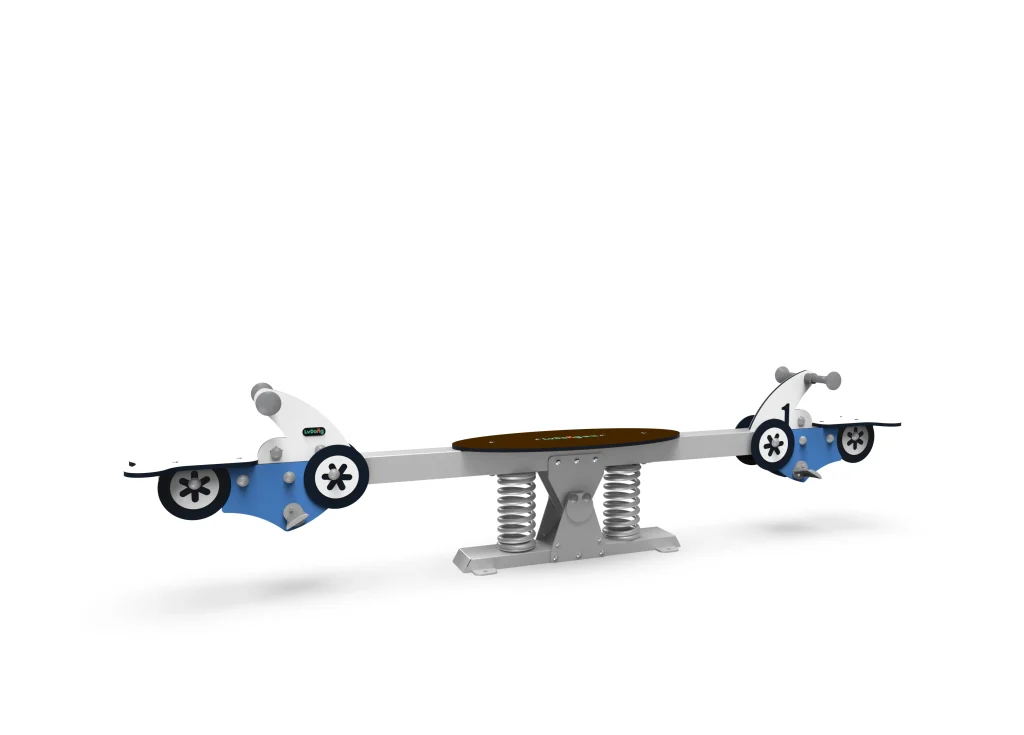
Every playground seesaw requires a clear zone around it — the use zone — where no other equipment, fencing, or hard surfaces can intrude. This zone accounts for the equipment’s range of motion and the space a child needs to mount, dismount, and fall safely.
ASTM F1487 and EN 1176 both specify how to calculate use zones. The general rule extends the zone at least 1.8 meters (roughly 6 feet) from the outermost edges of the equipment at its maximum travel position. For a traditional seesaw, that means measuring from the seat position when the beam is at its highest point, not from the pivot. Underestimating this distance is one of the more common layout errors I see in site plans.
The surfacing within that zone must absorb impact consistent with the equipment’s critical fall height. Critical fall height is the maximum height from which a fall onto a compliant surface would not produce a life-threatening head injury. The relationship between fall height and surfacing depth is not linear — a 10 cm increase in fall height may require a disproportionately thicker layer of impact-absorbing material.
Common surfacing options:
- Engineered wood fiber (EWF): Cost-effective and natural-looking. Requires periodic raking and replenishment to maintain depth, especially in high-traffic areas directly under seats.
- Rubber tiles: Consistent impact absorption, easier to maintain level, and accessible for wheelchairs. Higher upfront cost than loose-fill options.
- Poured-in-place rubber: Seamless, highly customizable in color and thickness, excellent for accessibility. The initial investment is significant, but long-term maintenance costs tend to be lower.
- Sand or pea gravel: Traditional and inexpensive, but displacement is constant. These materials migrate out of use zones and require frequent depth checks.
A playground seesaw installed over inadequate surfacing — or with a use zone that overlaps another piece of equipment — fails inspection regardless of how well the seesaw itself is built.
Why Material Selection Determines Long-Term Seesaw Performance
The materials in a playground seesaw dictate how it weathers, how often it needs maintenance, and how long it stays in service before replacement becomes necessary.
Steel frames provide the structural backbone. Galvanized or powder-coated finishes prevent rust, but the quality of that coating matters. A thin powder coat applied over poorly prepared steel will chip within two seasons of outdoor exposure. Thicker coatings applied after proper surface prep — sandblasting or phosphate treatment — hold up for a decade or more in coastal or high-humidity environments.
Polyethylene seats and panels (LLDPE or HDPE) resist UV degradation when properly stabilized. Unstabilized plastic fades and becomes brittle within a few years. The difference is not visible at purchase — it shows up three or four years later when seats crack under normal use. Asking for UV stabilization documentation is a reasonable request during procurement.
Springs on spring riders carry the entire dynamic load of the equipment. High-strength steel springs rated for the intended user weight range and cycle count will outlast undersized springs by a wide margin. Replacement springs are available, but the labor cost of swapping them repeatedly adds up.
Fasteners are easy to overlook. Stainless steel or galvanized hardware resists corrosion. Tamper-resistant heads prevent removal by unauthorized hands. Recessed or capped fasteners eliminate snag points. All three properties should be present in any commercial-grade playground seesaw.
What Installation Gets Wrong and How to Avoid It
A well-built playground seesaw installed incorrectly is still a liability. Installation errors account for a significant share of post-opening safety findings.
Site assessment comes first. Drainage patterns, underground utilities, sun exposure, and existing grade all influence where equipment can go and how foundations need to be designed. A site that floods after rain will undermine concrete footings and wash away loose-fill surfacing.
Foundations must match manufacturer specifications. Concrete footings sized for a light-duty residential seesaw will not anchor a multi-person commercial unit. The depth, diameter, and concrete mix all matter. Skipping the curing period — pouring footings and installing equipment the same week — leads to anchor pullout under load.
Assembly sequence affects structural integrity. Tightening fasteners out of order can introduce stress concentrations or misalignment. Manufacturer instructions exist for a reason; deviating from them voids warranties and creates inspection findings.
Surfacing installation happens after equipment is anchored. Installing surfacing first and then cutting through it to place footings compresses the material around the cut, reducing its impact-absorbing properties in exactly the area where falls are most likely.
Final inspection is not optional. A walk-through with a checklist — checking fastener torque, verifying use zone clearances, confirming surfacing depth at multiple points — catches problems before the playground opens. Fixing a loose bolt before children arrive costs nothing. Fixing it after an incident costs far more.
I worked on a community park project where the original site plan placed a multi-person seesaw at the low point of a subtle slope. Water would have pooled under the seats after every rain. Adjusting the layout and adding a French drain along the uphill edge solved the problem before installation began. That kind of issue is obvious in hindsight but easy to miss on a flat site plan.
Matching Playground Seesaw Selection to Project Requirements
The right playground seesaw for one site may be wrong for another. The selection process works backward from constraints and objectives.
User demographics: A playground serving primarily toddlers needs low fall heights and gentle motion — spring riders fit that profile. A playground serving elementary-age children benefits from multi-person seesaws that challenge coordination and support group play.
Available space: Measure the footprint you can dedicate to seesaw equipment, then subtract the use zone requirements. What remains is the maximum equipment envelope. A 10-person seesaw with a 6-meter beam will not fit in a space that only accommodates a 4-meter use zone.
Budget allocation: Equipment cost is only part of the total. Surfacing, site prep, installation labor, and ongoing maintenance all contribute. A less expensive seesaw that requires annual spring replacement may cost more over a 10-year period than a higher-quality unit with a longer service life.
Play value diversity: A playground with three identical spring riders offers less developmental variety than one spring rider, one two-person seesaw, and a spinning element. Mixing equipment types creates a richer play environment.
Inclusivity requirements: Some seesaw designs accommodate children with mobility limitations better than others. Bucket-style seats with back support, transfer platforms at accessible heights, and smooth surfacing that permits wheelchair approach all expand who can use the equipment.
If your project involves a community park, school, or commercial recreation facility, discussing specific requirements with a manufacturer that handles design, production, and installation as an integrated process reduces the risk of mismatched components. For projects with particular site constraints or custom theming needs, that conversation should happen early — before site plans are finalized.
To discuss requirements for a playground seesaw project, contact Suzhou LvDong Amusement Equipment Co.,Ltd at [email protected] or via WhatsApp at +8613915684545.
Frequently Asked Questions
What safety standards apply to playground seesaws?
ASTM F1487 governs playground equipment in North America; EN 1176 applies in Europe. Both standards specify requirements for design, materials, fall heights, use zones, and installation. Equipment sold for commercial use should carry documentation of compliance with the relevant standard for your jurisdiction. Standards are updated periodically, so confirm the equipment meets the current revision, not an outdated version.
How frequently should a playground seesaw be inspected?
Daily visual checks catch obvious problems — missing caps, loose seats, debris in the use zone. Monthly operational inspections go deeper: checking fastener torque, spring condition, pivot wear, and surfacing depth. Annual comprehensive inspections by a certified playground safety inspector (CPSI) provide third-party verification. Inspection frequency may increase for high-traffic sites or after severe weather events.
Can a playground seesaw be installed on any ground type?
No. The ground must be level, stable, and capable of supporting concrete footings or other anchoring systems. Drainage must direct water away from the equipment and surfacing. Loose or expansive soils may require deeper footings or soil stabilization. Installing a seesaw on unprepared ground leads to equipment movement, surfacing failure, and safety findings. Site assessment before installation identifies these issues while they are still correctable.
What surfacing materials work for playground seesaws?
Engineered wood fiber, rubber tiles, and poured-in-place rubber all meet impact-attenuation requirements when installed to the correct depth for the equipment’s critical fall height. Sand and pea gravel are acceptable but require more frequent maintenance to keep material in place and at adequate depth. The choice depends on budget, accessibility requirements, maintenance capacity, and aesthetic preferences. Whatever material you select, verify that the installed depth matches the manufacturer’s specification for your equipment’s fall height.
If you are evaluating playground seesaw options for an upcoming project, reach out to discuss how different configurations fit your site and user requirements.
If you’re interested, you may want to read the following articles:
- Outdoor Playground Equipment: A Comprehensive Guide
- Safety Standards for Commercial Playgrounds
- How to Choose the Right Playground Surfacing
Playground Slide Materials LLDPE vs 304 Steel Performance
Slide Platform Height and Exit Safety Guidelines for Playgrounds
Tornado Playground Spinner Strategic Installation Site Planning
Child Development Benefits Playground Spinning Toy Impact