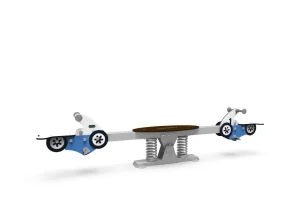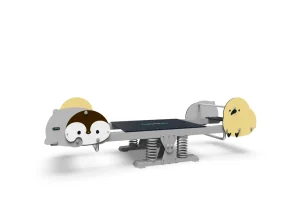
Vertical play solutions do more than save space in urban pocket parks. They decide whether a site under 200 square meters becomes a used play destination or a dead patch of rubber surfacing. The common mistake is not buying too little equipment. It is buying equipment whose fall zones overlap, so each item sits unused for safety reasons. I approach these compact layouts by putting vertical structures at the edge, grouping compact motion equipment, and keeping the center open for circulation. The target is three or more play functions, with no fall height above 77 cm.
Vertical Play Design Benefits for Compact Urban Sites
In a pocket park, height is the clearest way to expand play value without expanding the footprint. A slide tower with a platform at 90 cm can offer climbing, sliding, and a view from the same ground area that would otherwise hold one bench. The first question I ask on a compact urban plan is not how many children the park should hold. It is how many different movement paths the equipment can create in the same vertical column.
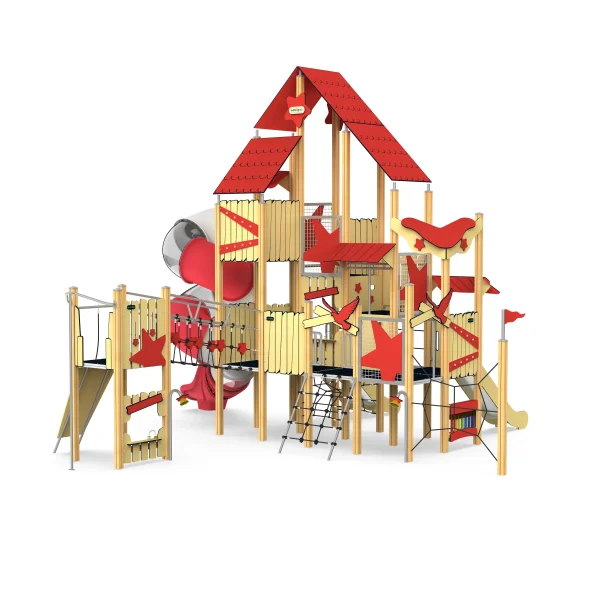
Vertical play also shifts supervision. Children moving through a defined sequence are easier for parents and staff to track than children scattered across separate spring riders. When the line of sight is short and the movement is predictable, fewer adults need to reposition constantly. That matters in pocket parks where seating and shade already consume limited area.
One caution: vertical height must not become a fall hazard. I keep platform steps, transfer points, and slide entrances within the age profile of the site. If the park serves toddlers and school-age children, I separate the high path from toddler-level play with a low panel or surfacing change rather than a sign alone.
Equipment Footprints Suited to Under 200 Square Meters
Many compact urban designs start with the wrong comparison. Buyers compare the visible footprint of a spring rider, a spinner, and a seesaw without adding the free space each one needs. In an under-200-square-meter park, the free space is usually the limiting factor, not the equipment itself.
| Equipment type | Typical footprint | User capacity | Maximum fall height |
|---|---|---|---|
| Multi-player spinner | 120 to 200 cm diameter | 6 to 10 children | 55 to 77 cm |
| Single-player spinner | 60 × 60 × 90 to 95 × 80 × 160 cm | 1 child | 34 cm |
| Spring rider | 60 to 99 × 35 to 39 cm base | 1 child | 50 cm |
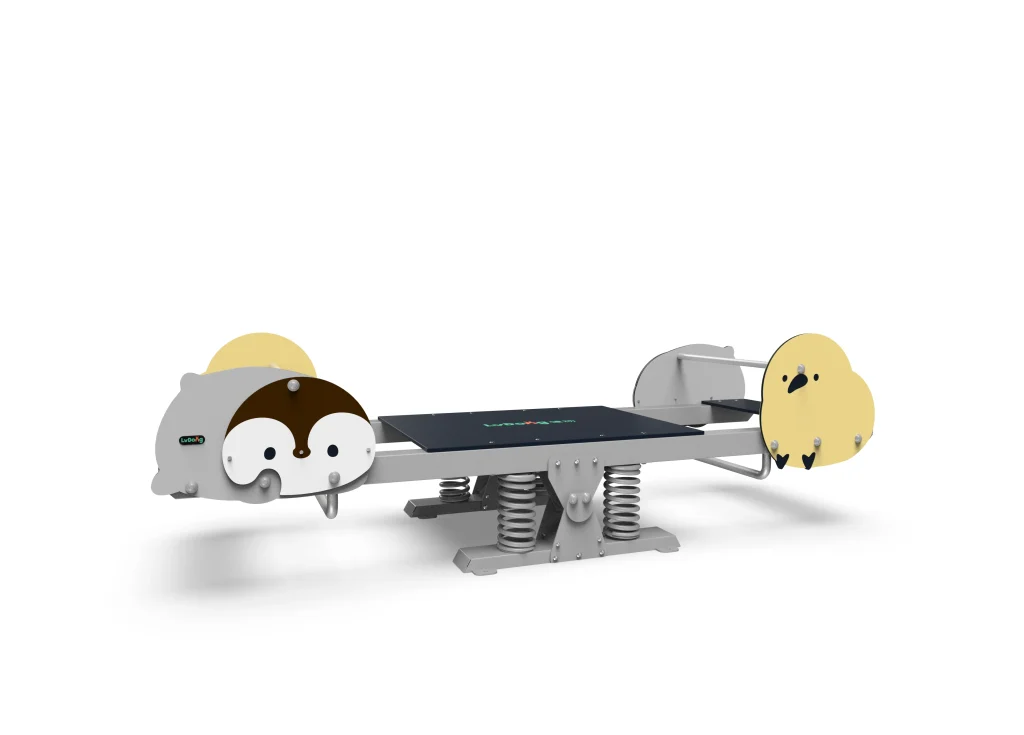
| Multi-person seesaw | 300 to 320 × 39 to 110 cm | 2 to 10 children | 60 cm |
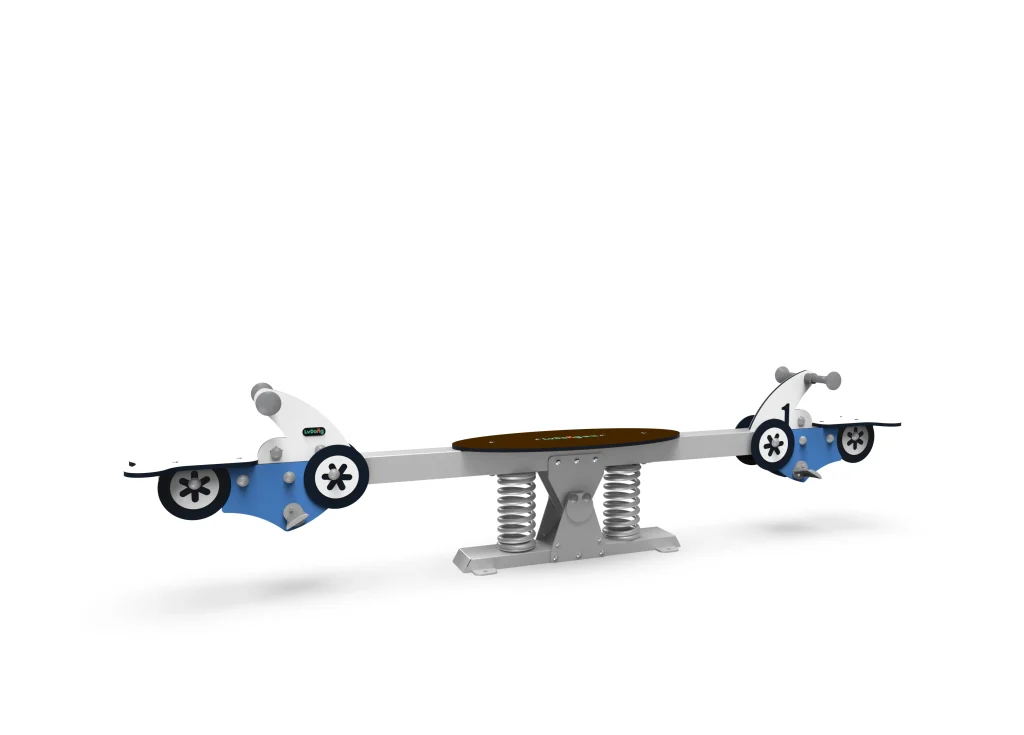
The table shows why one multi-player spinner can outperform two single-player units in a small park. The larger spinner serves more children from roughly the same fall-zone area, while the single-player options remain useful for toddler corners or as secondary pieces along a path. Multi-person seesaws have a long footprint and belong at a boundary, not in the center, if the site is under 200 square meters.
Spinners and Spring Riders for High-Density Play
In compact urban parks, I usually place one multi-player spinner before adding individual spring riders. A spinner creates continuous social play for six to ten children in the same area that a single rider might serve. The rotation stays predictable, and the fall height between 55 and 77 cm is easier to surface correctly than a taller slide exit.
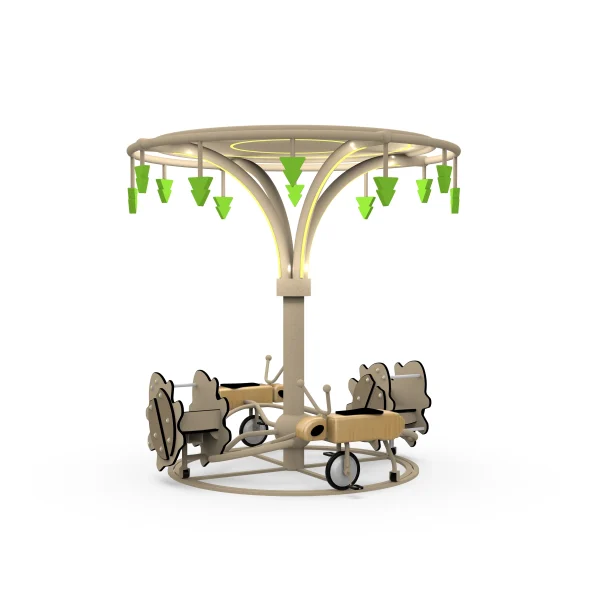
Spring riders still earn space where the target age is two to four. Their base of 60 to 99 cm by 35 to 39 cm is small enough to line a narrow planter edge without pushing into the main path. What I watch is not the spring itself. It is the area behind and beside the rider where a child may lean or step off. That clearance is part of the footprint even though it never appears on the catalog page.
In a pocket park, the spinner’s rotation radius is often the hidden constraint, not the equipment diameter. <Buying Playground Spinners Pricing Discounts and Supplier Insights> covers how bulk pricing and fall-zone requirements interact when you compare one multi-user spinner with several smaller units.
Spring riders and spinners also hold up better than static panels when the park gets crowded. Motion creates its own turn-taking rhythm, which shortens waiting and reduces the chance that children climb on surfaces meant for standing.
If your site mixes toddler and school-age play in one tight corner, send the plan and age target to [email protected]. We can mark the rotation radius, fall lines, and the best position for a compact spinner before you commit to a layout.
Safety Zones and Fall Surfacing in Tight Pocket Parks
Safety zones decide what fits in an urban pocket park more than any catalog dimension. EN 1176 and GB/T 34272-2017 require free space around moving equipment, and that free space cannot overlap except in specific cases. On a 14 by 14 meter site, two overlapping fall zones can consume half the play area if they are not drawn at the planning stage.
Fall surfacing itself has a footprint. A multi-player spinner with a 77 cm fall height may need a safety surface that extends beyond the rotating platform in all directions. In compact sites, I run the fall-zone study before choosing equipment, not after. The surfacing boundary often reveals that a taller slide tower must move closer to the perimeter or that a seesaw should be swapped for a pair of spring riders.
Fall-zone planning in a pocket park is not only about equipment spacing. <School Playground Equipment Zoning for Grade Based Development> covers how grade-based zoning keeps toddler movement from crossing active swing and slide zones.
The other detail is supervision sightlines. A compact site with dense planting can hide a child behind a spinner in seconds. I prefer low planters or open railings around the edge, not shrub masses that break the line of sight from the main seating area.
Procurement Details to Confirm Before Your Order
For urban pocket parks, procurement should start with site constraints, not with a product wish list. The supplier needs the clear play area, entry points, existing utilities, and surfacing depth before quoting. Without that, a quote can be accurate for the equipment but wrong for the installed park.
I also ask for the full fall height and free space table for each item, not the product’s overall size alone. That documentation is what municipal reviewers and installers use to confirm code compliance. It is easier to compare products when every fall line is listed in the same format.
Urban pocket park procurement often gets delayed by site access and foundation details, not by equipment choice. <International Playground Equipment Procurement A Step by Step Guide> covers the sequence from supplier screening through shipment, including what to fix before production starts.
If your site is under 200 square meters and you need to fit climbing, spinning, and spring play without overlapping fall zones, send your site drawing and age target to [email protected] or WhatsApp +8613915684545. We will return a marked layout with the equipment dimensions, fall lines, and surfacing edge clearly placed.
Common Questions About Pocket Park Equipment
Can a playground under 200 square meters still meet EN 1176?
Yes, but only if the fall zones are drawn before the equipment is selected. EN 1176 does not set a minimum park size. It sets free space and impact attenuation requirements around each item. In a compact site, the equipment mix has to follow the available clearance, not the other way around. A one meter overlap between two moving items is usually enough to reject a layout. With the right product sizes and a boundary-first plan, a 150 to 200 square meter pocket park can hold three play functions and still pass inspection.
What is the best equipment for mixed ages in a small park?
It depends on whether the older and younger groups enter at the same time. If the park serves mostly families with toddlers, I lead with low fall-height spring riders and a compact spinner with a 34 to 50 cm fall height. If school-age children are the main users, a multi-player spinner and a small slide tower earn more play value. A long multi-person seesaw usually belongs at the perimeter, because it consumes a 300 to 320 cm linear zone.
How much space does a spinner actually need?
The catalog page shows the deck diameter, but the real space requirement is the safety zone around the rotating platform. A multi-player spinner with a 200 cm diameter needs free space around the full rotation, not just the equipment pad. The fall-height range of 55 to 77 cm determines the surfacing type and the safety distance from other equipment and site furniture. I usually take the largest free-space dimension in both directions and then add the safety area behind any standing platform.
Can you ship compact equipment when the urban site has narrow access?
In urban projects I have worked on, site access is usually less of a barrier than the equipment footprint. A spring rider or single-player spinner can be carried through a pedestrian gate without crane access. Larger multi-player spinners and slide towers can be split into components for assembly on site. Send the gate width, path width, and delivery address to [email protected], and we will confirm the packaging and unloading plan before your order is placed.
If you’re interested, check out these related articles:
12 Critical Post Installation Acceptance Tests for Playgrounds
Hotel Kids Club Playground Equipment Configuration Guide 2
Buying Playground Spinners Pricing Discounts and Supplier Insights