Most procurement checklists stop at asking for certificates and unit prices, but when you are buying outdoor playsets for children, the real safeguard sits on the factory floor and inside the design studio. I have spent over a decade designing unpowered playground equipment and managing nationwide project delivery. I know that verifying a supplier means more than collecting documents. It means walking through how they build, how they think about safety, and how they stand behind their work years after the invoice is paid. This checklist moves past surface-level questions. It covers safety certifications, manufacturing quality, custom design capability, after-sales support, and the red flags that experience teaches you to spot before placing an order.
Safety Certifications to Verify
Most suppliers will tell you they are certified. Your job is to confirm those certifications are current, relevant to your market, and backed by independent testing.
| Certification | What It Covers | How to Verify |
|---|---|---|
| EN 1176 | European playground equipment safety standard covering design, installation, and maintenance | Request a test report from a notified body; check that the certificate matches the equipment models you are ordering |
| ASTM F1487 | U.S. standard for public playground equipment performance | Ask for a third-party lab report; verify testing covers impact attenuation, head entrapment, and protrusion limits |
| TÜV Rheinland / SÜD | German third-party product safety and quality certification | Look for the TÜV mark on documentation; confirm the scope includes playground equipment |
| GB/T 34272-2017 | Chinese national standard for small amusement devices | If importing, request translated test summaries; verify the supplier’s production facility is audited to this standard |
Do not rely on a single digitized certificate. Request photos of the test setup, the equipment age range it covers, and the name of the testing laboratory. A legitimate supplier will have these records organized and ready to share.
Manufacturing Quality Checks
Certificates tell you what a supplier should be doing. A factory visit tells you what they actually do. If you can travel, walk the production line yourself. If not, ask for a real-time video tour.
Factory tour questions to ask:
– Can I see your raw material storage? Look for protected, labelled steel and plastic stock.
– What is your welding procedure, and do you have in-process inspection records?
– How do you control powder-coating thickness and UV resistance?
– Where are components assembled before shipping, and what prevents mix-ups?
Material selection makes or breaks an outdoor playset within two years. In our production base, we use high-tensile steel with a consistent wall thickness because we have seen lighter-gauge alternatives deform after a single hot season. For plastics, HDPE and LLDPE are common, but the grade matters. Ask for a material datasheet and compare it to the intended use and climate.
A clean, organized factory with clear work-in-progress zones is a positive signal. A facility that hesitates to show you certain areas is a red flag you should not ignore.
Custom Design Evaluation
Pre-configured playsets work for simple sites, but uneven ground, tight spaces, or specific age-range needs often require customisation. The difference between a supplier and a true design partner is how they handle the custom process.
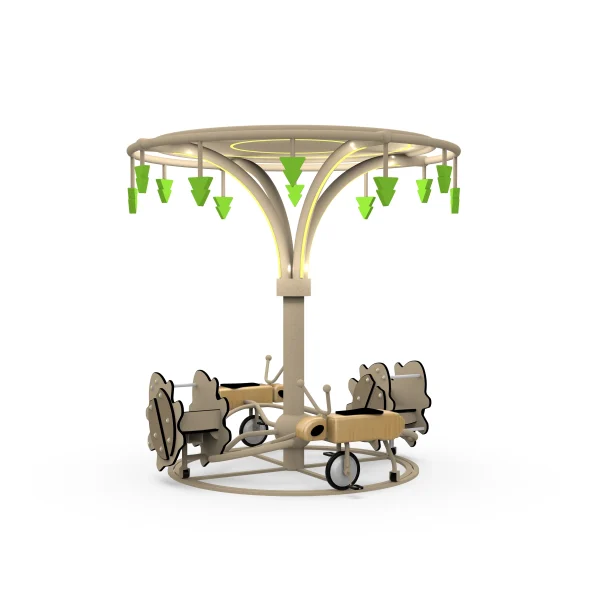
A capable supplier starts with a site consultation and a 3D model. They do not just stretch a standard design. They adjust platform heights, slide angles, and fall zones to match your actual space. Ask for a layout drawing that includes safety surfacing boundaries and drainage considerations.
I strongly recommend requesting a visual proof before production. In our projects, we provide detailed renderings that show exactly how the playset sits on the site, including access paths and adjacent activity zones. This step prevents installation-day surprises and gives you leverage to request changes before materials are cut.
If your site has complex ground conditions or you need to blend the equipment with existing landscaping, it is worth confirming the supplier’s in-house design capability early. Reach out at [email protected] with your site plan, and our team can review the feasibility before you commit.
Delivery and After-Sales Support
An outdoor playset is a long-term asset. The supplier’s responsibility does not end when the shipping container leaves their factory. Confirm these points before you sign:
- Lead time accuracy: Ask for a written production schedule with key milestones. A reliable supplier will commit to dates they can keep, not the shortest possible timeline.
- Installation support: Will the supplier provide an installation supervisor or full turnkey installation? If you plan to use your own crew, request a detailed installation manual and a parts identification guide.
- Spare parts availability: Common wear items include swing chains, bearings, and spring covers. Ask for a spare parts price list and typical dispatch lead times. A supplier that stocks components permanently is more trustworthy than one that manufactures spares only on demand.
- Warranty terms: Standard warranty periods range from one to five years depending on the component. Steel structures often carry longer coverage. Read the fine print for exclusions related to coastal environments or unsupervised public use.
Common Supplier Red Flags
Some signals are subtle. Others are obvious once you know what to watch for.
- Unrealistically low pricing. If a quote comes in 30% below the average of other bids, there is usually a hidden cost in material grade, installation support, or warranty coverage.
- Vague answers about testing. Statements like “our products meet international standards” without naming a specific standard or test body are a red flag.
- No reference projects. A supplier who has completed hundreds of installations will have photos, client contacts, and site addresses to share. If they are reluctant to show completed work, walk away.
- Rushed production promises. High-quality playground equipment requires proper curing time for coatings, drying time for timber (if applicable), and careful assembly checks. A supplier that promises to ship complex custom equipment in less than two weeks is probably cutting corners.
- No documented quality control process. A credible manufacturer will have a QMS in place, whether ISO 9001 or an internal equivalent, and should be able to describe inspection points during production.
What to Ask When You’re Close to a Decision
Are pre-configured playsets suitable for community parks?
Pre-configured sets work well when the ground is level, the space is open, and the age range is clearly defined. I still recommend checking that the fall zones match your actual site because park layouts often include benches, pathways, and fences that reduce the usable area. In programs we have supported, a quick layout review prevented costly reinstallation.
How can I confirm a supplier’s quality before visiting their factory?
Request a sample panel or component before committing to a full order. A physical sample lets you check paint adhesion, weld smoothness, and plastic quality without leaving your office. It is a low-cost way to filter out suppliers who talk quality but do not deliver it.
What is the biggest mistake buyers make when ordering outdoor playsets?
The most expensive mistake I see is buyers treating the purchase as a commodity transaction rather than a partnership. They focus on price per square meter and ignore the supplier’s ability to manage the project from design through installation. This leads to mismatched equipment, unsafe installations, and equipment that sits unused because it does not fit the children it was meant for.
Does a supplier need to be local, or can I import safely?
Importing from a reputable manufacturer is a strong option, especially when the supplier has experience with international shipping, customs documentation, and remote installation support. The key is verifying that the supplier has successfully delivered projects in your region or similar climates. A supplier who understands your regulatory environment and logistics saves you from learning expensive lessons on your own.
When you are ready to move forward, share your requirements and site dimensions with our team at [email protected]. We will confirm the applicable standards, design feasibility, and production timeline so you can place your order with certainty.
If you’re interested, check out these related articles:
Sensory Play Panels Inclusive Design for Special Needs
Custom Playground Slide Design From Vision to 3D Reality