When you’re outfitting a school playground, selecting a reliable school playground equipment supplier matters just as much as the equipment itself. A low quote doesn’t guarantee child safety, and a glossy website doesn’t equal manufacturing depth. Over the past ten years, I’ve designed and produced unpowered playground equipment and watched schools get the best long-term results when they partner with a company that can handle design, production, installation, and after-sales service under one roof. This article lays out a practical way to evaluate that kind of supplier so your playground is safe, durable, and genuinely matched to your students’ ages and play patterns, not just another purchase order.
How to Identify a Reliable School Playground Equipment Manufacturer
Look beyond the sales pitch for concrete signs of reliability. A trustworthy school playground equipment supplier will openly share its production facility details, past project lists, and the safety certifications its products carry. In my experience, the manufacturers worth considering are the ones with a full in-house team rather than middlemen who subcontract production.
Ask for a company profile that includes the number of completed projects. A supplier with a track record of over one thousand installations, for example, has likely refined the processes that keep equipment consistent and projects on schedule. Equally important, confirm they follow internationally recognized standards. At our operation, every piece of equipment meets EN 1176 or the Chinese GB/T 34272‑2017 standard, and we provide third-party test reports without hesitation.
What you’re really buying is peace of mind. When a supplier controls its own factory floor and quality checks, you reduce the risk of receiving equipment that looks fine online but frays after one wet season.
How to Evaluate a Supplier’s Production and Quality Control Processes
A factory visit tells you more than any brochure. The size and organization of the production space, the material storage conditions, and the presence of a documented quality management system all indicate whether a supplier can deliver uniform quality batch after batch.
When we host school delegations at our 10,000-square-meter production base, they notice the difference between a workshop that cuts steel in a corner and a facility where every station follows a standard operating procedure. Welding jigs, paint curing areas, and assembly lines should be clearly separated. Ask to see the supplier’s incoming material inspection records. Steel pipe wall thickness, LLDPE sheet density, and fastener grades directly affect durability and child safety.
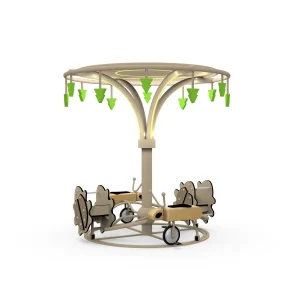
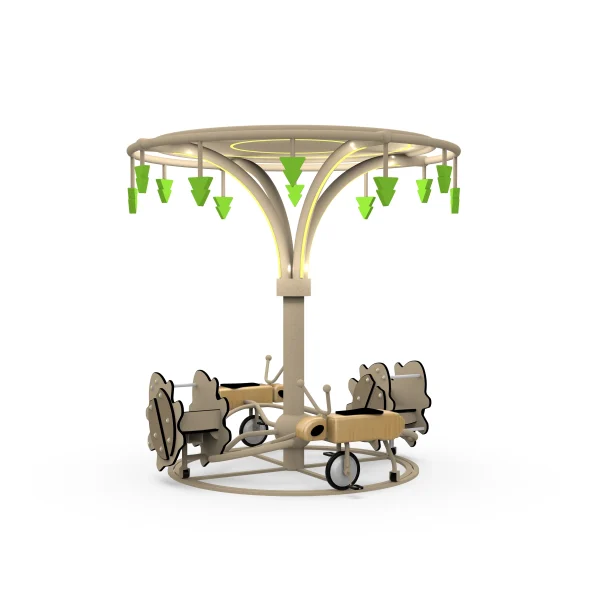
A capable manufacturer also tests finished products. The table below shows a few equipment categories from our range and the fall-height and age parameters we verify before shipment, measurement against the relevant standards.
| Equipment Type | Age Range | Max Fall Height | Key Standard |
|---|---|---|---|
| Multi-Player Spinning Wheel | 2–6+ years | 55–77 cm | EN 1176 |
| Single-Player Spinner | 2+ years | 34 cm | EN 1176 |
| Outdoor Spring Rider | 2+ years | 50 cm | EN 1176 |
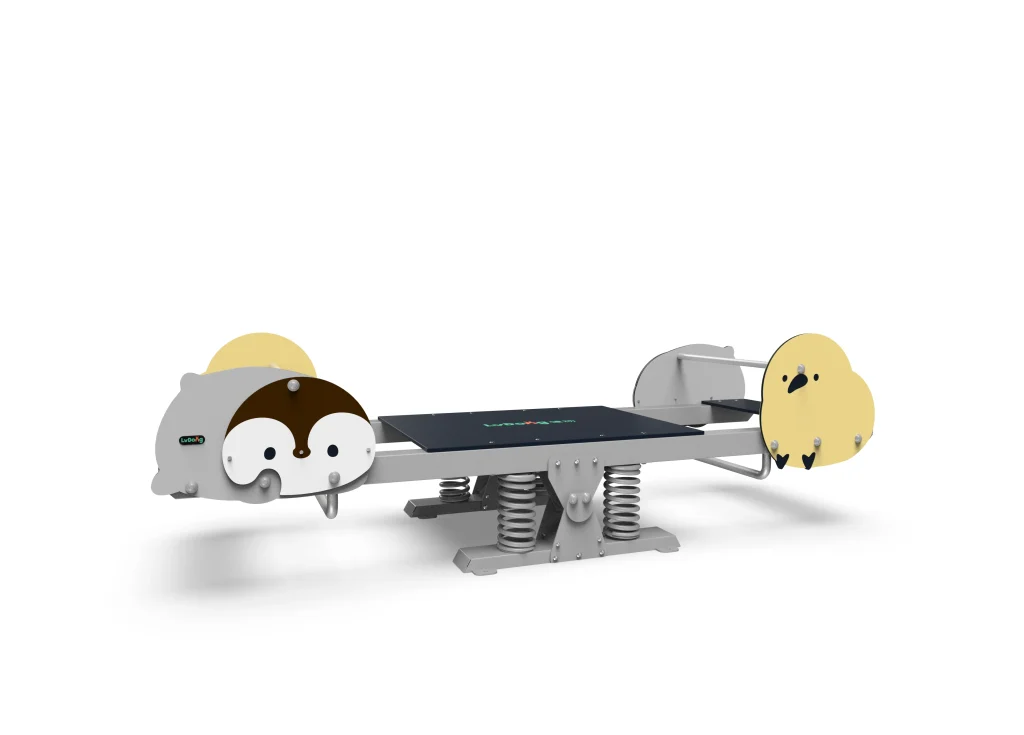
| Multi-Person Seesaw | 3+ years | 60 cm | EN 1176 |
Production capacity matters too. If a school order of twenty modules takes the supplier four months to produce while they juggle retail orders, your timeline is at risk. A well-organized manufacturer should be able to give you a realistic delivery window based on current factory loading, not a generic estimate.
How to Ensure the Playground Design Fits Your School’s Space and Age Groups
A playground that ignores the actual site dimensions and grade mix wastes budget. I have seen a cramped yard become a rich play environment simply because the supplier’s design team reoriented the layout, grouped activities by age zone, and selected equipment with compact footprints that still met the activity needs of 6‑ to 12‑year‑olds.
Start by sending the supplier a site plan with measurements, drainage information, and any fixed obstacles. A capable design department will return a 3D proposal that shows fall zones, circulation paths, and how different age groups are separated. Our in-house designers regularly produce free concept layouts so schools can visualize the end result before committing.
Age-appropriate equipment selection is not just about height. A spring rider sized for 2‑ to 5‑year‑olds has different ergonomics, fall height, and grip spacing than equipment for older children. If your school serves kindergarten through elementary, the plan needs clearly marked zones with play types that challenge each group without creating supervision blind spots.
If your school has an irregularly shaped yard or a mix of toddler and elementary grades, the supplier’s design experience directly affects how much usable play space you get. Ask to see previous school layouts similar to your site configuration.
How to Read a Playground Equipment Quote and Avoid Hidden Costs
A one-line quote that states only a total price is a warning sign. A complete playground equipment quote should break down the equipment cost, surface treatment, shipping, installation labor, ground preparation, and any post-installation safety testing.
Over the years, I have seen schools surprised by freight charges that nearly equal the equipment cost because the supplier didn’t include shipping logistics. If you are importing, confirm whether the price covers FOB, CIF, or DDP terms. Also check whether installation tools, fasteners, and concrete anchors are included or billed separately.
Warranty language deserves a close look too. Some suppliers offer a blanket three-year warranty but exclude moving parts like bearings and spring mechanisms. Those are the components that wear first in a high-traffic school setting. A transparent supplier will spell out which parts are covered and for how long, and will provide a spare parts price list upfront.
Finally, ask about the post-installation acceptance checklist. A supplier that cares about safety will run through a documented inspection with you, checking anchor torque, surfacing depth, and entrapment openings before handing over the playground. That service should appear in the quote as a line item, not as an afterthought.
How to Secure Smooth Installation and Ongoing Support
The best equipment can be undermined by poor installation. When the same company that manufactured the equipment also sends its own installation crew, the team arrives already familiar with the structure, hardware, and assembly sequence. That familiarity reduces installation time and avoids the field modifications that happen when a third-party crew interprets the drawings for the first time.
Our installation teams have worked on municipal parks, kindergarten courtyards, and cultural tourism sites, and they carry calibrated torque wrenches and safety-surfacing depth gauges as standard tools. Before leaving the site, they verify that every anchor is set to the specified depth and that critical fall-zone surfacing meets the impact attenuation required by EN 1176.
After the playground opens, ongoing support matters. Within the first year, moving parts like swing hangers and seesaw bearings may need a tension check. A supplier with a stocked spare parts department can ship replacements within a few days. When you’re looking at suppliers, ask them to confirm the typical lead time for wear items and whether they maintain a safety stock. A manufacturer that also serves as the after-sales contact keeps the relationship simple; you won’t have to chase a separate distibutor for a warranty claim.
A school playground represents years of daily use by energetic children. It deserves a supplier that treats the project as a long-term partnership, not a one-time transaction. While upfront price matters, the real measure of value is how the playground holds up under sun, rain, and hundreds of recess periods, and how quickly the supplier responds when a component eventually needs attention.
If you are evaluating suppliers and want to discuss how an integrated manufacturing partner can deliver a safer, more tailored playground, you can reach me directly at [email protected] or via WhatsApp at +8613915684545. Share your school’s requirements, site dimensions, and grade levels, and we will prepare a preliminary design proposal that shows how the layout can work on your specific site.
Common Questions When Choosing a School Playground Supplier
What safety certifications should a playground equipment supplier provide?
A credible supplier should offer equipment that meets EN 1176 for the European market or ASTM F1487 for North America. In China, GB/T 34272-2017 applies. Ask for third-party test reports, not just a statement of compliance. The reports should cover structural integrity, entrapment hazards, and impact attenuation. If your country has its own import requirements, a supplier with export experience will know how to arrange the necessary documentation before shipping.
How long does a complete school playground project usually take?
From order confirmation to the first day of play, a typical school project takes eight to twelve weeks. That timeline includes design finalization, production, container shipping, and installation. Complex custom layouts with multiple large structures can extend to fourteen weeks. A supplier that manufactures in its own factory can often compress production time once the design is approved, whereas a trading company has less control over the factory schedule.
Is it better to buy pre-configured sets or request a custom design?
It depends on your site and educational goals. Pre-configured sets are quicker to quote and deliver, and they work well for standard rectangular yards. Custom design is worth the extra time when you have an irregular space, need to separate toddlers from elementary children with clear zones, or want to combine play types that aren’t available in a catalog bundle. In our projects, we often start with a base structure and then adapt the slide length, climber type, or panel set to match the site.
What should I look for during a factory visit?
Focus on three things: organization, material storage, and quality control documentation. A tidy production floor with designated welding, painting, and assembly areas signals process discipline. Check that steel tubes and plastic sheets are stored indoors, not exposed to weather. Ask to see a completed quality inspection report for a recent order. If the factory cannot produce one, that raises questions about consistency.
Do you keep spare parts available years after installation?
A responsible manufacturer stocks commonly worn parts like swing bearings, spring assemblies, and slide connectors, and can ship them within a few business days. For heavy-use school environments, moving parts may need replacement every three to five years. It’s wise to confirm the supplier’s spare part policy and typical lead time before placing your order. If your equipment list includes custom-sized components, share it with us and we’ll verify stock compatibility so you aren’t waiting for a special production run later.
If you’re interested, check out these related articles:
Buyers Guide to Spinning Playground Equipment in 2025
Global Import Regulations for Playground Equipment by Country
Playground Slides Buying Guide Height Slope and Critical Safety
Top 10 Animal Spring Rider Designs for Modern Playgrounds
Free 3D Design for Community Park Playground Equipment Solutions