Seesaw damping systems are not an optional comfort detail. For children aged three to five, a hard seesaw landing sends a short compressive spike through the spine before the child can brace. Most playground buyers understand surfacing depth and fall height, but far fewer specify the descent control mechanism that determines whether the stop is gradual or abrupt. This article explains the damping components that matter, the loads they reduce, and the documentation buyers should request before a preschool seesaw is approved. The core position is simple: for preschool use, a damped pivot or spring-assisted base should be a minimum specification, not an upgrade.
Preschool Seesaw Safety Starts With Controlled Descent Forces
On a standard undamped seesaw, the descending seat accelerates until the frame or ground halts it. Children often let go or shift their weight at the wrong moment, and the residual energy has to go somewhere. In a three-year-old, that energy compresses the spine, the pelvis, and the neck in a short impact the child cannot fully absorb. The issue is not only the fall height. It is the rate at which the motion stops. A controlled descent spreads that energy across a longer deceleration distance, reducing the peak load even when the falling height remains the same. EN 1176 and GB/T 34272-2017 set structural and entrapment requirements, but they do not relieve a buyer of the need to select a motion control mechanism matched to the youngest users.
Seesaw Damping Systems Reduce the Peak Load That Reaches a Child’s Spine
The value of a damping system is not that it makes a seesaw slower in a boring way. It clips the force spike at the end of travel. A rubber buffer can absorb some energy, but it often rebounds quickly. A hydraulic damper controls the descent rate and reduces snapback. A spring-assisted base stores part of the downward energy and releases it progressively. In each case, the child experiences a smoother reversal instead of a hard stop. The table below shows the practical differences.
| Damping approach | How it works | What it does for preschool users | Maintenance tendency |
|---|---|---|---|
| Rubber bumper | Compresses at end of travel | Softens the final stop but can rebound | Needs periodic compression-set checks |
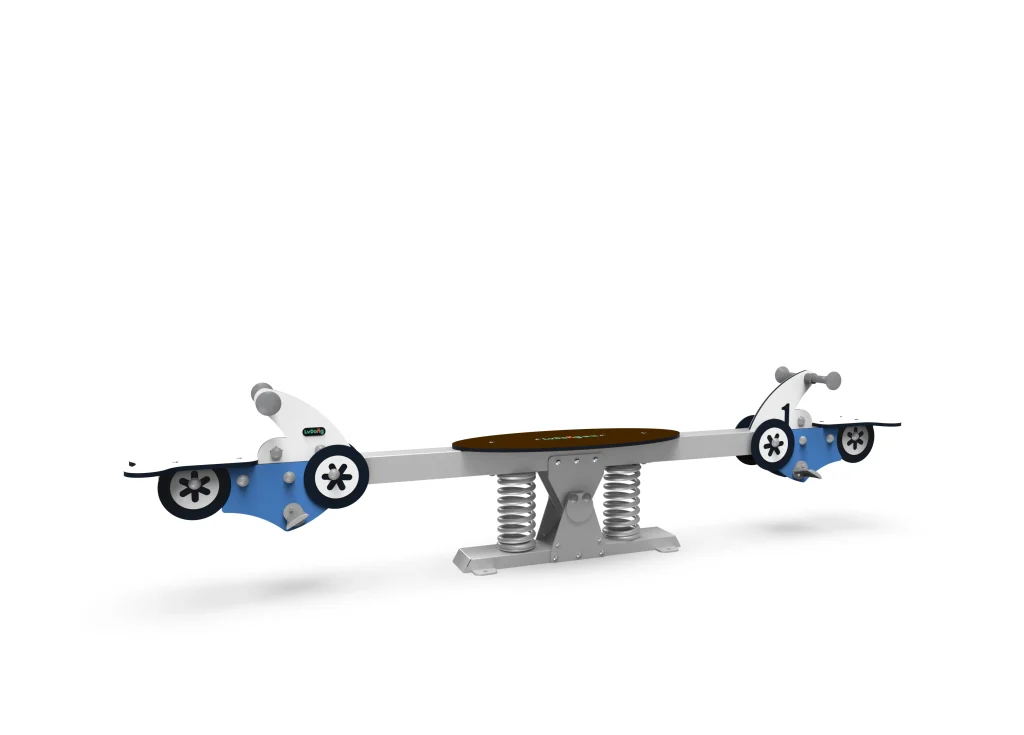
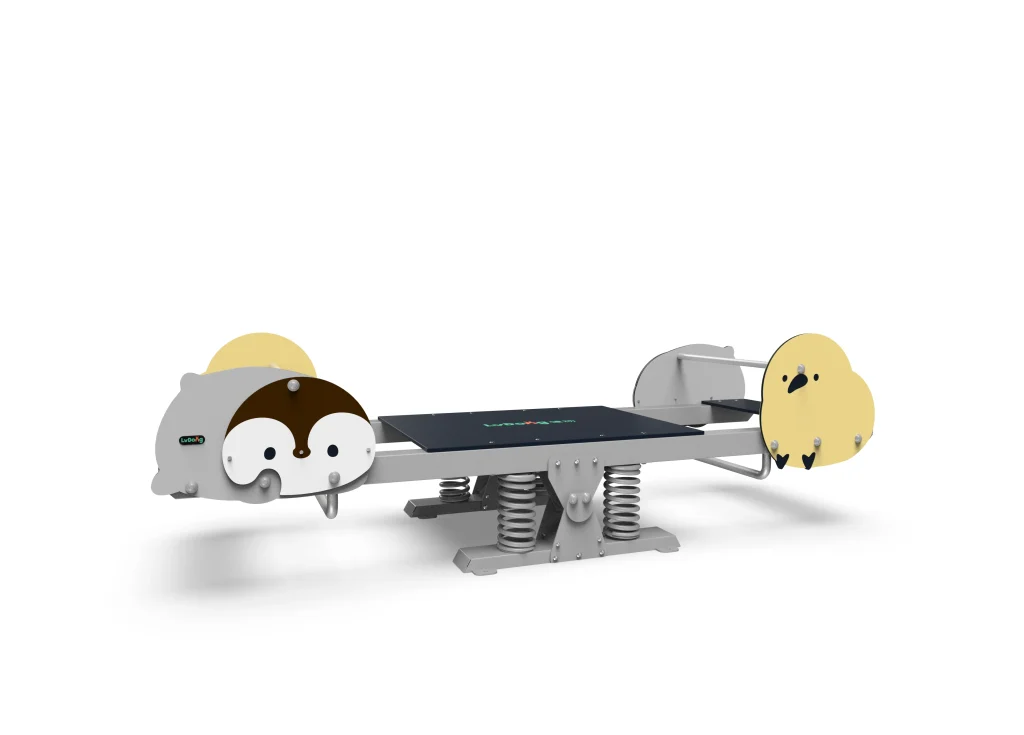
| Spring-assisted base | Stores and returns energy gradually | Controls descent and stabilizes the seat | Check spring fatigue and mounting bolts |
| Hydraulic damper | Restricts fluid flow to slow motion | Most controlled deceleration, least snapback | Confirm seal life and replacement availability |
| Undamped pivot | Rigid stop or direct ground contact | Hard jolt, higher peak load | Minimal parts but highest injury exposure |
I have inspected undamped seesaws in community settings where the metal contact was loud enough to make children stop using the equipment, even though no fall had occurred. The mechanism was simple: a sudden stop at the lowest point transferred energy back into the seat and the child. In a preschool context, that failure mode is avoidable with a properly selected damping component.
Why does the descent rate matter more than the fall height?
For preschool children, the impact to the spine depends on deceleration, not only the distance dropped. A child who drops 30 cm but stops over a very short distance absorbs a sharper load than one who drops the same 30 cm but decelerates through a longer damping stroke. That is why two seesaws with the same maximum fall height can feel completely different. When comparing models, ask for the descent control method and, where available, the force-displacement curve rather than relying on the fall height number alone.
Buyers Should Verify Damping Components Before Specifying a Preschool Seesaw
A specification that says “seesaw with safety features” is too vague. The buyer should be able to name the damping mechanism and the age range the product is rated for. For preschool installations, the seesaw should be rated for children aged three and above, with a maximum fall height that matches the project’s surfacing plan. We look for spring-assisted bases or damped pivots with a maximum fall height no greater than 60 cm on multi-person preschool seesaw models. The product’s EN 1176 or GB/T 34272-2017 documentation should be available, but the damping behavior itself needs to be stated in the purchase requirement.
A damping system is one of the places where price and quality diverge quickly. <Playground Equipment Balancing Price and Quality for Lasting Value> covers how to compare lifecycle cost when a lower upfront quote hides shorter component life.
What documentation should a preschool seesaw order include?
A complete purchase requirement should identify the damping mechanism, the maximum fall height, the suitable age range, the relevant standard, the installed footprint, and the replacement schedule for damping parts. If the supplier cannot state the mechanism before shipment, the buyer is accepting an unknown impact characteristic.
Maintenance Keeps Seesaw Damping Predictable After Installation
Damping systems are not static. Rubber bumpers harden over time, springs lose force through fatigue, and hydraulic seals can leak. The first sign is often a louder end stop or a slight bounce at the bottom of travel. Maintenance staff should check damping parts on the same schedule as bearings and bolted connections. A weekly visual check can catch damaged rubber, a monthly check should confirm that the seat returns smoothly, and an annual check should include fastener torque and spring or damper condition. Without that routine, a damped seesaw can slowly return to undamped behavior.
Damping components follow the same wear logic as springs and bearings. <Replacing Chains Bearings Springs Lifespan Guide Strategies> covers how spring fatigue and bearing play develop over time, and why inspection intervals should change with user volume.
If your site has mixed age groups or you need to confirm damping behavior against a specific surfacing depth, it is worth checking the maximum fall height and descent control documentation before finalizing the purchase. Send your site plan and target age group to [email protected] and we will check the specification with you.
A Preschool Seesaw Order Should Include Damping Performance Requirements
Many preschool orders are delayed or corrected because the damping requirement was never written down. The result is a seesaw that meets a generic safety standard but still produces a hard stop in daily use. The practical fix is to specify the descent control mechanism, the maximum fall height, and the supported age range. If you are preparing a purchase specification and need to confirm the right damping configuration for three to five year old users, send your layout and target age range to [email protected] or WhatsApp +8613915684545. We will review the configuration against your site plan and age group.
Buyers Still Ask These Questions About Seesaw Damping Systems
Does a damped seesaw remove all injury risk for preschoolers?
No. A damped seesaw reduces the peak spinal jolt at the end of travel, but it cannot replace age-appropriate supervision, correct footwear, or adequate impact surfacing. A child can still fall from the seat, twist, or collide with another child. The damping system addresses one specific injury mechanism: the abrupt deceleration that can occur during a normal descent. That reduction is valuable, but it must be part of a broader playground safety plan. Buyers should consider damping as a required component for preschool seesaws, not as a substitute for other protective measures.
Is a thicker rubber bumper enough to protect young spines?
A thicker rubber pad can feel like an upgrade, but thickness alone does not control how quickly the seat stops. Rubber absorbs energy by compressing, yet it often releases that energy quickly as a rebound. That rebound can surprise a preschooler or create a secondary jolt. A spring-assisted base or hydraulic damper shapes the entire descent, not just the final contact. If a supplier offers only a rubber bumper on a seesaw intended for three-year-olds, ask what controls the descent rate before the bumper contacts the frame.
Do damped seesaws require more maintenance?
It depends on the design. A sealed hydraulic damper may need only an annual seal and function check. A spring-assisted base needs periodic inspection of spring fatigue and mounting bolts, especially in sandy or coastal environments where corrosion can accelerate. A plain rubber bumper is the simplest part to inspect but may need replacement more often. The maintenance burden should be written into the purchase decision. Ask the supplier for a replacement schedule that matches your site’s user volume and climate, and stock the damping parts that are most likely to wear.
Which damping configuration should a kindergarten order first?
In projects we have reviewed, we start with a spring-assisted or damped pivot seesaw rated for children aged three and above, then confirm the maximum fall height against the planned surfacing. The goal is a controlled descent with a low fall height, not a complex mechanism that is difficult to maintain. For a kindergarten with limited maintenance staff, a spring-assisted multi-person seesaw often fits best because the damping behavior is visible and simple to inspect. Send your layout and target age range to [email protected] or WhatsApp +8613915684545 and we will confirm the right damping configuration and documentation.
If you’re interested, check out these related articles:
Age Appropriate Playground Sets for Child Development
Hotel Kids Club Playground Equipment Configuration Guide 2
Weatherproof Play Panels Material Durability Comparison
Selecting Commercial Playground Manufacturers A Step by Step Guide
Negotiating Bulk Playground Equipment Orders Expert Strategies
To discuss seesaw selection for preschool users, contact the LvDong team with your project requirements.