Selecting a reliable outdoor playground manufacturer shapes the safety, durability, and long-term value of any play space project. For park managers, school administrators, and community developers, this decision determines whether children play on equipment that meets rigorous safety standards or equipment that creates liability exposure and premature replacement costs. A manufacturer with verified certifications, transparent quality control, and a documented project history delivers play solutions that serve communities for years without unexpected failures.
What Safety Certifications Should You Verify Before Selecting a Playground Manufacturer
Safety certification goes beyond a checkbox on a spec sheet. When I evaluate a manufacturer, I look at how they implement standards throughout their production process, not just whether they hold a certificate. The difference between a manufacturer that tests finished products and one that builds testing into every fabrication stage shows up in field performance over five to ten years.
ASTM F1487 governs public playground safety in North America, covering fall height limits, entrapment hazards, protrusion risks, and structural integrity requirements. EN 1176 serves a similar function in European markets, with detailed test methods for materials, construction quality, and installation practices. For projects in China or sourcing from Chinese manufacturers, GB/T 34272-2017 provides the relevant national standard. A manufacturer selling internationally should demonstrate compliance with whichever standard applies to your installation location.
ISO 9001 certification indicates a quality management system that covers the entire operation, from material procurement through final inspection. This matters because playground safety depends on consistency across production runs, not just prototype testing.
| Standard | Geographic Application | Key Coverage Areas |
|---|---|---|
| ASTM F1487 | North America | Fall height, entrapment, protrusions, structural integrity |
| EN 1176 | Europe | Materials, construction, installation, inspection methods |
| GB/T 34272-2017 | China | Design, manufacturing, safety performance |
| ISO 9001 | International | Quality management systems across operations |
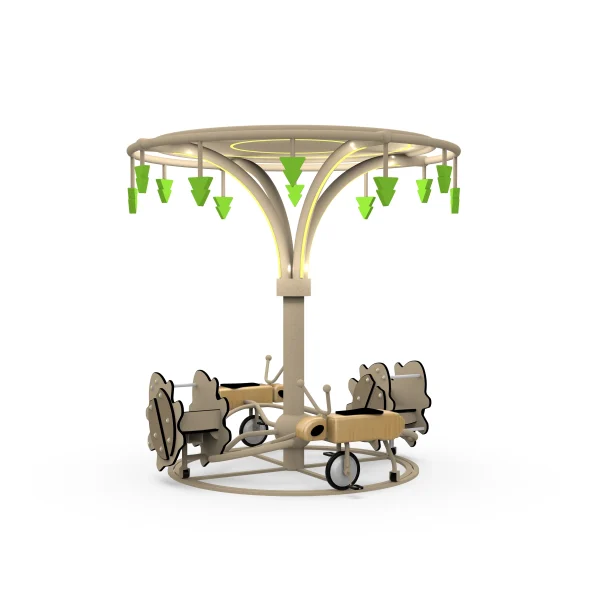
At Suzhou LvDong Amusement Equipment Co.,Ltd, we test components against both EN 1176 and GB/T 34272-2017 throughout production. Our Multi-Player Playground Spinning Wheel, for example, undergoes load testing and entrapment checks before leaving the factory. This approach catches issues that post-production inspection alone would miss.
How to Evaluate a Manufacturer’s Track Record and Production Capability
A manufacturer’s history tells you more than their marketing materials. I recommend requesting specific project references in settings similar to yours, whether municipal parks, school campuses, or residential communities. Ask about projects completed three to five years ago and follow up with those clients about maintenance issues, warranty claims, and responsiveness to problems.
Production capacity matters for project timelines. A manufacturer with limited fabrication capability may quote competitive prices but struggle to deliver on schedule when orders stack up. Ask about current production volume, lead times for custom work, and how they handle peak demand periods.
Since 2015, our company has completed over 1,500 installations across municipal parks, educational facilities, and high-end residential developments. This range demonstrates capability across project types and scales. More importantly, it provides a reference base where prospective clients can verify our performance claims.
Financial stability deserves attention as well. A manufacturer that disappears or restructures cannot honor warranty commitments or supply replacement parts. Established companies with documented operating history present lower risk for long-term support.
Why Custom Design Capability Matters for Playground Projects
Standard catalog equipment works for some sites, but many projects benefit from design modifications that address specific constraints or opportunities. A manufacturer with genuine design capability can adapt equipment to unusual site dimensions, integrate thematic elements that connect to local identity, or create inclusive play features that serve children with varying abilities.
I worked on a cultural tourism project where the client wanted playground equipment that reflected local historical themes. Our design team developed custom structural elements and color schemes that tied the play area to the site’s narrative. Visitors responded positively, and the playground became a destination feature rather than a generic amenity.
Custom work requires more than sales flexibility. Look for manufacturers with in-house design staff, 3D visualization tools, and documented experience modifying standard products. Ask to see examples of previous custom projects and speak with those clients about the design collaboration process.
Age-appropriate design affects both safety and play value. Equipment scaled for older children creates hazards when younger children use it, while equipment designed for toddlers fails to engage school-age users. A manufacturer should demonstrate understanding of developmental stages and how equipment features support physical, social, and cognitive growth.
What Material Specifications Indicate Long-Term Durability
Material quality determines how playground equipment performs after years of weather exposure and heavy use. The difference between equipment that looks worn after three years and equipment that maintains appearance and function for a decade often comes down to material specifications and surface treatments.
Galvanized steel with appropriate coating thickness resists corrosion in most climates. For coastal or high-humidity environments, stainless steel components or enhanced coating systems may be necessary. Ask manufacturers about their galvanization process, coating specifications, and warranty terms for structural components.
LLDPE (linear low-density polyethylene) and HDPE (high-density polyethylene) plastics used for slides, panels, and rotationally molded components should include UV stabilizers that prevent fading and brittleness. Manufacturers should provide material specifications and explain their UV protection approach.
Fastener quality often gets overlooked. Stainless steel or coated fasteners prevent the rust streaking that makes equipment look neglected. Concealed fastener designs reduce vandalism opportunities and eliminate pinch points.
| Material | Application | Key Quality Indicators |
|---|---|---|
| Galvanized steel | Structural frames, posts | Coating thickness, galvanization method |
| LLDPE/HDPE | Slides, panels, molded components | UV stabilizer content, wall thickness |
| Stainless steel | Fasteners, high-wear components | Grade specification, corrosion resistance |
| Powder coating | Surface finish | Thickness, adhesion testing, UV resistance |
Request material certifications and test reports. A manufacturer confident in their material quality will provide documentation without hesitation.
What Installation and After-Sales Support Should You Expect
Professional installation affects safety as much as equipment design. Improper assembly creates hazards that may not be obvious during initial inspection but cause failures under use. Ask whether the manufacturer provides installation services, certifies independent installers, or offers detailed installation documentation with training support.
Warranty terms vary significantly across manufacturers. Compare coverage periods for structural components, moving parts, and surface finishes separately. A five-year structural warranty combined with a one-year parts warranty may provide less actual protection than a three-year comprehensive warranty. Read the exclusions carefully.
Spare parts availability matters for long-term maintenance. Equipment that requires proprietary components from a single source creates dependency risk. Ask about parts inventory, lead times for replacement components, and whether the manufacturer maintains parts availability for discontinued products.
Post-installation inspection services help identify assembly issues before they cause problems. Some manufacturers include inspection visits in their service package; others offer them as optional add-ons. For large installations or custom equipment, professional inspection provides valuable assurance.
If your project involves specific site constraints or you want to discuss equipment options in detail, contact us at [email protected] or WHATSAPP:+8613915684545.
How to Assess Total Cost of Ownership Beyond Purchase Price
Initial purchase price represents only part of playground investment cost. Maintenance requirements, expected lifespan, and replacement part costs affect the total financial picture over the equipment’s service life.
Durable equipment with higher upfront cost often delivers lower total cost when maintenance and replacement expenses are factored in. Ask manufacturers for maintenance guidelines and estimated annual maintenance costs. Request references from clients who have operated similar equipment for five or more years and ask about their actual maintenance experience.
Lead time affects project scheduling and may have cost implications if delays affect other construction phases or opening dates. Get realistic delivery estimates in writing, including any conditions that might affect timing.
Value engineering discussions can help align equipment specifications with budget constraints without sacrificing safety or durability. A manufacturer willing to suggest alternative approaches or phased installation options demonstrates partnership orientation rather than simple order-taking.
Frequently Asked Questions
What certifications should a playground manufacturer have?
For North American installations, look for ASTM F1487 compliance. European projects require EN 1176 certification. ISO 9001 indicates quality management systems across the manufacturer’s operations. Request copies of current certificates and verify they cover the specific product categories you are purchasing.
How can I verify the reliability and experience of a playground manufacturer?
Request client references from projects completed three to five years ago in settings similar to yours. Ask those references about equipment performance, maintenance issues, warranty claim handling, and overall satisfaction. Review the manufacturer’s project portfolio for evidence of capability at your project scale and type.
What questions should I ask about material quality?
Ask for material specifications including steel grade, galvanization method, coating thickness, and plastic UV stabilizer content. Request test reports or certifications for key materials. Ask about warranty terms specific to material failures and what conditions void material warranties.
How important is custom design capability?
Custom capability matters most for projects with unusual site constraints, thematic requirements, or specific inclusive play goals. For standard installations, catalog equipment from a quality manufacturer may serve well. Evaluate custom capability based on documented previous projects, not just sales claims. To explore whether custom design would benefit your specific project, reach out to discuss your requirements.
If you’re interested, check out these related articles:
Evaluate Playground Equipment Samples Before Buying A Guide
Hurricane Spinner Load Testing Unpacking Playground Safety Standards
Global Import Regulations for Playground Equipment by Country