I’ve spent over ten years designing and delivering unpowered playground equipment for schools, and from that experience the single most costly mistake I see is not a bad product choice but a rushed supplier selection. School administrators often focus on catalog images and unit prices while overlooking the manufacturing depth, safety compliance chain, and project execution capability behind the supplier. Choosing a playground equipment supplier for your school means evaluating whether the company can carry responsibility from design intent to a child’s hand on a swing bar, years after installation. It is a decision that shapes daily play, liability exposure, and maintenance budgets.
Define Your School’s Playground Needs and Safety Standards First
Any supplier discussion that jumps to pricing before understanding your site constraints and usage patterns is already off track. Before contacting manufacturers, document the grade levels using the space, the daily user count, existing infrastructure, and any inclusion requirements. A kindergarten playground serving ages 2–5 demands different equipment categories, surfacing, and fall-height limits than a community-use elementary area hosting after-school hours. We’ve seen schools receive visually appealing layouts that later required major redesign simply because no one flagged a drainage issue before finalizing the equipment list.
Safety standards are the non-negotiable layer that should appear in every specification document. For school playgrounds, the equipment must comply with EN 1176 or equivalent local norms, but compliance doesn’t end at a certificate. Enquire about how the supplier verifies critical dimensions, entrapment points, and structural load paths during production, not just on a type-test sample. On several school projects our team has managed, the most revealing quality signal was the supplier’s ability to show in-process test records rather than a single pass/fail report.
Evaluate Manufacturer Quality Through Production Capabilities and Certifications
School procurement teams often evaluate a playground supplier by the final product photos, yet the manufacturing floor reveals far more. I’ll be direct: if the supplier does not control core fabrication steps like steel tube bending, welding, or roto-molding in-house, quality consistency becomes harder to guarantee across multiple sites. Ask what is produced internally versus outsourced, and request photos of the factory line, not just the showroom.
Certifications matter when they are audited regularly. Look for ISO 9001, and if the equipment involves plastic components, ask about SGS or TÜV material test reports for heavy-metal content and UV resistance. In many school tenders I’ve prepared, we attached factory audit checklists that included welding procedure qualifications and anti-corrosion treatment records. Without those, a polished enamel surface can hide thin coating that fails within two rainy seasons.
The table below compares what different certification levels typically cover, helping you form a baseline for your own supplier questionnaire.
| Certification/Standard | Scope Covered by Supplier | What Schools Should Verify |
|---|---|---|
| EN 1176 / GB/T 34272 | Final product safety | In-line dimension checks, not only type-test reports |
| ISO 9001:2015 | Quality management system | Audit is current and covers production, not just sales |
| SGS / TÜV material report | Raw material safety | Report batch aligns with delivered equipment, not a sample |
A few of our more durable installations, such as stainless steel slide platforms and multi-user spinning wheels, hold up because the welds were ground smooth and passivated before painting. That step is invisible to a buyer but directly determines injury risk two years later.
Assess Design Expertise and Customization: More Than a Catalog
A supplier who only offers fixed catalog SKUs can deliver equipment but rarely solves site challenges like irregular boundaries, tree roots, or integration with existing structures. The playground design process for schools should start with a site-specific layout that respects safety zones around swings and slides while encouraging natural play flow. I’ve found that even a 30-centimetre adjustment in slide exit alignment can prevent sand migration onto pathways, a detail that emerges only when a designer walks the actual site.
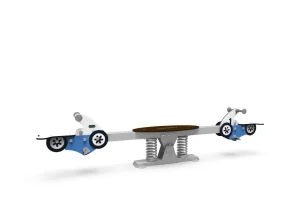
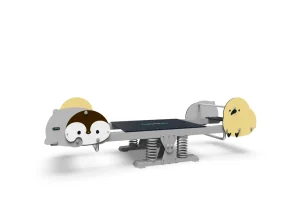
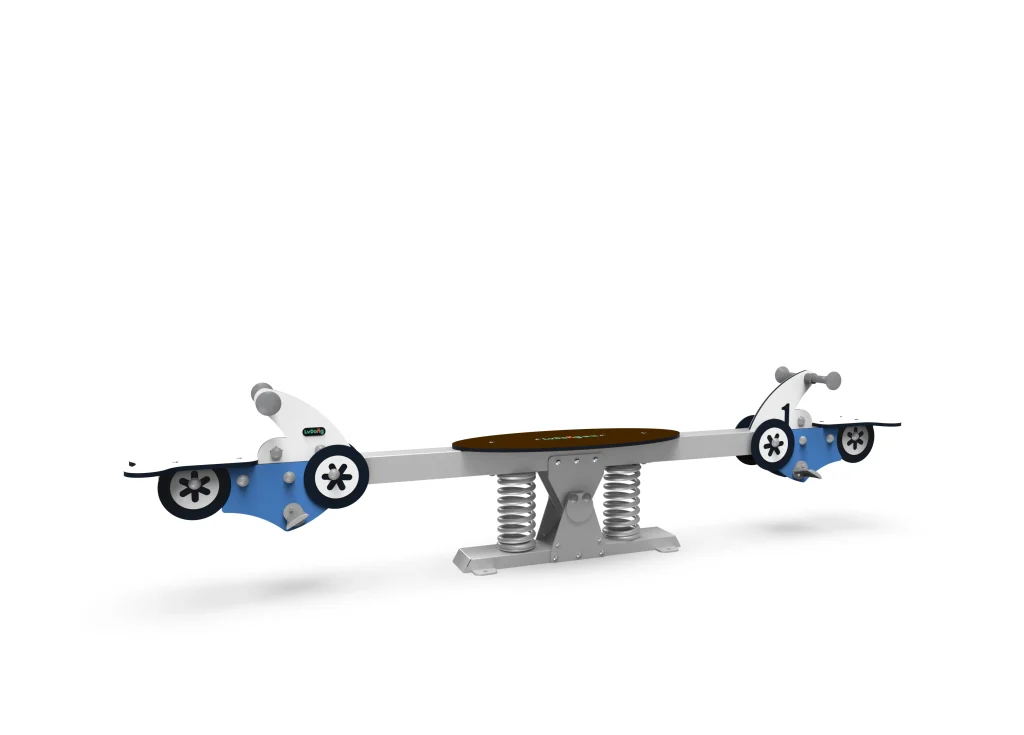
Customization capability signals a manufacturer willing to think beyond standard modules. For example, we adapted a multi-person seesaw for a school with limited linear space by widening the base and shortening the beam, while still keeping the fall height under 60 cm. This type of adjustment needs an internal design team that understands force distribution, not a reseller passing requirements to a third factory.
When reviewing proposed designs, test the supplier’s technical fluency. Ask how they determine the swing beam height relative to the pivot point, or what material changes occur if a slide platform height exceeds two metres. The answers will separate a manufacturing partner from a trading company. If you’re considering combining a tunnel slide with a playhouse structure, verify that the supplier can provide a ventilation and structural support plan, not just an assembly image.
If your project involves a specific combination of equipment types, like a multi-function playhouse with slide and swing, the integration of different modules often reveals whether the manufacturer’s engineering goes beyond basic steel frames.
Verify Project Delivery, Installation, and After-Sales Support
The period between order confirmation and the first child climbing onto the equipment is filled with logistical details that can delay a school term. I advise requiring a project timeline that separates production lead time, shipping, customs clearance, and on-site installation. Large playground slides, for instance, may need crane access planning that a supplier unfamiliar with exporting will overlook. We had a municipal school project where the container arrived on schedule but the installation team discovered the ground anchors did not match the soil density report, something that could have been avoided with a pre-shipment site data reconciliation.
After-sales service becomes the real test of a supplier’s commitment. A warranty period means little if spare parts are not stocked or if the response timeline is measured in months. Ask the supplier to commit to specific spare part availability windows, and if possible, request a replacement cycle estimate for high-wear items like swing bearings, spring rider coils, and slide panel seals. For school playgrounds, I recommend a minimum of two-year full warranty with post-warranty spare part pricing published upfront.
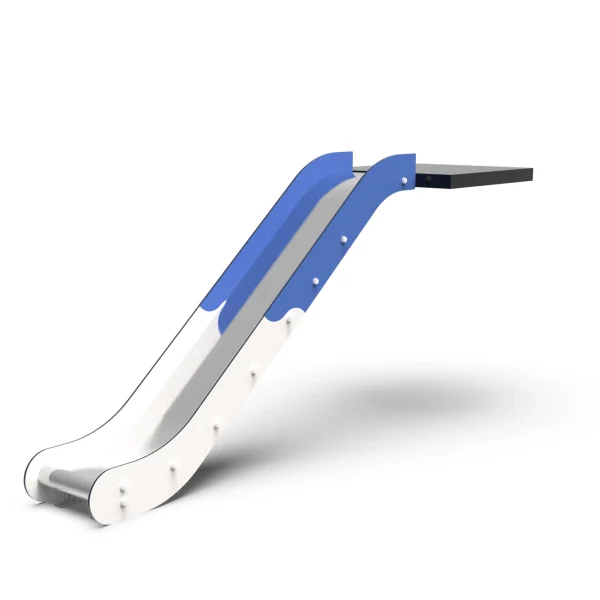
Installation capability matters equally. Some manufacturers offer supervised installation or provide a certified local partner list. If your school is in a region with specific import requirements—such as fumigation certificates for wooden components—the supplier should demonstrate familiarity with those processes rather than treating them as afterthoughts. On one hospital-adjacent playground project, we coordinated with the client’s groundworks contractor to ensure drainage channels were integrated before the equipment arrived, because the site had a high water table. A supplier without direct project management experience would have defaulted to “install as per manual” and left the drainage problem unresolved.
Make the Right Choice: Comparing Quotes, Contracts, and Long-Term Partnership
When the proposal arrives, the quoted price per square metre hides more than it reveals. Line items for freight, customs duties, foundation materials, and site supervision often appear only in the fine print. I’ve seen school procurement committees accept the lowest bid only to face a 20% cost increase after factoring in missing installation hardware. Always request a line-item breakdown and validate that all necessary components—from ground anchors to safety surfacing—are included.
Contract clauses deserve the same scrutiny as the equipment design. Insist on clear delivery terms (Incoterms), payment stages tied to production milestones, and defined acceptance criteria post-installation. A 12-post-installation acceptance checklist is standard for larger projects; it should cover structural stability, safety zone compliance, surface finish integrity, and operational testing of moving parts. Without these, a minor assembly error can go unnoticed until it becomes a liability.
Long-term partnership thinking benefits schools far beyond the first order. Evaluate the supplier’s track record of supporting repeat projects and their willingness to store custom molds or jigs for future phases. A supplier who remembers your school’s colour scheme and equipment layout when you call three years later for an extension is worth more than a marginally lower upfront cost.
Common Questions Schools Ask When Choosing a Playground Equipment Supplier
Is EN 1176 certification enough, or should we demand additional testing?
EN 1176 sets the baseline for safety, but for school use with high daily cycles, I recommend also asking for dynamic load tests on moving equipment like swings and spinners. The standard covers structural integrity, but many school playgrounds see double the usage that a typical public park would, so a manufacturer’s internal endurance test data becomes equally important.
How do we balance quality and budget without overpaying?
Focus your budget on high-wear, high-fall-height items like slides and climbers, where manufacturing precision directly affects safety. Custom-themed panels and decorative elements can often be simplified without reducing play value. I’ve helped schools reallocate funds by choosing LLDPE slides over full stainless steel for areas where summer heat isn’t extreme, while investing the savings in better anti-corrosion treatment for steel frames.
Should we visit the supplier’s factory before ordering?
A factory visit provides the clearest picture of production quality, but if travel isn’t possible, request a live video tour of the welding workshop and final assembly area. Confirm that the facility you see matches the one that will produce your equipment. A detailed factory visit checklist is a useful tool. If you’re planning one, a structured approach will help you focus on what matters.
Can a supplier handle a multi-age playground zone for K-5 within one contract?
Yes, but they must demonstrate age-group zoning competence. We often segment a school playground into an early childhood area (2–5) with lower platforms and enclosed slides, and a junior area (5–12) with taller climbers and more physically challenging spinners. The supplier should provide clear safety buffer zones between the two, which not all designs account for.
What is the most overlooked cost in playground equipment procurement?
Site preparation and drainage. Schools frequently focus on equipment cost and overlook groundworks, which can reach 25–30% of total project expense if the site has poor soil or slope. Getting a geotechnical assessment early and sharing it with the supplier before design finalisation prevents costly surprises later.
While every school playground project has unique requirements, the supplier selection process should narrow the field to manufacturers with genuine in-house production, safety document transparency, and a record of completed school installations. If you are preparing a tender or starting to compare options, send us your site dimensions, age group, and any special requirements to [email protected]. We can provide a preliminary equipment layout and compliance documentation review to help you make an informed choice. Reach out on WhatsApp at +8613915684545 if you need a quick technical consultation.
If you’re interested, check out these related articles:
Playground Equipment Balancing Price and Quality for Lasting Value
Multi Function Playhouse with Slide and Swing Commercial Solutions
Stand and Spin Equipment Essential Maintenance Safety Guide