Selecting a school playground equipment supplier is not simply a matter of comparing quotes. The safety of hundreds of children, every school day, rests on the structural integrity and design of the equipment you install. Over a decade designing and delivering playground projects for schools and communities, I have seen how the wrong supplier choice leads to premature rust, loose fasteners, and safety failures that no school can afford. A supplier that controls the entire chain—from concept design through production, installation, and after-sales—can deliver equipment that meets international safety certifications and stands up to years of demanding use.
Key Factors in Choosing a School Playground Equipment Supplier
A school playground is a long-term investment, and the supplier you choose will shape its safety, play value, and maintenance burden for years. When I speak with school administrators and facility managers, I tell them to look beyond the catalog photos and examine four fundamentals: a supplier’s in-house design and engineering capability, its manufacturing quality control, its project delivery track record, and its commitment to post-installation support.
Many playground equipment companies are essentially trading firms that outsource production to multiple small workshops. This fragmented model creates gaps in quality consistency and makes it difficult to trace responsibility when something goes wrong. For a school project, I recommend working with a supplier that handles R&D, design, production, and installation under one roof. Suzhou LvDong, for example, operates a 10,000-square-meter intelligent production base with a standardized quality management system. That level of integration means the engineer who designs the structure understands exactly how it will be fabricated and installed. This is not just a convenience; it is a safety mechanism.
Ask prospective suppliers how many school projects they have completed and request to see relevant case examples. A supplier with over 1,500 completed installations across municipal parks, educational institutions, and communities has weathered the full range of site conditions and age-group requirements. Ask specifically about the percentage of repeat clients—schools that come back for additional equipment or phase-two expansions trust a supplier because their first experience held up.
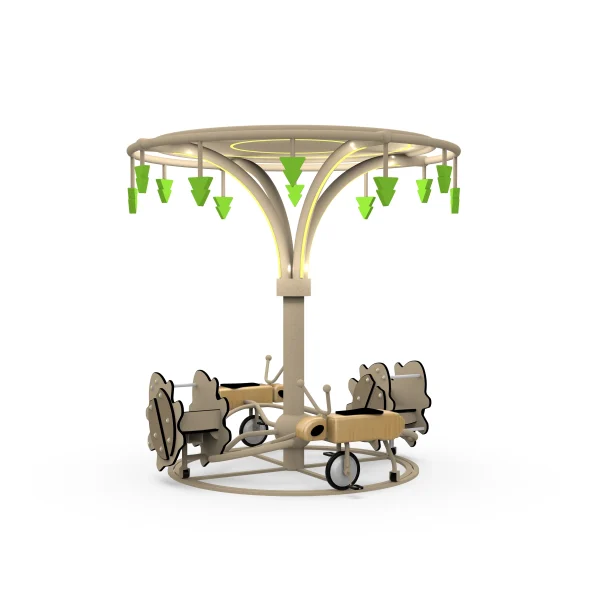
Beyond project count, probe the supplier’s design software and prototyping process. School playgrounds often need to fit irregular site boundaries, accommodate mixed age groups, and comply with local safety zone requirements. A supplier that uses 3D modeling and can produce a rendered layout before you commit any money gives you a concrete basis for decision-making, not a vague sketch.
Safety Certifications and Standards for School Playground Equipment
Safety standards are the non-negotiable foundation of school playground procurement, but a certificate hanging on an office wall does not tell you how that equipment was tested. I require all the equipment I design and oversee to comply with at least EN 1176 (the European playground equipment standard) and GB/T 34272-2017 (the Chinese national standard). For projects destined for North American markets, ASTM F1487 and CPSC guidelines are also necessary. The critical point is that these standards are not interchangeable; they differ in fall height calculations, entrapment test probes, and impact attenuation requirements for surfacing.
When evaluating a supplier’s safety documentation, I suggest requesting the full test report, not just the certificate. A test report from an accredited third-party laboratory will show you exactly which elements were tested, under what conditions, and whether any non-conformities were noted and corrected. This level of transparency separates suppliers that treat safety as a compliance checkbox from those that treat it as an engineering discipline.
The following table summarizes the key standards and their primary application regions.
| Standard | Region | Key Focus |
|---|---|---|
| EN 1176 | Europe, Middle East, Asia | Entrapment, fall height, impact attenuation, structural integrity |
| GB/T 34272-2017 | China | Localized version with additional material and installation requirements |
| ASTM F1487 | United States | Head and neck entrapment, surfacing impact testing, accessibility |
| AS 4685 | Australia | Modified from EN 1176 with specific heat and UV requirements |
For schools, I pay particular attention to the standard’s requirements for accessible play. EN 1176-1 includes provisions for inclusive design, but the interpretation varies. A supplier that has built inclusive school playgrounds will know, for example, that transfer platforms on elevated structures must be positioned to allow a child in a wheelchair to move from the ground-level surfacing onto the play structure, and that the surfacing under those transfer points must meet impact attenuation criteria just like any fall zone. Ask for the engineering drawings that show these details.
In-House Manufacturing Quality for Durable School Playgrounds
In a school setting, playground equipment faces a harder life than equipment in a community park. The usage is concentrated into short, intense bursts during recess and lunch breaks, often by the same group of children day after day. This pattern exposes material weaknesses quickly. Over the years, I have seen school swing chains that stretched beyond safe limits within a single school year because the links were too thin, and powder coating that chipped within months because the pretreatment bath was rushed.
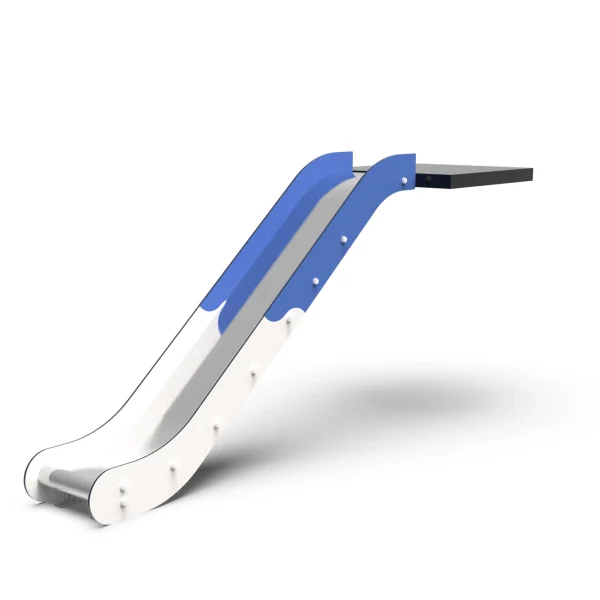
To avoid this, I recommend schools look closely at a supplier’s manufacturing substrate. The two materials I trust for longevity are rotationally molded LLDPE (linear low-density polyethylene) for panels, slides, and decorative shells, and structural-grade steel pipe for posts and frames. LLDPE, when properly rotationally molded with UV-stabilized pigment throughout the wall thickness, will not fade, crack, or delaminate like laminated or painted alternatives. The steel pipe should be specified with a minimum wall thickness of 2.5 mm for main posts and 2.0 mm for secondary members, with full-circumference welded joints, not spot welding.
A high-quality manufacturing facility will have an in-house powder coating line with a multi-stage pretreatment process: degreasing, phosphating, and drying before the electrostatic powder application, then a curing oven that brings the coated parts to a specific temperature for a set dwell time. This is visible during a factory tour; you can see whether the pretreatment tanks are clean, whether workers are following a documented process, and whether the finished parts have a uniform coating thickness. At Suzhou LvDong’s production base, the quality management system is audited against ISO 9001 requirements, and every batch of steel pipe is checked for wall thickness before cutting begins.
Another detail I examine is the fastening system. School playgrounds vibrate, twist, and shift with use. Bolted connections need Nyloc nuts or similar prevailing-torque lock nuts, not standard nuts with split washers. All exposed bolt ends must be covered with dome‑head caps that cannot be removed without a tool. I have seen a supplier save a few cents per connection by omitting these caps, only for a child to catch a sleeve on a protruding bolt thread. In school playground procurement, the small hardware decisions accumulate into a safety record.
If your school has a particular concern about summer heat, which I address in more detail in our guide on metal slide heat prevention techniques, the material selection becomes even more critical. LLDPE slides stay cooler to the touch than steel slides under direct sun, though they still require shading solutions for hot climates.
Custom Design and Site Planning Services from Your Supplier
School playgrounds rarely fit neatly into a standard equipment package. A typical school site has existing trees, drainage slopes, buried utilities, and multiple grade levels that each need age-appropriate equipment. A supplier that merely sends a catalog of pre-configured sets is leaving the hardest part of the job to you.
I tell school clients that the moment a supplier starts asking about your specific site dimensions, age-group distribution, and student capacity, you are talking to a company that understands the design process. A proper site-responsive design starts with a measured topographical survey, not a guess. From that survey, the supplier’s design team should produce a 3D rendering that shows equipment footprints, fall zones, sight lines for teacher supervision, and circulation paths between playsets.
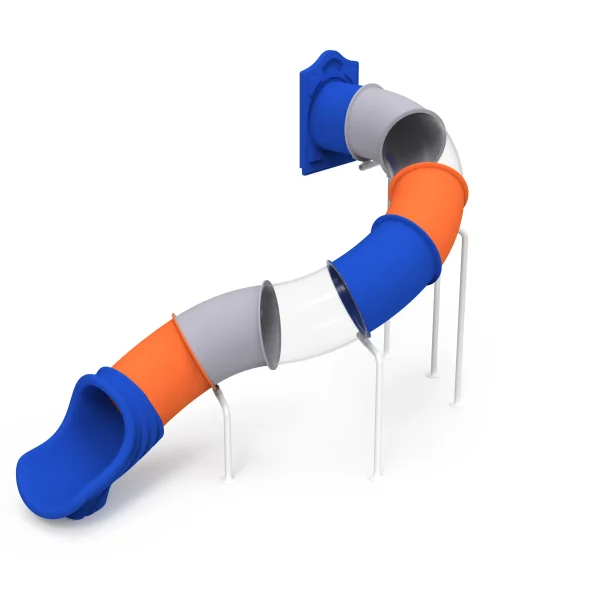
We handle this through an in‑house design team that uses 3D modeling software to generate renderings clients can review before any metal is cut. In the rendering, you can see exactly how a tunnel slide will exit in relation to the swing set’s fall zone, or whether the proposed spring rider cluster leaves enough clear space for a wheelchair-accessible route. This is not a sales gimmick; it is the engineering-level planning that prevents costly site regrading or equipment relocation after delivery.
Grade-based zoning is a particular strength of a design-led supplier. A kindergarten area for ages 2‑5 needs low platform heights (60 cm maximum deck), short slides, and ground-level activities like spring riders and sensory panels. A primary school area for ages 5‑12 can handle taller structures, more complex climbing challenges, and faster slides. I always ask schools to think about the transition zone between these age groups—if a 5‑year‑old can wander from the junior play area into the senior area, the equipment in that overlap zone needs to meet the stricter requirements for the younger user. This kind of nuance is built into a well-planned design but is invisible in a standard catalog.
If your school has unique space constraints or grade-specific needs, our design team can create a custom layout. Reach out at [email protected] for a free 3D design consultation.
After-Sales Support, Warranty, and Long-Term Supplier Partnership
A school playground does not end when the last bolt is tightened. Over a 10‑year service life, equipment will need paint touch-ups, replacement of moving parts like bearings and swing hangers, and possibly a major structural inspection after a severe weather event. The supplier’s willingness to stand behind its equipment over that full timeline is a better measure of quality than any upfront price difference.
I recommend requesting a written spare parts policy before signing a purchase order. A responsible supplier keeps a stock of high-wear components—chains, bearing sets, spring coils, and fastening kits—and commits to supplying discontinued models for a defined period after production stops. Without this commitment, a broken swing chain five years from now could mean the entire swing bay is out of service for weeks while the school scrambles to find a compatible part.
Warranty terms vary widely in the playground industry. Some suppliers offer a blanket one-year warranty on everything, while others differentiate between structural components and wear parts. A fair warranty for a school playground is a minimum of five years on steel structure (posts, decks, and welded joints) against rust-through and structural failure, and one year on moving parts like bearings and chains. This matches the warranty structure we provide at Suzhou LvDong, but I suggest schools always verify that the warranty is backed by the manufacturer itself, not just a distributor, so that claims are processed directly without delay.
Post-installation support matters just as much. Ask whether the supplier conducts a formal handover inspection with a documented checklist you can use for your own periodic safety audits. A supplier that leaves you with a laminated inspection sheet and a maintenance calendar is treating the handover as the start of a long-term relationship, not the end of a transaction. For reference, our 12-point post-installation acceptance test covers everything from foundation bolt torque to surfacing depth verification, and we train school maintenance staff on what to look for during weekly visual checks.
A Step-by-Step Checklist for Vetting a School Playground Supplier
When a school has narrowed its list to two or three suppliers, the following structured evaluation steps reveal differences that a glossy brochure hides. I have used this sequence in my own factory, and I suggest school buyers apply it to every candidate.
| Step | Action | What This Reveals |
|---|---|---|
| 1 | Request ISO 9001 or equivalent quality management certification | Whether the supplier operates a documented, auditable quality system |
| 2 | Request test reports from an accredited lab for the specific models you are buying | Whether the equipment meets EN 1176 or GB/T 34272-2017, not just a general claim |
| 3 | Arrange a factory visit and walk the production line | Welding quality, pretreatment cleanliness, coating uniformity, and overall organization |
| 4 | Ask to see a current project log with lead times and installation schedules | Production capacity and ability to meet your deadline |
| 5 | Request contact information for two recent school installations | Real-world feedback on delivery, installation professionalism, and after-sales responsiveness |
| 6 | Review warranty terms in writing, distinguishing structural coverage from wear parts | Long-term protection and clarity on what constitutes a warranty failure |
| 7 | Verify spare parts availability policy and minimum stock commitment | Whether you can obtain replacement parts years after purchase |
| 8 | Request a 3D design rendering of your site with equipment placed to scale | Design capability and willingness to invest time before receiving a deposit |
Treat this checklist as a minimum. If a supplier cannot satisfy any of these eight points, dig deeper before proceeding. I have seen schools skip the factory visit only to discover upon delivery that the actual equipment finish did not match the sample shown in the showroom. The cost of a one‑day visit is negligible compared to the cost of replacing unsafe equipment.
What School Buyers Should Ask About Playground Equipment Suppliers
How long does it take from order to a completed school playground installation?
Production typically takes 30 to 45 working days for a standard school order, depending on the complexity and quantity of equipment. Shipping and installation add another two to four weeks, with the exact timeline influenced by the distance from the factory to the site and the size of the installation crew. We always confirm a delivery schedule in the contract and keep the school updated with weekly progress photos during production so there are no surprises.
What warranty do you provide on school playground equipment?
Our standard warranty covers structural steel components for five years against rust-through and manufacturing defects. Moving parts like chains, bearings, and spring assemblies carry a one-year warranty, which reflects their expected wear rate under normal school use. I recommend schools always clarify whether the warranty includes the cost of labor for replacement, not just the parts themselves, because that can make a substantial difference in the total cost of ownership.
Can we visit your factory before placing an order?
Factory visits are encouraged. I tell every serious buyer that seeing our 10,000-square-meter production floor, the pretreatment line, the welding stations, and the quality control laboratory is worth far more than any brochure. On the visit, you can inspect finished equipment, watch a load test, and discuss your project in person with the design and production teams. A supplier that hesitates to open its factory doors for a scheduled visit should be treated with caution.
Do you supply spare parts for older equipment models?
We maintain a stock of the most commonly requested spares—swing hangers, bearing sets, spring coils, and fastening kits—and we can fabricate parts for discontinued models when needed. A school playground should not have to go out of service for lack of a $5 component, and our policy is to keep schools running, not to force a complete equipment replacement. If you have an existing playground of any brand that needs parts, share the specifications with us and we will confirm whether we can source or produce a compatible replacement.
If you’re interested, check out these related articles:
Playground Slides Buying Guide Height Slope and Critical Safety
Evaluate Commercial Playground Manufacturers 8 Critical Selection Factors
Buyers Guide to Spinning Playground Equipment in 2025
Child Development Benefits Playground Spinning Toy Impact
Playground Equipment Balancing Price and Quality for Lasting Value