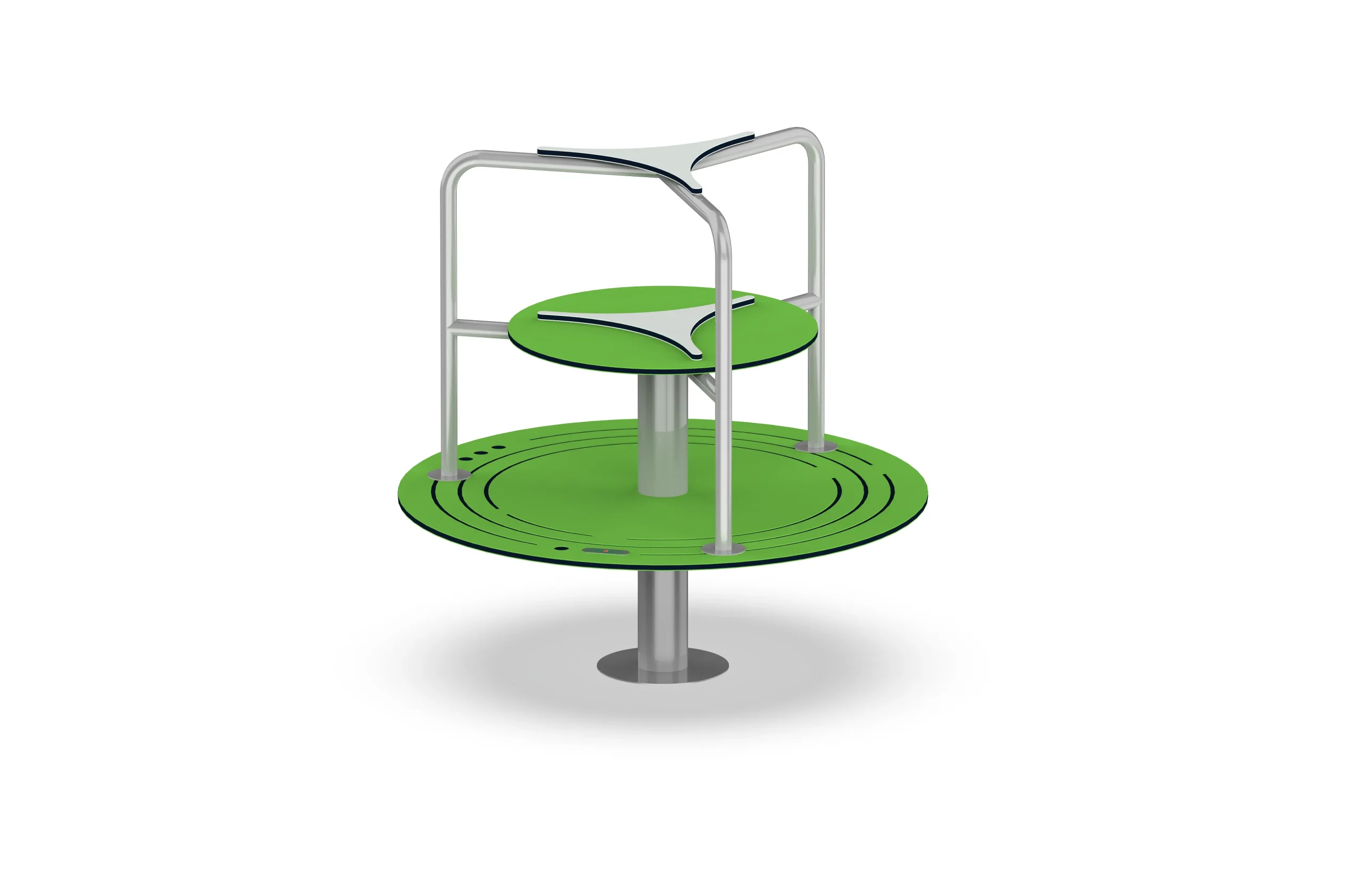
Double-Layer Green Ring Playground Spinner
A 6-user double-layer playground spinner with a sci-fi interstellar station design. Two stacked emerald-green rotating discs, triangular upper-deck seats, metal armrests, and a silent bearing axis. Upper and lower riders experience different rotational intensity on the same spin. EN 1176-compliant. Φ120 cm platform, ages 2+.
| Specification | Value |
|---|---|
| Capacity | 6 users |
| Platform diameter | Φ120 cm |
| Overall height | 120 cm |
| Maximum fall height | 56 cm |
| Installation | 2 persons / 1 hour |
| Age range | 2 years and up |
What Makes This Playground Spinner Different from Flat-Platform Designs
A single-tier playground spinner gives every rider the same position and the same experience. The Double-Layer Green Ring gives children a choice before they step on. Upper-deck riders sit at the platform’s outer radius in triangular seats — maximum centrifugal sensation, maximum visual speed. Lower-deck riders sit closer to the center axis, where the rotation feels smoother and the outer ring blurs past them rather than carrying them. Same angular velocity, meaningfully different ride.
Children figure this out within two or three rotations and start trading positions. That position-switching behavior is what separates sustained engagement from a single-use thrill. On a flat spinner, the scenario exhausts itself when everyone has spun fast enough. On a two-tier platform, “what does it feel like up top versus down low?” keeps children negotiating and re-boarding through an entire recess period.
The sci-fi interstellar framing amplifies that dynamic without requiring adult direction. Upper deck becomes the command level. Lower deck becomes the engine room. The rotation becomes a mission. Children aged 2 to 12 respond to that narrative differently — younger children respond to the visual language of emerald-green discs and geometric patterning, older children build the mission scenario — but both groups stay on the playground spinner longer than they would on a generic rotating platform.
| Specification | Value |
|---|---|
| Capacity | 6 users |
| Platform diameter | Φ120 cm |
| Overall height | 120 cm |
| Maximum fall height | 56 cm |
| Installation | 2 persons / 1 hour |
| Age range | 2 years and up |
Playground Spinner Structural Design for Outdoor Commercial Use
Two seating decks on a single rotating axis create a more complex load path than a flat platform. The silver-gray galvanized steel posts carry both decks’ occupant weight through the center bearing to the ground anchor. Galvanization bonds zinc to the steel substrate at a molecular level — the corrosion protection does not peel, chip, or require seasonal recoating. For school playgrounds and municipal parks where maintenance crews inspect quarterly, that durability translates directly into lower total cost of ownership over a 10-to-15-year service life.
The metal armrests on both decks are the primary contact point for seated riders. They carry lateral force when a child leans into a spin, and their geometry positions the rider’s center of gravity over the seat rather than behind it — which keeps riders stable without relying on grip endurance. That matters across the 2-and-up age range where grip strength varies significantly between users.
The center bearing assembly uses a silent buffer axis. A two-tier playground spinner with six riders generates more rotational inertia than a single-deck unit of the same diameter. The silent axis manages that inertia smoothly across the full speed range, keeping noise output within the acoustic limits of school sites near classrooms and urban parks under noise ordinances. The anti-rollover limit structure caps platform angular displacement under asymmetric loading — five children on one side of the upper deck, one on the lower, and the platform holds level. That constraint is passive and always active; it does not depend on riders distributing their weight correctly.
Safety Standards Procurement Teams Verify for This Playground Spinner
EN 1176-5 governs carousels and rotating platforms in European commercial playground procurement. For a two-tier seated playground spinner, the standard covers structural load rating across the full six-user configuration, entrapment geometry between deck layers, armrest height and grip geometry for ages 2 and up, and fall zone specifications at the 56 cm maximum fall height. Test documentation should specifically cover the two-tier simultaneous loading scenario — a unit tested only in single-deck configuration does not satisfy EN 1176-5 for a dual-deck product.
The 56 cm maximum fall height determines impact-absorbing surfacing requirements under EN 1177. Poured-in-place rubber, rubber mulch, and engineered wood fiber each require different installation depths at this fall height; the calculation uses material-specific compression factors. Request the surfacing depth calculation from your surfacing supplier using 56 cm as the input. The playground spinner and its surfacing are specified as a system.
North American buyers reference ASTM F1487. Both standards address the same structural concerns: positive handholds at accessible heights, no exposed pinch points in the bearing assembly, adequate fall zone clearance around the use zone, and rotational dynamics appropriate to the stated age range. Dual-standard compliance documentation reduces re-specification cost for multi-site operators and international procurement teams managing installations across regulatory jurisdictions.
Playground Spinner Installation: Two-Person Crew, One Hour on a Prepared Site
The 2-person, 1-hour installation timeline assumes concrete footing poured and fully cured, or a compacted aggregate base verified to the manufacturer’s bearing capacity specification. That figure is realistic for experienced crews working from manufacturer drawings on a clean, prepared site. Surfacing installation is a separate scope of work.
The Φ120 cm platform footprint fits standard playground bay allocations without displacing adjacent equipment. Specifiers calculating the full use zone — platform radius plus fall zone clearance at 56 cm — should verify total clearance against EN 1176-1 or ASTM F1487 requirements before finalizing the layout. Post-installation inspection covers bearing rotation, bolt torque at all structural connections, armrest rigidity on both decks, and anti-slip surface condition on both seating levels. Annual third-party inspection by a qualified playground safety inspector is standard practice for commercial installations across UK and EU member states.
Developmental Outcomes of a Two-Tier Seated Playground Spinner
Seated spinning activates the vestibular system differently than standing spinning. With a stable seat contact, the inner ear processes rotational acceleration without the additional variable of maintaining upright balance. For children aged 2 to 5, that stability makes vestibular input more accessible — they focus on the spinning sensation rather than managing their footing. For older children, the two-deck choice adds a predictive cognitive layer: forming a hypothesis about how the upper and lower positions feel different, then testing it.
Cooperative coordination develops on a six-user seated playground spinner because initiating rotation requires distributed effort. One child pushing does not move six riders efficiently. Children learn to push in coordinated bursts, read each other’s readiness, and negotiate when to stop. Those are the same social skills that structured cooperative play programs target deliberately; a well-designed spinner produces them without facilitation.
The interstellar station aesthetic gives mixed-age groups a shared play scenario with natural role differentiation. Younger children respond to the emerald-green visual and the physical sensation. Older children assign roles, run missions, and use the two-tier structure as a set. That imaginative scaffolding distinguishes thematic playground equipment from generic equipment: it gives children material to extend the play beyond the physical activity itself.
Talk to Us About Your Playground Spinner Installation
Municipal parks, school playgrounds, and community recreation spaces each present different site constraints — surfacing type, clearance zone availability, compliance documentation requirements, and procurement timelines all affect which configuration makes sense. If you are working through specifications for a specific site, we can support that process directly.
Contact our team: Email: [email protected] Phone: +86 18013233386
Share your site dimensions and target age range, and we will confirm compatibility with your surfacing plan and local compliance requirements.
Planning a commercial playground project? Explore commercial playground spinners in our Playground Spinner category, or request a custom quote for site-specific design and manufacturing support.
There are three prominent core advantages:
1. It adopts a galvanized steel frame that is easy to process, rust-resistant, and durable, ensuring children’s play safety.
2. It is equipped with an anti-slip chassis and an anti-toppling limit structure, which runs smoothly and quietly, reducing the risk of accidents.
3. Enhanced Safety Performance, Risk Rate Reduced by 80%.
Adopts a thickened galvanized steel pipe frame, designed in strict accordance with international standards, and adds an anti-rollover limit structure and a silent buffer axis. The anti-rollover design reduces the risk of play accidents by 80%, the silent axis reduces site noise pollution, and the safety redundancy is increased by 50% through material upgrading and structural optimization.
Our playground equipment spinning wheel products are widely used in kindergartens, preschool education institutions, outdoor activity areas, community parks, municipal parks, indoor parent-child parks, children’s playgrounds, cultural tourism scenic spots and outdoor amusement camps, covering a broad range of users.
While allowing children to release their nature and delight their minds and bodies, they strengthen physical strength, improve balance and coordination, promote bone development, build exercise endurance, and foster perseverance and resilience against setbacks.
Get A Free Consultation!
FAQs
What surfacing is required under this playground spinner?
The 56 cm maximum fall height is the input for the surfacing depth calculation. Under EN 1177, required depth varies by material — poured-in-place rubber, rubber mulch, and engineered wood fiber each have different compression ratings at this fall height. Under ASTM F1292, the surfacing must meet the HIC threshold at a 56 cm drop. Request the calculation from your surfacing supplier using 56 cm as the specified fall height. The playground spinner and surfacing are sized as a system, not independently.
Do the upper and lower decks spin at different speeds?
No. Both decks share the same rotating axis and turn at the same angular velocity. The perceived difference comes from each rider’s distance from the center — upper-deck riders at the outer radius feel more centrifugal force than lower-deck riders seated closer to the axis. The two-tier structure creates a differentiated experience within a single synchronized rotation, which is what drives children to trade positions and re-board.
Can this playground spinner be installed indoors at a family entertainment center?
Yes. The galvanized steel frame and sealed bearing assembly perform equivalently indoors and outdoors. The silent buffer axis is particularly useful in enclosed commercial spaces where rotational noise accumulates. The Φ120 cm footprint fits standard FEC bay widths. Concrete slab anchoring is standard; raised or suspended floors require a structural assessment before anchor loads are specified.
What is the realistic service life under commercial playground conditions?
Galvanized steel framing in a maintained commercial installation typically warrants structural assessment at 15 years. The center bearing assembly is the primary wear component and is serviceable independently — replacing it does not require replacing the full playground spinner. Annual inspection covering bearing rotation, bolt torque at all connection points, and armrest rigidity on both decks is the standard maintenance schedule for this equipment category.
Are color options available beyond the standard emerald-green and silver-gray finish?
The emerald-green disc and silver-gray post combination is the standard specification, designed to function as a coherent thematic unit. Alternative colorways are available for orders meeting minimum volume thresholds. Provide your RAL or Pantone reference at the quote stage and we will confirm feasibility and any lead time impact.